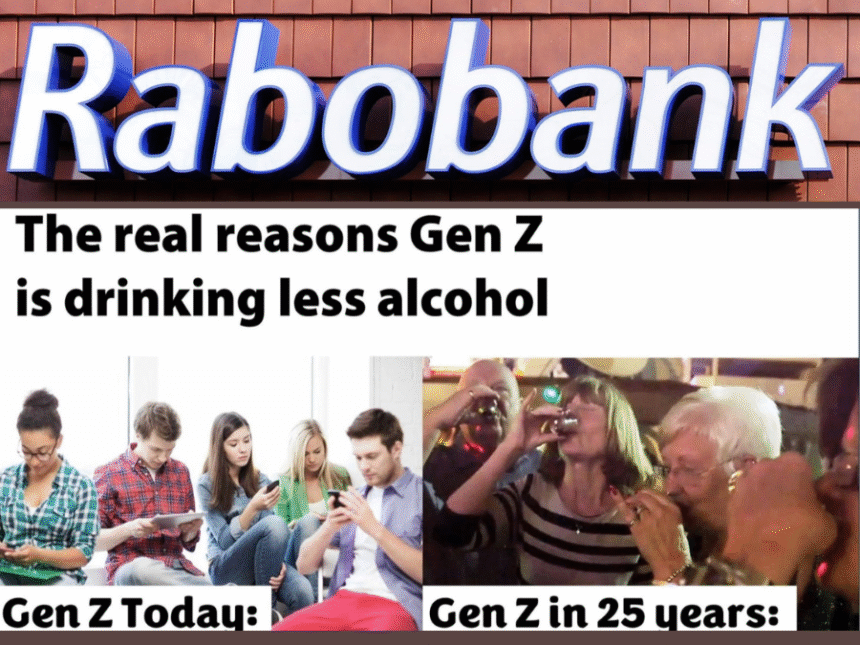
In the second of our two-part interview with Rabobank’s beverage research VP, Bourcard Nesin considers the juxtaposition of ‘drink less, but drink better’ against a younger consumer base that appears less interested in drinking alcohol altogether.
How do you account for the current growth of the no- & low-alcohol category?
Older people than Gen Z! The people that are drinking alcohol-free beer are those who have a lot of experience drinking regular beer. The reasons that young people drink aren’t relevant to a non-alcohol beverage. The mistake that’s being made is thinking young people want a premium experience with less alcohol. Their concept of healthy is no sugar, but they still want it to be boozy.
The actual demographic that would be interested in a low- or no-alcohol product is probably someone in their 30s or 40s who is putting on weight and is aware of how much harder it is to put a kid to bed when you’re tired because you had a beer with dinner. Is a 20-year-old who can’t afford to buy rice going to spend their money on a non-alcohol beer that costs twice as much as regular beer?

Are brand owners self-sacrificing by focusing on ‘drink less, but drink better’ at the expense of younger LDA consumers?
That’s probably true in some categories. Wine is a good example of a category that hasn’t done a great job of exciting young consumers. In the US, we’ve seen incredible innovation in making alcohol more interesting to a diverse audience, such as hard seltzer. Historically, women have been alienated from the beer category – there wasn’t anything ‘sessionable’ for women 25 years ago. Then, hard seltzer came along; not bitter, no misogynistic baggage and zero sugar.
The amazing thing was that hard seltzer also delighted young men. We tend to internalise the idea that women are more self conscious, but men are just as likely to be on a diet as women. Men also don’t want to feel bloated and want to look hot on the beach at summer. Identity is a very fluid thing.
When it comes to prioritising premiumisation, young women today make just as much money as young men do, if not more. And it’s still the case that women drink half as much as men do, volume-wise. That doesn’t mean they’re going to spend half as much. So, it does make sense to offer more premium products to women, but do a better job of targeting them.
The fact that women are becoming a larger share of the drinking population is one of the clearest drivers of premiumisation.
So, a brand owner that’s prioritising premiumisation should prioritise female consumers?
Yes – and it’s very important how you do that. That doesn’t mean you need to create products that are pink, it means you need to thoughtfully represent women’s experiences in your advertising. The only way you can do that is by having more women make your advertising.
That sounds like quite a challenge to this most traditional of industries.
I don’t want to tell a senior manager at a beverage alcohol company that there’s a moral or ethical imperative to hire a more diverse workforce, because I don’t think they’ll do it. I don’t think telling somebody that climate change is important is going to make them change their behaviour if it costs them more money.
Companies don’t make changes unless it hurts their bottom line. Period.
It’s going to be impossible to market to young people without being able to speak specifically to their experiences and their values. The easiest, fastest, most economical and effective way to do that is to hire young people that look like the audience you’re trying to market to. As with hard seltzer – created with women in mind but also delighted men – the insights and strategies that that process creates is actually the most interesting thing for your traditional target audience.
My job as an analyst is to help companies make more money sustainably. Hiring people that look like the audience you’re trying to market to is probably the least utilised yet most effective way to do that.
The wine industry, for example, has to convince Asian, black and Latino consumers, who don’t have strong wine drinking traditions, to get into wine. That’s a daunting task. But I’ve met just one Latino marketer in the wine business in my entire career.
How are you going to speak to that audience if you don’t know what their life experience is? For a wine company, I would say hire somebody who’s 25, knows how to use TikTok and hand them the reins. It can’t be as boring as what you’ve been doing so far!
How big do you think the challenge is to the alcohol industry?
I don’t think it’s existential, but it is structural.
It’s a very difficult time to work in the beverage alcohol business right now – instead of hirings, its layoffs; instead of stability, it’s constant restructuring; instead of celebrating wins, it’s mitigating losses.
But, the desperation and the oversupply that we’re seeing across the industry at the moment is creating the foundation for a much stronger industry down the road.
The fact that there’s going to be a lot of very good wine at very low prices means it’s going to be more accessible to young people. The fact that marketers are trying to figure out if something works by throwing all the spaghetti against the wall means that they’re going to find something that sticks. Previously, because the industry was growing steadily and a rising tide was lifting all boats, people didn’t have to try that hard.
That’s the foundation for the next 25 years of growth. The conditions that are creating the misery right now are the conditions that are going to drive the future growth of the industry.
A necessary part of that is serving this young group of consumers that look different to that 50-year-old marketing manager in Connecticut, who’s going to have to give up some power to people who can speak to these audiences more effectively.
Twenty years from now, we’ll look back at this time and see that’s when things really changed.
Beyond their recruitment, what other advice do you have for brand owners?
Recruitment is the cheat code to do a better job and come up with new ideas.
I guess my advice would be to stop talking about stuff that’s outside your control. Focus on the stuff that is meaningfully impactful to your business and is within your control. A big part of that is what your brands look like and where they’re being sold.
Focusing on your geographic, innovation and product diversity, as well as your messaging and creative diversity to meet consumer needs is something you have control over. Worrying about the things you can do nothing about is a distraction.