

Regulatory, sustainability and cost pressures are the driving forces behind a recent spate of eye-catching ultra-lightweight bottles. Technical execution, however, remains key.
Lightweighting is hardly a new concept in beverage alcohol packaging, but the past couple of years have ushered in an exciting new era of ‘ultra-lightweight’ bottles. Brand owners and their manufacturing partners have pushed technical boundaries while still minding the classic considerations for any successful bottle design – that it remains structurally stable, cost-efficient and looks good on the backbar.
The result has been a flurry of eye-catching ultra-lightweight bottles that have helped push the often functional area of glass manufacturing to the forefront of brands’ efforts to become more sustainable.
The pressure to transition to ever-lighter bottles is no longer solely a green initiative, of course. It’s also a response to two simultaneous pressures that are making heavier glass bottles an economic liability.

Regulatory pressures
The first is regulatory. In the UK, for example, the Extended Producer Responsibility (EPR) and 2026 eco-modulation (RAM) schemes are making lighter bottles a no-brainer. Under RAM, ‘red-rated’ packaging already incurs a 20% surcharge, a penalty that is set to rise to 60% in 2027 and 100% by 2028.
Lightweighting aligns commercial and environmental incentives, as per-unit fees are increasingly calculated by weight.
The UK is by no means an outlier. Other European countries have introduced similar reward-penalty schemes, and in August, the EU’s Packaging & Packaging Waste Regulation (PPWR) will begin to harmonise these rules across all 27 member states.
Meanwhile, in the US, the world’s biggest premium wine and spirits market, seven states (including the country’s most populous state, California) have already introduced EPR-style legislation, while more than ten others are considering following suit.
Compounding this pressure is the much more recent and urgent energy shock caused by the Middle East conflict. With the Strait of Hormuz having been closed since the end of February, wholesale gas prices have skyrocketed, pushing gas up by 20% in key glass production hubs such as India. Because glass furnaces require constant gas-fired heat, brands that fail to light-weight are now effectively paying an additional ‘Persian Gulf Tax’ on every shipment.
At global agency Equator Design, whose drinks clients have included Molson Coors Beverage Co, Schnucks bourbon and Morrisons supermarket’s ‘The Best’ own-label wines, creative director Nathan Ball believes the conflict could even catalyse a shift away from glass altogether.
“Heavy glass carries a cost premium,” he says, “but many brands accept that trade-off, because the weight signals quality, permanence and luxury. When that cost premium is compounded by inflation, the equation starts to look very different.
“I think the current crisis might accelerate something we were already seeing: a move towards lighter glass used more creatively, and a shift to alternatives like aluminium, which carries sustainability credentials.”

Rémy Cointreau and Diageo light the way
Two notable ultra-lightweighting projects have thrown a spotlight on the trend in recent months.
In April last year, in the challenging sparkling wine category, Rémy Cointreau’s Champagne Telmont unveiled an 800g bottle (above), reduced from 835g — a huge engineering feat by manufacturing partner Verallia, given that a sparkling wine bottle must withstand six bars of pressure.
With manufacturing accounting for 30% of the champagne industry’s carbon footprint, the new bottle could be a game changer — Telmont claims that if the concept is adopted across the industry, it could eliminate 8,000 tonnes of CO2 emissions a year.
Meanwhile, in the once-conservative world of scotch whisky, Diageo unveiled Johnnie Walker Blue Label Ultra (below), a 180g bottle billed as the “world’s lightest 70cl scotch whisky” glass bottle.
Developed with Turkish glass manufacturer Şişecam and limited to only 888 bottles, the handblown teardrop shape, announced in September 2024, relies on advances in glass-forming and structural design to reduce weight by over 50% without compromising strength. Unusually, Diageo decided to open-source the bottle patent royalty-free to encourage other producers to innovate with lightweight bottle designs.

Is 300g the new standard?
The primary concern for producers is whether ultra-light glass can survive high-speed filling lines without breakage. Johnnie Walker’s limited-edition 180g concept bottle was filled on a specialised ‘white gloves’ line, because it is currently impractical for high-speed production. However, a flurry of new releases is now finding success at the 300g mark.
In April, Australian Vintage’s McGuigan brand launched its new 300g lightweight burgundy bottle – a 25% reduction on its predecessor, developed in partnership with Verallia.
“There were no changes needed to the line or materials,” says the group’s UK brand manager for McGuigan, Emily Waterston. “After extensive trials at different line speeds – especially in high-pressure areas like capping and accumulation points – both the work done at Greencroft Bottling Co and the improvements Verallia made in glass manufacturing ensured the bottles performed consistently with the design.”
The 300g burgundy bottle follows a 300g bordeaux bottle, released by McGuigan last year. Waterston says she was surprised at how little consumers noted the change. “There’s an assumption that weight signals quality, particularly at premium price points, but acceptance was strong across both consumers and retailers,” she says.
Other manufacturers are also now pushing 300g as the new industry baseline.
Last July, Spanish glass manufacturer Vidrala unveiled an even lighter 260g 70cl bottle at Expo 2025 Osaka, using up to 80% recycled glass and ultra-thin walls to reduce its surface area by 20%. A month later, Luxembourg-based sustainable glass & metal producer Ardagh Group launched a 300g bottle designed to perform on high-speed lines while maintaining premium shelf appeal.
Meanwhile, family-owned UK glass packaging & closure supplier Croxsons released its Rightweight solution in March this year. The culmination of more than 16 years of development, it says the solution can reduce the weight of glass bottles (and jars) by 30%.
The company’s premium-quality Apollo 70cl spirits bottle, suitable for gin, rum, tequila, vodka and whisky, now benefits from the Rightweight technology, with its weight reduced substantially from 575g to 400g.
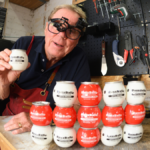
“It’s not a race to the lightest-possible container,” says MD Tim Croxson (below). “It’s about achieving an optimum balance between material reduction, strength and high-performance logistics, with consumer experience and brand presentation.”

700g ‘commercially realistic’
At China-based glass and ceramic bottle manufacturer Rockwood Glass, maximising visual impact and structural performance take precedence over achieving the lightest possible weight. Even so, the French-owned company has heavily invested in its production lines and processes to help clients achieve a premium feel without resorting to a heavy-base bottle design.
“This includes lower-temperature melting methods that reduce energy consumption while improving glass workability, allowing the material to better reach complex angles and detailed contours,” says founder & CEO Henri Berthe.
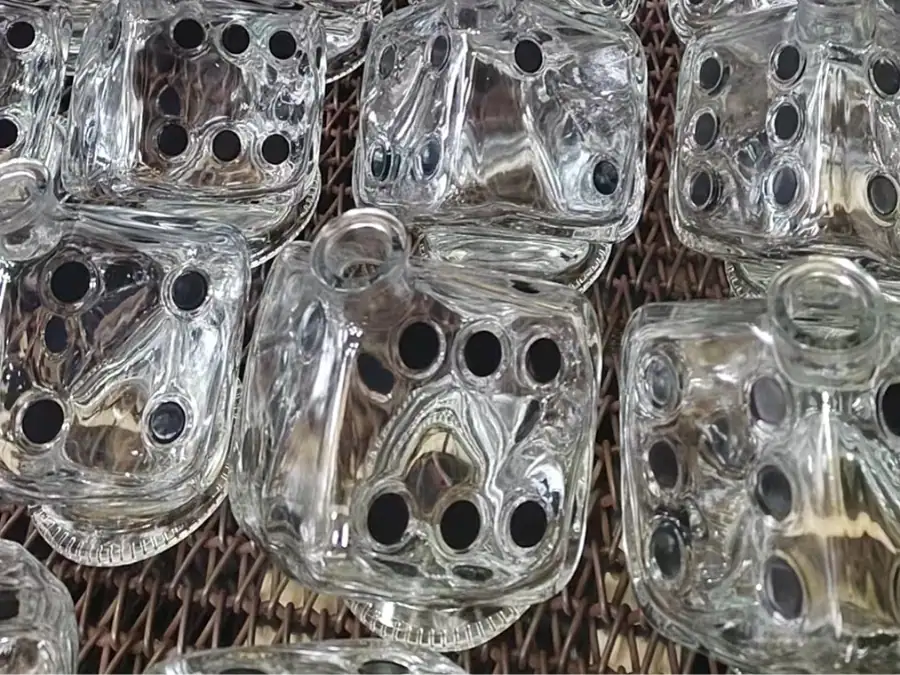
Recent projects where Rockwood lowered production weights include its Patriot Eagle and Glass Dice (below) bottles. “Both designs feature complex geometries and strong visual presence, while remaining within commercially realistic production weights of approximately 700g,” says Berthe.
“These projects demonstrate that premium perception is increasingly driven by originality of form, technical execution and shelf impact, rather than simply maximising bottle weight.”
Prestige acceptance
Nonetheless, ultra-lightweight advances are winning over many – even prestigious names from the French wine world, such as Château Galoupet, a sustainability-focused cru classé estate in Provence, and part of Moët Hennessy’s stable of brands since 2019.
The maison recently launched the second vintage of its G de Galoupet organic rosé line in a 300g bottle made from 85% recycled glass. MD Nadine Fau explains: “Knowing that the bottle alone accounts for 40% of a winery’s carbon impact, we chose to reduce its weight and use recycled rather than clear glass.”
Perhaps the most radical example of innovation within ultra-lightweighting is the move toward flat-glass formats. At the beginning of this year, Pernod Ricard-owned Martell Cognac and Chinese high-tech material supplier Vitalink Technology unveiled a sleek prototype ‘glass origami’ bottle made of flat glass as thin as 0.7mm. Vitalink VP Xu Ren describes the process as “folding and lasering advanced flat glass to create an ultra-lightweight, almost surreal bottle”.
Equator Design’s Ball notes that flat formats are “good for design because the squarer profile gives you more surface area, more shout-out on shelf, and formats that work for direct-to-door delivery”.
With its use of high-precision techniques and processes not unfamiliar to the smartphone and watchmaking sectors, the Martell bottle proves that ‘light’ in the context of packaging no longer needs to mean ‘basic’ in terms of bottle design.
Members-only intel
Keep reading this members-only article – and every one like it
- ✓All paywalled news and interviews
- ✓Category and market data
- ✓Monthly GDI magazine
- ✓Full archive + daily newsletter
Secure checkout · Cancel any time · Company invoices available
Already a member? Log in
See all plans, incl. 10-reader and corporate
Check if your company already pays for you Your company may already give you free access.
Corporate subscribers: AB InBev, Bacardi, Campari Group, Diageo, Moët Hennessy, Pernod Ricard, Proximo Spirits, Suntory Spirits Group, William Grant and Sons.
Activate company accessNot ready yet? Get the headlines free in our daily newsletter.
Sign up free