

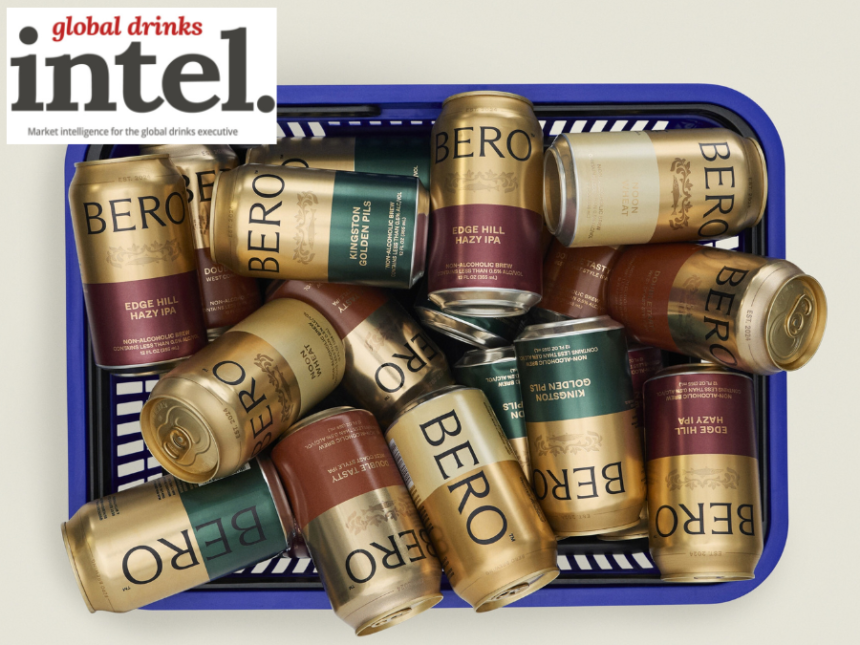
In the second part of Global Drinks Intel‘s exclusive interview with the CEO of Bero, John Herman (below) shares with deputy editor Jess Broadbent the on-premise strategy for the alcohol-free beer. Herman also explains how Bero has been positioned against its non-alc competition and why the beer was extended into glass bottles earlier this year.
You’re working on growing Bero’s presence in the on-premise. How far behind Europe do you feel the US is for non-alc beer’s penetration of the channel?
In the US, non-alc beer right now is in the sub-2% range of total category. We’ve seen analysts quoting a potential ceiling of between 10% and 20%. The on-premise is going to drive that for the foreseeable future. Given the segment’s at around US$2bn [per year] right now, if the on-trade’s growing at over 40% and the off-trade’s in high single-digit growth, non-alc beer in the US is on course to double in size to $4bn by 2030.
In volume terms, we expect to see the on-premise account for 70%-75% of non-alc beer’s volumes by 2030, from around 45% to 50% now. This is all going to happen, but it’s going to take time. Maybe it won’t be as apparent as it is in the UK today, but it will make major strides.
What’s been the main hindrance to growth for non-alc beer in the US on-premise? Could it be slower consumer demand or a lack of brands?
It’s a bit of everything. We need to give credit to Athletic for looking at a consumer opportunity in the US that would previously be linked to having a drinking problem and for switching the dynamic to ‘I just don’t want to drink alcohol’. They helped change the dynamic to becoming something more mainstream.
Another problem in the US has been that we have a very convoluted route to market. Even though Bero contains no alcohol, we’re still regulated and treated in many of the 50 states in the same way that full strength alcohol would be. That means we go through the three-tier distribution system, and securing access to more on-premise locations is going to be dependent on the distributor prioritising it. That’s an additional layer of training, education and development that doesn’t exist in much of the rest of the world.
On the brands piece, for a category to grow, it can’t be done by just one brand. When you look at legacy beer brands that have created a non-alc version, that’s wonderful because they put a lot of marketing dollars behind it, but that’s for a brand that’s relevant more to the older generations as opposed to the next generation. The pure-play brands deliver a level of authenticity and credibility to the category that those brands can’t. Legacy beer brands deliver beer credibility, but not non-alcoholic credibility.
Going further, while many other pure-play brands have chosen to emulate Athletic, we never set out to do that with Bero. We really want to be something completely different, to drive incrementality and a different demographic while expanding the mindset of usage. The more brands that can discover a distinct moment or consumer will allow the category as a whole to grow, as opposed to just cannibalising itself.
How have you tried to achieve this with Bero?
As well as brewing great beer, we look at innovation differently. For many, innovation can look like proliferation, whereas for us it’s more about introducing new consumers or usage occasions.
For Bero, two-thirds of our consumers are under the age of 45. For the non-alc beer segment and its brand leader, it’s only about 45%. We’re capitalising not only on Gen Z consumers, but also on the 30-somethings with kids who want an elevated form of beer that speaks to their lifestyles.
It’s important to bear in mind that non-alc beer as a whole has a younger consumer, is more balanced in gender, ethnicity and heritage, and is pretty differentiated to full-strength beer.
How have you tried to differentiate Bero to ensure standout?
We didn’t want to create a brand that looked like a craft beer with a funny name. We wanted something that looked more appropriate.
The beer in your hand is a bit of an accessory, and we wanted to make sure that Bero looks great in the highest-end settings and blends in more with the aesthetic of those kinds of establishments than our craft beer competitors in non-alc do.
Does that explain your addition in August of a glass bottle to Bero’s pack offer?
Beer just tastes better out of a glass bottle than out of a can. I don’t know the science behind it, but it truly does! At the same time, the smaller craft non-alc players haven’t made this move.
Oftentimes, if your can-only brand is being served in a restaurant, for example, then it’s not being presented with the can. With a glass bottle, we can be presented with the glass as well. The branding opportunity for sampling and trial really makes it stand out.
Will you phase out the can?
Generally, the on-premise accounts will be a high bottle focus, while the off-premise will be a heavy can focus.
What longer-term challenges do you foresee for Bero and non-alc beer in the on-premise?
There’s a general need for the on-trade to see an improvement in its foot traffic. The channel’s still recovering from years ago. If you’re a bar or restaurant owner, the list of things you need to manage is so long. Making sure they’re thinking about the evolution of consumer behaviour is a big part of it.
For non-alc, there are so many layers of education – consumer, distributor, retailer, bar owner – that it’s going to take time, which in turn becomes a risk for the category. If we can’t holistically educate and develop all the people in the chain that need to be part of the journey, it won’t hit the scale that it needs to.
That makes it harder for brands to thrive and grow, because you need to be able to hit a level of scale that allows you to be a sustainable business.