

- After initially building momentum in retail, non-alcoholic (NA) brands are increasingly looking to the on-premise to drive discovery, trial and repeat purchase
- NA beer leads the on-premise charge. Established alcohol-free brands are gaining traction through draught, pubs, casual dining and sporting occasions
- Draught remains an opportunity and a challenge. Being on the front bar can help normalise the NA experience, but scarce tap space makes listings hard to come by for smaller brands
- NA consumption is extending beyond the health & wellness ‘months’ into everyday occasions such as a midweek treat
- Functionality offers new opportunities, but brand owners warn against adding ingredients simply to chase the next trend
- NA wine continues to face a significant taste and quality challenge, but the on-premise is emerging as a bright spot as by-the-glass availability improves
The alcohol-free category has so far defied the longstanding maxim in the drinks industry that ‘brands are built in the on-premise’. Across beer, spirits and wine, established brands have debuted zero-ABV extensions while new, dedicated non-alcoholic (NA) brands have built momentum, primarily in the off-premise.
Now, brand owners believe, the on-premise is finally coming into its own as an important proving ground for the category.
According to alcohol-free UK brewer Lucky Saint, the NA drinking occasion in the on-premise has broadened beyond Dry January and other wellness months. “People are consuming these products in the moments when they’re also drinking,” says the company’s insights & category director, Lou Pollitt.
She attributes this to improving quality, range and distribution, alongside ongoing health trends and increased investment behind mainstream alcohol-free brands, such as Guinness 0.0, which has won over more sceptical consumers. But the category is also contending with many of the same challenges facing beverage alcohol in the on-premise.
“Pub closures, price inflation and efficiency drives, which mean that fewer taps are available not just to the bigger brands, but also to smaller, dedicated players,” Pollitt lists.
Beer leads the on-premise charge
Alcohol-free beer is not only the primary volume driver for non-alc, but also and its most established segment in the on-premise.
Lucky Saint’s sales are “fairly equally split” between channels, although Pollitt says the on-premise “has always been a real priority”. In early 2020, the company launched its namesake 0.5%-ABV lager on draught in London venues, before going nationwide in time for Sober October. (UK/EU/Australia guidance allows ‘alcohol-free’ drinks to contain up to 0.5% ABV.)
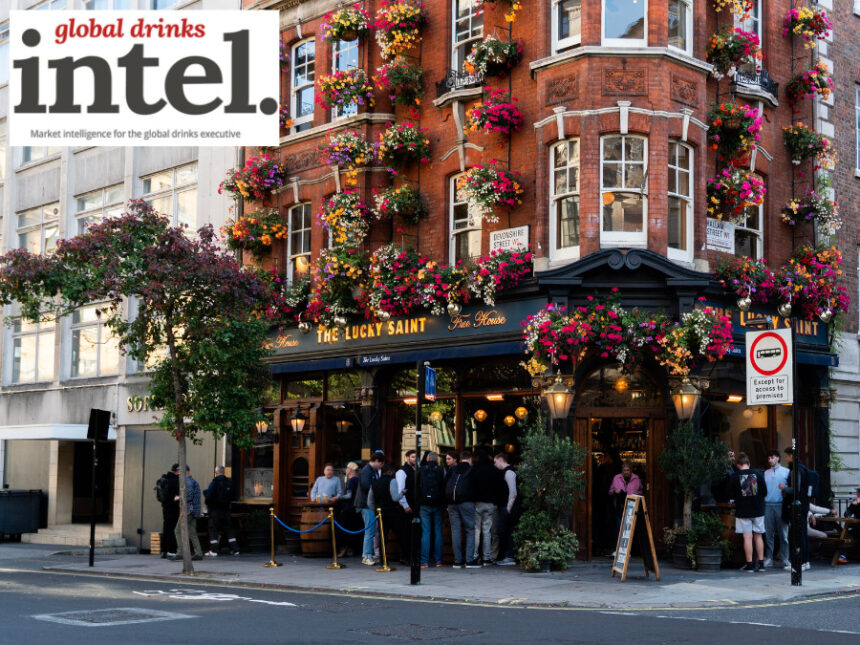
“Our draught launch was the first for any major dedicated brand into the on-trade,” Pollitt says. “For us, draught really equalises the experience.” The brewer underscored its commitment to the on-premise by opening The Lucky Saint pub (main image) in London three years ago.
Alongside traditional on-premise venues, many alcohol-free brewers dabble in sports-led consumption occasions and other outdoor events. “Some of the places that we can play in are different to full-strength,” says Pollitt.
“We have a really strong relationship with the running community; we do a lot of work with [running app] Strava. Whereas full-strength brands are focused more on the audience for sport, we can be a bit more on the participation side.”
After five years as a one-SKU brand, the company expanded into functional lager in April with Lime & Sea Salt. The response has been “pretty astonishing”, according to Pollitt. “Alcohol-free inherently has something taken away from it,” she says. “Functional can add that back in.
“However, we need to give people credible propositions that meet a clear health need and are easy to understand. Hydration is a really obvious starting point for that.”
Lime & Sea Salt’s performance since launch has been led by direct-to-consumer (D2C) sales, but Pollitt maintains that the lager has had “a lot of interest from the on-trade, which we didn’t necessarily expect from the functional side of things”.
Fellow alcohol-free brand Big Drop Brewing agrees that functional NPD needs to be carefully considered. “I’m all for innovation,” says CEO Rob Fink, “but I think if you start running around throwing stuff in liquid just because somebody thinks the next big thing is going to be ‘X’, then you risk alienating your own audience.”
Founded in the UK in 2016, Big Drop brews to 0.5% from the outset, rather than removing alcohol from full-strength beer, which it says preserves body and aroma. The company has built its brand around the breadth of its offering.
“We understand that 60% to 70% of the country [UK] drinks lager, but there’s still a consumer out there who wants an alcohol-free IPA – that’s where we can come through,” says Fink.
When it comes to draught, Fink says, “it’s absolutely essential to be on the front bar”. As an independent brand fighting for tap space against established names like Heineken, which has large contracts and runs its own cellar-maintenance service, Fink advises: “You have to play where you can win.”
“You need to find somebody who hasn’t sewn up all their listings with a larger provider,” he continues. “You need a route-to-market to get listed in the first place – a wholesaler won’t take you unless somebody’s going to buy you. Then really, it’s about brand. This is a branding game. You’re trying to convey to people that your brand stands for something different.”
Big Drop targets “lunchtime” and “casual dining” occasions. Meanwhile, D2C alcohol-free sales are increasing, says Fink, driven by consumers seeking a “mid-week treat”.
Given this development, Fink might take a different route-to-market if he were launching Big Drop today. “I would build the brand through e-commerce first,” he muses.
“Then I would look to get some on-premise listings around that, then go into the supermarkets last.”
US on-premise grows
In the US, dedicated non-alc brewer Bero says the off-premise is growing in the “high single-digit, low double-digit range”, while “this year, the on-premise is growing at 45%” – albeit from a smaller base.
Like Big Drop and Lucky Saint, Bero has an ABV of 0.5%. (In the US, beverages labelled ‘alcohol-free’ must contain no alcohol, while those 0% ABV–0.5% ABV are classified as ‘non-alcoholic’.) The brand was founded in 2024 by ex-Nutrabolt president John Herman and Spider-Man actor Tom Holland.
Herman predicts the NA channel will “expand dramatically” in the on-premise over the next five years, describing this growth as “extremely important” to the wider category. “By having a stronger on-premise business, brands can in turn have greater velocities at shelf and distribution winds, as well as expansion within retail,” Herman says.
“So it becomes a healthy cycle. The on-premise is really the vehicle that can grow this category further.”
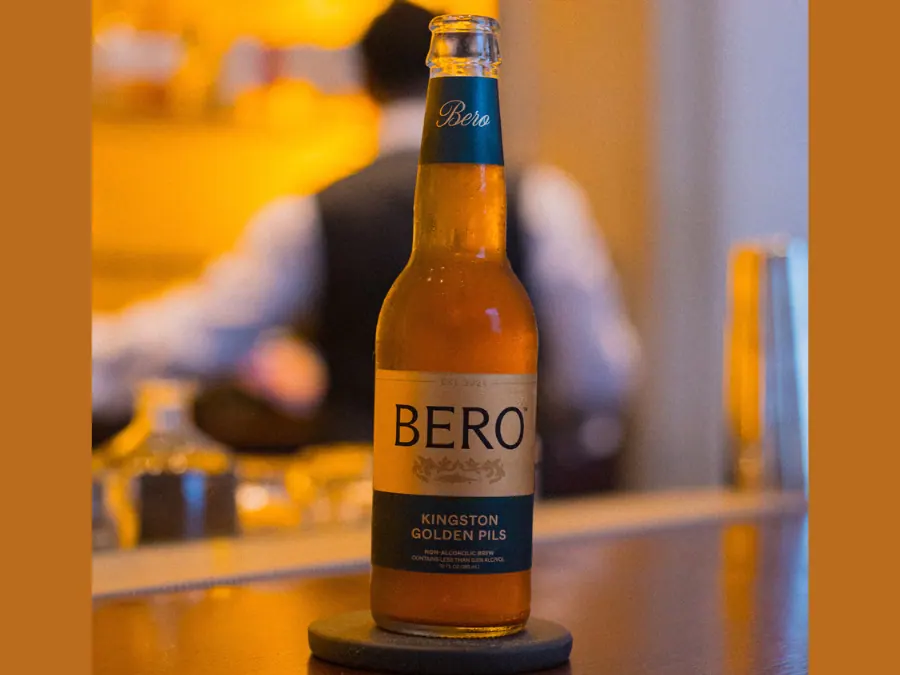
Although Bero’s sales are still skewed to the off-premise, the company aims to “flip that in the very near term”. Initiatives include the recent introduction of glass bottles (below) – a simple way to brand-build, says Herman.
“Oftentimes, if your can-only brand is being served in a restaurant, for example, then it’s not being presented with the can,” he explains. “With a glass bottle, we can be presented with the bottle as well. The branding opportunity for sampling and trial really makes it stand out.”
Besides, he adds: “Beer just tastes better out of a glass bottle than out of a can. I don’t know the science behind it, but it truly does! At the same time, the smaller craft non-alc players haven’t made this move.”
“The beer in your hand is a bit of an accessory, and we wanted to make sure that Bero looked great in the highest end of settings and blends in more with the aesthetic of those kinds of establishments than our craft beer competitors in non-alc do,” adds Herman.
But Bero’s cans aren’t disappearing anytime soon. “Generally, the on-premise accounts will be a high bottle focus, while the off-premise will be a heavy can focus,” he says.
When it comes to draught, Herman says the US is still behind the UK. “The category needs to move to becoming a higher-velocity play before it can warrant that tap space,” he says. “We’re not completely sold yet, but we’re exploring [it] long term.”
Spirits extensions versus new brands
Henkell Freixenet’s alcohol-free strategy has been to lean on established brand equity, which it says “gives on-trade partners confidence” to list new SKUs and helps consumers in their choices due to the “familiar brand worlds”.
“Wherever possible,” says head of communications Vanessa Lehmann, “we believe it makes sense to position alcohol-free variants alongside their alcoholic counterparts. From a consumer perspective, this makes it easier to identify and choose the option that best fits the occasion.
“It also reinforces the idea that alcohol-free variants are a natural part of the brand portfolio rather than a separate or niche category. For the on-trade, it helps create a more inclusive drinks offering while leveraging the recognition and trust already associated with established brands.”
For alcohol-free spirits, the standout consumption occasion undoubtedly sits with cocktails. According to Lehmann, the on-premise remains important for discovery, particularly in the aperitif moment, where many consumers simply aren’t aware of the range of options.
Henkell Freixenet is seeing “particularly strong momentum” in countries with established aperitivo and cocktail cultures, such as Germany, Poland, the UK and the US. However, the off-premise remains the company’s biggest sales channel for “many” of its alcohol-free lines.
Cocktail-liqueur specialist De Kuyper Royal Distillers, meanwhile, has seen its 0.0% ABV portfolio expand to account for 9% of its total produced volumes. “We see 0.0% becoming a structural part of the cocktail occasion,” notes global marketing director Marieke Liesting.
Last year, the Dutch company launched a ready-to-serve range for the on-premise called Batched 0.0%; elsewhere, the line’s Pornstar Martini premix is now De Kuyper’s third best-selling RTS.
“That crossover strength surprised us,” Liesting admits. In the six months to the end of June, Batched made up 28% of De Kuyper’s domestic RTS volumes. “We’re seeing the same development beyond the Netherlands,” Liesting adds. “Globally, non-alcoholic cocktails already represent around 15% of our total pre-crafted volume.”
De Kuyper also produces a range of kegged cocktails, but will there ever be enough demand to justify putting non-alcoholic cocktails on tap?
“Bar space will always be valuable, so demand needs to be strong enough to justify a dedicated tap,” Liesting replies. “As the 0.0% cocktail occasion continues to grow, I can certainly see draught becoming increasingly relevant, particularly in high-volume venues where speed, consistency and ease of service really matter.”
Check back on Global Drinks Intel later this week for the second part of this category deep-dive.
Members-only intel
Keep reading this members-only article – and every one like it
- ✓All paywalled news and interviews
- ✓Category and market data
- ✓Monthly GDI magazine
- ✓Full archive + daily newsletter
Secure checkout · Cancel any time · Company invoices available
Already a member? Log in
See all plans, incl. 10-reader and corporate
Check if your company already pays for you Your company may already give you free access.
Corporate subscribers: AB InBev, Bacardi, Campari Group, Diageo, Moët Hennessy, Pernod Ricard, Proximo Spirits, Suntory Spirits Group, William Grant and Sons.
Activate company accessNot ready yet? Get the headlines free in our daily newsletter.
Sign up free