

In the second part of Global Drinks Intel’s exclusive interview with the CEO of Suntory Global Spirits, Greg Hughes tells deputy editor Jessica Broadbent about the impact on the company of the Middle East conflict, the current state of play for its scotch whisky operations and the future plans for Suntory’s Japanese whisky portfolio.
Europe wasn’t referenced much in Suntory Global Spirits’ results commentary. How would you describe business there right now?
We’re making very strong progress on [market] share in particular in Europe, but given the cost of energy and the exposure to the Middle East for energy costs and the inflation cycle that’s created, some of the region’s developed-market categories are more challenged.
We’ve seen some softness in Europe. That softness was largely offset by the strength in global travel retail, which we’ve had a particularly strong first half on because of our activations behind things like the House of Suntory shop-in-shops and the growth in our Japanese whisky, scotch whisky and Maker’s Market businesses. The GTR team has shown its agility this year, adapting to a challenging environment at Dubai and Doha duty free, for example, and pivoting to find other opportunities across the world.
GTR is hoping to offset some of the softness in Europe, but there’s slightly sluggish category demand in Europe right now.
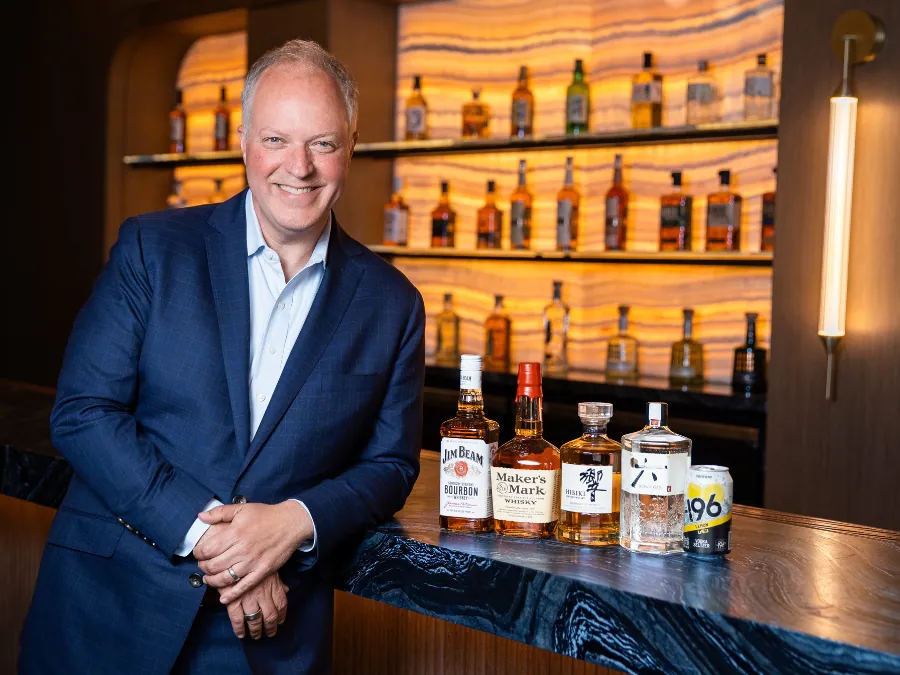
Since we last spoke in February, there’s been quite a lot going on in your scotch business – including production consolidation at Bowmore and Laphroaig, and then the cancelled maturation warehouse build in Scotland. Is the category a concern for you?
For this year, we’re forecasting strong growth from our scotch portfolio. As we think about our aspiration to be the world’s number one whisk(e)y player, scotch obviously plays a clear role in that as the sort of ‘mother brand’ of whisk(e)y.
Scotch is deemed [to be performing] stronger … in developing markets, and our portfolio in India is doing particularly well. Teacher’s should get back to around 1m cases (in India) for this year, which is great growth for the brand.
Similarly to other whiskey players, our maturing inventory got a bit out of balance with demand as demand slowed down through the post-Covid [period] and during the inflationary cycle. What we did was look to combine our distillation teams on Islay, across Bowmore and Laphroaig. We were able to do that completely with voluntary redundancies. The good news is that we were able to do this in a way that protected the quality of our whisky and … our commitment to Islay and to Scotland in general.
In terms of the maturation facilities, we were able to find other available warehouses to mature our product in, so it wasn’t a reduction in our maturation needs. We were just able to acquire some existing maturation warehouses that met our needs, so we didn’t need to advance with the development project anymore.
At the time, Suntory said the GBP150m (then-US$200.2m) that was earmarked for the whisky maturation site would be “redirected” – is there a specific plan for this cash?
Some has been redirected towards acquiring the warehouses, as opposed to building them. The rest will be used to support the growth of our global brands, based on whatever the production installation needs are, or the investment needs for the business.
Are you happy with where your inventory levels are now?
It’s a bit different across bourbon versus scotch, just given the age of the product. I think we will largely be through the inventory imbalance on bourbon relatively quickly: if not this year, then next year. I don’t foresee a need to further reduce our distillation, and I think we’ll start increasing distillation again.
Similarly, on scotch, we’re making good progress on reducing our surplus inventory and getting that back into balance. I don’t see a need for distillation reductions, we’ll actually start ramping distillation back up.
We’ve still got a bit of work to do to get the right balance between our forward demand and the inventory.
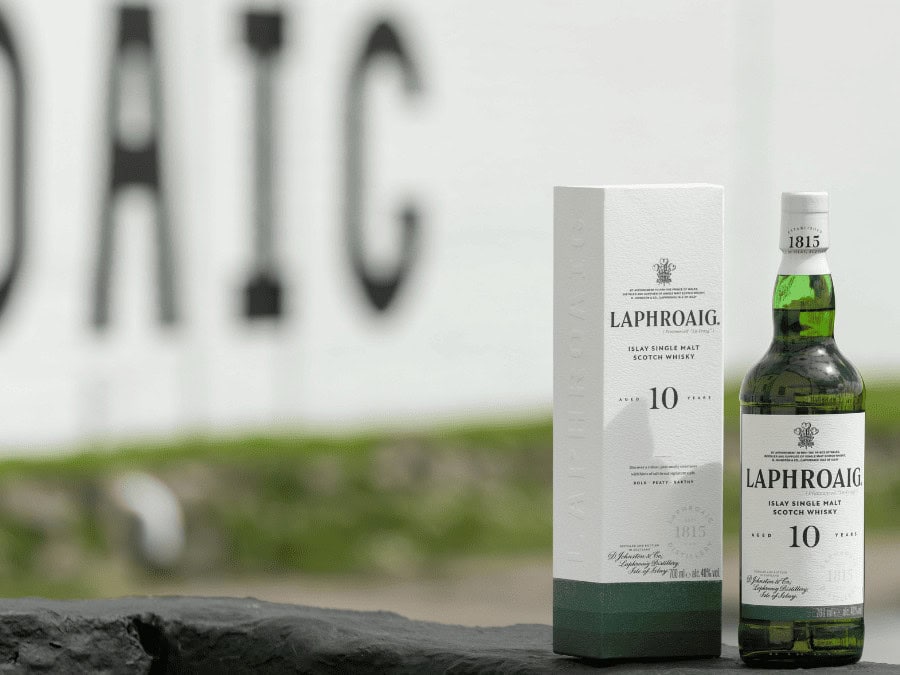
It’s harder to predict in Scotland because there’s a huge amplification effect. For example, if you take Laphroaig ten-year-old (below), a 10,000-case increase or decrease in demand – which isn’t a big number on a 500,000-case business – creates or removes a 100,000-case surplus overnight because you reset the base of demand for the next ten years. So it’s a little more volatile in getting to the right inventory balance in Scotland.
Hopefully, if we continue to see the momentum we’re seeing on Laphroaig and Bowmore this year, that surplus inventory will unwind pretty quickly.
There’s been a lot of a lot of marketing activity around your Japanese whisky brands this year. What are your expectations here for the next five years?
Japanese whisky is the hottest whisk(e)y category globally, and one of the hottest beverage alcohol categories. That’s largely because consumers are incredibly interested in Japanese food & beverage and culture, but also the attention to detail that goes into Japanese products. Being the founding brand of Japanese whisky really does give us an opportunity to be synonymous with [the category].
Our goal is to become the number-one whisk(e)y player in the world. Part of that is globalising bourbon outside the US and another – larger – part will be globalising Japanese whisky outside of Japan and Asia.
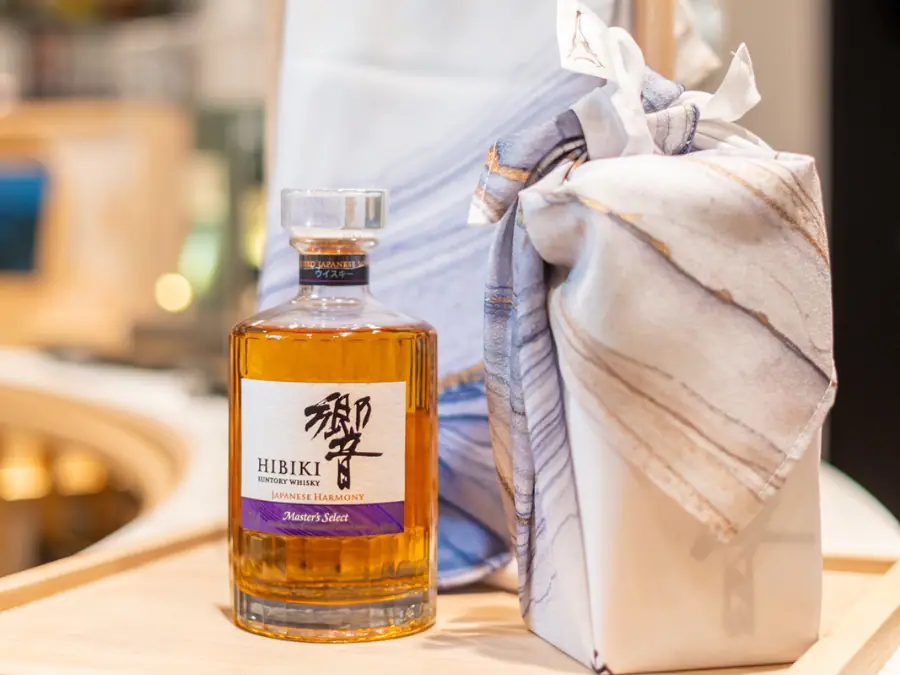
That takes on a few roles: we’ve got Toki and Kakubin targeting that more-approachable highball moment or a more sessionable, refreshing occasion as a way to come into the category. We’re seeing success from that work; Toki is delivering double-digit growth. Then, we’ve got the top end of the category … and we’ll continue to build out that ultra-premium tier with our signature House of Suntory brands.
One of the unfortunate challenges is a lot of products are misleadingly labelled as Japanese whisky. We’ve been working with the Japan Spirits & Liqueurs Makers Association (JSLMA) to establish a formal definition of what it legally means to be a Japanese whisky.
In the US, we’re starting to roll out a logo that identifies [spirits] as authentic Japanese whisky, across our Toki packaging. We’ll continue to push for adoption of standards – we want to make sure we protect the consumer experience when they come to the category.
Is there an issue of undercutting ‘real’ Japanese whisky on price, as well as a risk of category devaluation?
Their prices are the same, so it’s more a case of undercutting on quality. Some of the products are fine, they just use other sources of whisky, or are rectified, redistilled or rebottled in Japan. They aren’t the same quality as … authentic Japanese whiskey.
We’re working to help the JSLMA with governments around the world to try to strengthen the regulations, such as the standard requirements you see on other geographic origins, like scotch.
Will price be a barrier to growing Japanese whisky globally?
At the moment, supply is the barrier for growth. It’s the one category where demand is materially in excess of supply. The nice thing is that, because it’s such an established category in Japan, there’s already everything from opening price-point, accessible Japanese whiskies to premium whiskies … .
There’s already an ability for people to ladder from US$10 to $10,000 in Japanese whisky as there is in scotch. There’s a big opportunity there. The biggest challenge right now is supply and building out the consumer awareness of the category.
There’s the risk of inauthentic Japanese whisky filling that supply void with things that aren’t Japanese whisky, and changing the consumer’s perception of what the category is.
Members-only intel
Keep reading this members-only article – and every one like it
- ✓All paywalled news and interviews
- ✓Category and market data
- ✓Monthly GDI magazine
- ✓Full archive + daily newsletter
Secure checkout · Cancel any time · Company invoices available
Already a member? Log in
See all plans, incl. 10-reader and corporate
Check if your company already pays for you Your company may already give you free access.
Corporate subscribers: AB InBev, Bacardi, Campari Group, Diageo, Moët Hennessy, Pernod Ricard, Proximo Spirits, Suntory Spirits Group, William Grant and Sons.
Activate company accessNot ready yet? Get the headlines free in our daily newsletter.
Sign up free