

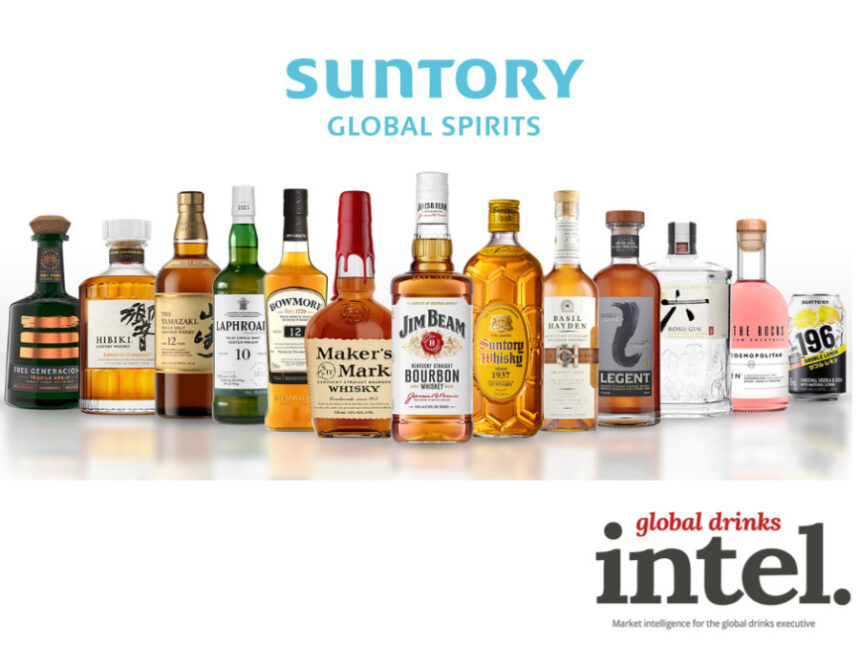
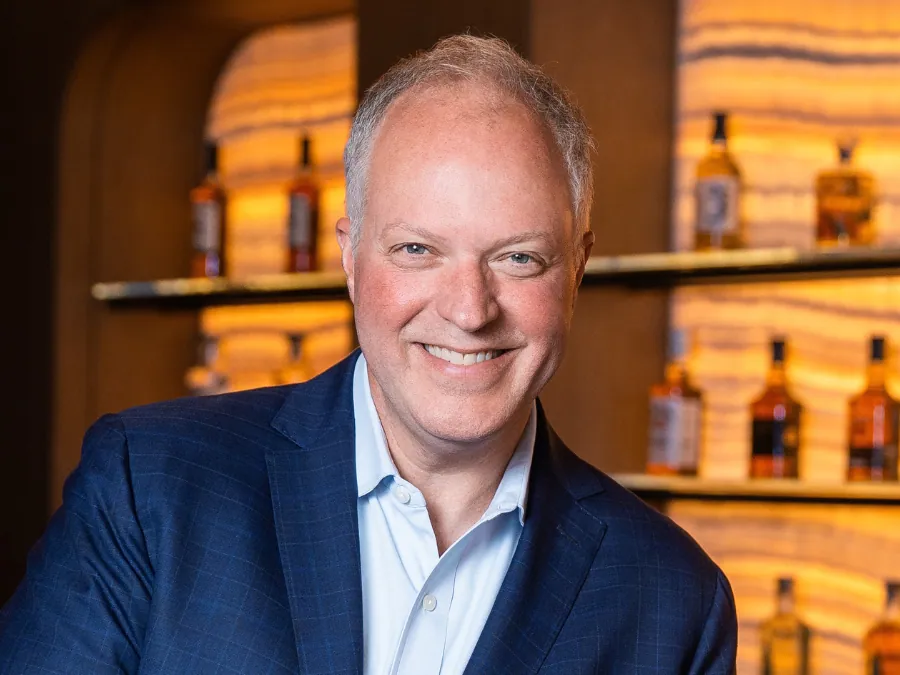
Late last week, Suntory Global Spirits posted a flat set of sales numbers for the six months to the end of June. The spirits arm of Japanese group Suntory Holdings pointed to “a great period of growth” from its ‘APAC’ reporting division, including in India and in Japan itself. Speaking exclusively to Global Drinks Intel’s deputy editor Jessica Broadbent, CEO Greg Hughes (below) provides his take on the Jim Beam owner’s half-year performance.
Did the first half of 2026 go as expected for Suntory Global Spirits?
The market environment has certainly been challenging and unpredictable with some of the external events, particularly in the Middle East. But, I’m quite proud of how our teams have navigated this uncertainty. The important thing is we’re seeing real signs of positivity and underlying momentum that are hopefully evidence of our strategy.
While our overall sales were flat, we did have strong performance and year-on-year momentum in some of our markets … particularly in Asia Pacific … with double-digit growth in India and strength in Japan. This helped offset some of the macroeconomic challenges and the consumer trends we’re still seeing in Europe – in particular in developed Europe – and in the US.
We also saw really strong agility and performance by our global travel retail team, which is important given the uncertain environment that emerged in the Middle East, in particular.
I’m feeling good about where the business is; the results we delivered across our brands in a challenging environment, still in the US and Europe, but with really strong growth across key brands and key segments across APAC, India in particular, global travel retail, and a strong progression towards our aspirations for leadership in whisk(e)y and RTD.
Suntory Global Spirits’ regional sales trends seem to be in line with 2025: strong in domestic, APAC and GTR, but battling headwinds in the US. Has much shifted?
Overall, the growth and momentum is still being driven by Asia Pacific, India and GTR. Underneath that, we’re starting to see really strong traction and momentum in RTDs, particularly in the US and developed Europe, which is very encouraging.
The Americas continues to face pressure from softer US demand, particularly for full-bottle spirits. That pressure, given the size of our full-bottle-spirits portfolio, overshadows the underlying momentum on RTD a little bit.
The other impact, particularly in the Americas, [was] from distributor inventory dynamics, which impacted shipment timings, particularly in the first half. This should be much better in the second half for us.
What caused that need for ‘inventory optimisation’?
Generally, the pattern of inventory and distributors when the US market was growing. Then, as the market slowed down, getting that inventory back into underlying adjustment has taken some adjustment over the course of 2025 and the first half of 2026. I think we’re largely through that now.
Looking forward to the second half of the year, do you expect to face any lingering inventory issues?
If you think about inventory in three buckets, consumer [or] home-bar inventory was a large issue that built up during Covid. I think we’re certainly through that and so is a lot of the [wider] industry
The second tranche was the inventory that had been built up when retailers were buying against the sudden change in demand – I think we were largely through that in 2024 and 2025. Retailer inventories are now in a good place.
What we’re seeing now is wholesaler inventories catching up with that. We’ve got our inventory levels at the place we want them to be – I can’t speak for the balance of the industry.
What’s your outlook for distribution in general in the US, following Republic National Distributing Co’s bankruptcy? Is the state of the system a concern for you?
We made a decision in 2020 – literally weeks before the Covid lockdowns – to move all of our open market distribution out of RNDC and to Southern Glazers Wine & Spirits. So that didn’t affect our business in the US in any way.
As we look at the evolving distributor dynamic in the US, as growth is balancing between full-bottle spirits and RTD, we’re also seeing category conversions between beer distributors and wine & spirits distributors as they’re looking for opportunities to drive growth and scale. We’ll continue to see beer distributors move more aggressively into spirits – not only ingo full-bottle spirits, but certainly spirits-based RTDs.
We’ll also continue to see wine & spirits distributors move into building out beer capabilities either through acquisitions or through building the infrastructure to be able to move at the speed of the RTD category (which moves much more like a beer business in terms of scale and velocity than a super ultra-premium full-bottle spirits business). We’ll see more convergence towards that.
You mentioned a slowdown in full-bottle spirits consumption in the US. Can you explain what’s going on there?
In developed markets, most of the growth in beverage alcohol right now is in RTD, and that’s consumers moving towards flavour and convenience and the options that RTDs provide. That’s exciting for us.
The top three RTD markets globally are the US, Japan and Oceania. We’re the number one player in Japan and, depending on the week, we’re the number one or two in Oceania. We’ve got work to do in the US, but we bring deep capabilities there. As consumers start to look for more flavour, convenience and the experiences they want on-demand, you’re seeing them moving to RTD.
There’s still a lot of growth available for full-bottle spirits. We’re just seeing that it’s a slower-moving category, so there’s a retrenchment of demand – and a recovery of consumer demand – driven by cost inflation and the overall macro markets and the structural and cyclical challenges that alcohol’s facing. The response to that in full-bottle spirits has been a bit slower, and the demand’s still sluggish, as consumers are gravitating from beer, wine and full-bottle spirits into RTD products.
How much of RTD’s growth rates can be put down to the fact it’s a smaller, younger category? In volume terms, could RTDs start to challenge full-bottle spirits?
The growth rates are inflated because, to your point, the base is much smaller than you’re growing off of. But if you go to markets with really advanced RTD businesses, such as Japan or Australia, the in-store space is fairly evenly divided, if not even more for RTDs. We’ll see categories shift over time for there to be more balance between full-bottle spirits and RTDs, certainly in the off-premise.
The high-end of the on-premise will always be a different animal, but for scale beverage alcohol, the momentum will be towards RTDs, with some of that coming out of full-bottle spirits and some coming out of beer, as consumers vote for that RTD option to give them convenience and flavour.
RTD is big enough that it’s driving total spirits category growth. So while full-bottle spirits are slightly down – in most developed markets by a few percentage points – growth is enough on RTD that it’s pulling total spirits into growth.
Again, this is a developed-market phenomenon. We don’t see the same dynamic when we go to, say, India, which is obviously one of the most dynamic and exciting markets for spirits in the world. There’s still population growth and consumer demand for full-bottle spirits. There’s probably a higher priority on the value out of full-bottle spirits versus the convenience from an RTD in those developing countries.
Can you tell us more about your strategy for IMFL whisky brand Oaksmith in India?
[IMFLs] deliver a great blended whisky taste at various levels of affordable price to the Indian consumer, and that’s the largest-scale portion of the Indian market.
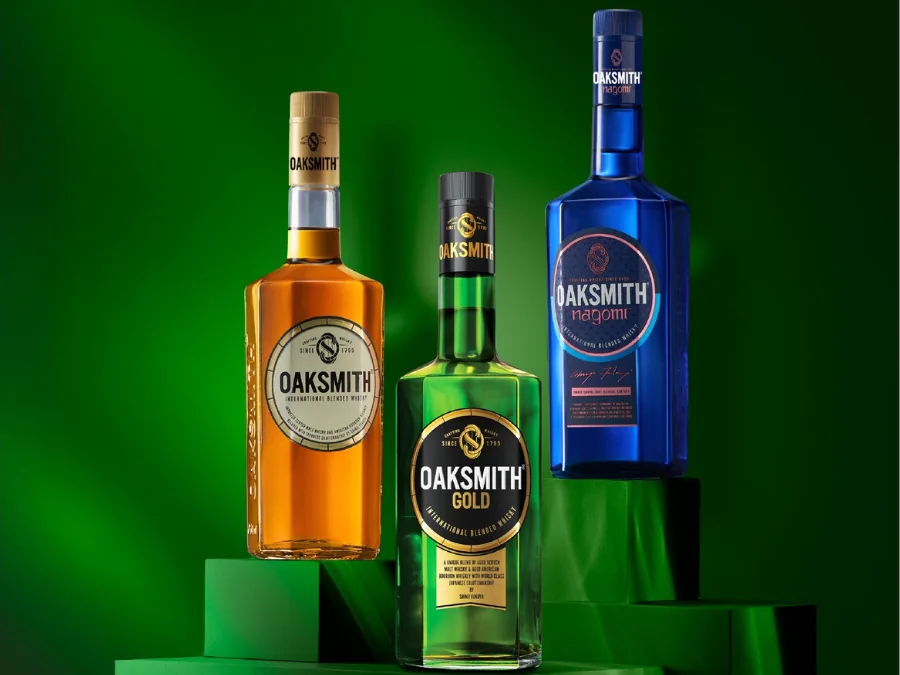
We have three Oaksmith sub-variants across three price tiers: Gold, International and a new product called Oaksmith Nagomi (below). We’ve been on a journey from launching the brand [in 2019] to building out distribution across the key markets, focusing on major cities like Mumbai, Delhi and Hyderabad … and driving strong growth and momentum and share across that business.
[The brand has grown by] double digits since launch and is tracking on getting to 2m cases this year. Largely, that’s been a combination of commercial fundamentals … product quality and … the right marketing at the point of purchase to help people understand the moment of consumption for Oaksmith.
[We’ve also] partnered with the likes of Indian Premier League Cricket to help support our Oaksmith Water.
There’s an Oaksmith water brand?
India’s a dark market, so you typically market affiliated products as part of your marketing model.
What potential do you see in more premium or single malt Indian whisky?
Our focus in the market is across our full whisk(e)y portfolio. India’s an incredible market; it’s adding 20m LDA consumers a year, but it’s also premiumising. Every time I’m there, there’s more dynamism and premiumisation.
In the world’s largest whisk(e)y market, there’s everything from the top-end luxury hotels, people with strong interest in our scotch and Japanese and bourbon portfolio … then there’s big growth ambition for us across Teacher’s blended scotch. We’re seeing strong momentum across Jim Beam, which is up 20% this year in India … and then there’s our IMFL business with Oaksmith, which is our biggest in terms of volume, but not necessarily in revenue.
We don’t specifically have an Indian malt whisky. Our Indian whisky brand is Oaksmith, but we’re selling all of our significant whisk(e)y brands in India.