

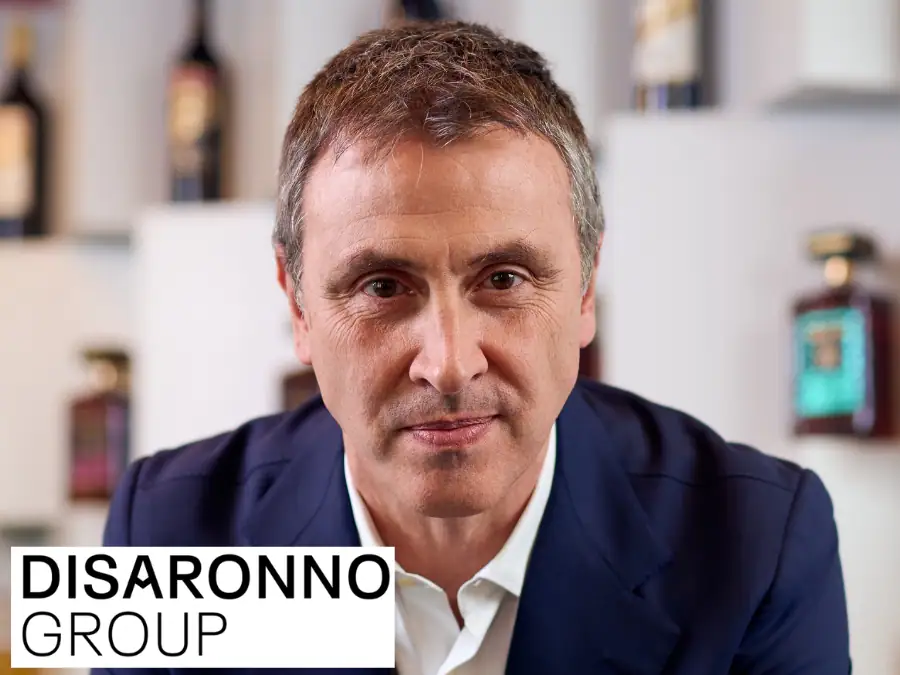
At the start of October, Marco Ferrari will celebrate the third anniversary of starting his current role as CEO of Disaronno Group. The company today has changed somewhat from the company he joined, not least in name. Earlier this month, Ferrari (below) sat down with Global Drinks Intel editor Olly Wehring to talk through Disaronno’s name change from Illva Saronno, the group’s management of its namesake liqueur brand and the perils and pitfalls of working in ice cream.
You’ve worked in the alcohol industry for 30 years. What has been your journey?
I started with Martini and Rossi, which was part of the Bacardi group at that time, and spent 12 years there, most of which were abroad outside of Italy. After that, I decided I wanted to work for smaller companies, but in bigger roles.
I had a few years with Fratelli Branca Distillerie, working on the Fernet Branca and Carpano brands. This was followed by four years with Stoli Group, based out of Luxembourg. My first opportunity to be a CEO came at Grupo Montenegro, and then I came here, to Disaronno Group.
I would say it’s been a mix of luck and dedication! Ours is a small industry: Once you’re in, it’s really hard to get out, for many reasons. I often say that you want to behave properly, because whoever you’re facing one day, it’s likely you’re going to face that person again in the future.
Your career has been spent exclusively in privately-owned companies. Have you avoided listed companies on purpose?
It’s a choice in many ways, but it’s also the way opportunities came to me. I would say Bacardi is a bit of a hybrid, in that it’s a family-owned company, but it’s massive. When I was there, its annual sales were around US$6.5bn, so the company’s behaviour was more corporate. Although we weren’t tied to quarterly results, we did have pretty disciplined and thorough financial control.
I have a lot of respect for entrepreneurs; for those who risk their money and put their name to something. I’ve always thought that trying to find the right balance between an entrepreneurial approach and some discipline and structure, is the winning formula.
A publicly-driven corporate culture shows its limitations in times like these, when the markets are not booming. Companies like Disaronno Group aren’t just looking at this year, they’re looking way beyond what happens in 2026. The acquisitions [of Amaro Averna and Zedda Piras from Campari Group] that we formalised earlier this month are a good example. We’re spending big money for a company our size to acquire brands that haven’t been booming in recent years, because they weren’t a top priority for their previous owner, given their big portfolio. In our portfolio, though, they can play a different role.
We’re looking at that return in the very long term.
You joined Disaronno Group – then called Illva Saronno – in September 2024. What was your SWOT analysis on day one?
I already knew the company reasonably well, having been in the industry for a long time, and I knew how great the portfolio was. I had some positive confirmations of what I expected when I joined, but I was surprised by a couple of things. I didn’t realise how international it was. The strong presence in markets such as the US, the UK, the Netherlands and Belgium meant that the international culture within our commercial team was quite impressive. I was also surprised by the strength of the brands, in terms of their equity: Disaronno’s a fantastic brand, and so is Tia Maria [acquired from Pernod Ricard in 2009]. At the same time, I found the company’s approach to acquisitions very reassuring, as it indicated where the shareholders wanted to take it.
On the less positive side, it’s a very complex company. I tell every consultant I meet that they should create an index to measure the complexity in organisations, because we have amazing complexity. Our group is more than wine and spirits; our spirits division is about two-thirds of our revenue, while our wine division is less than 10%. Then, we have Disaronno Ingredients, which manufactures and sells ingredients for ice cream shops and accounts for around 25% of revenues.
I look after the whole Disaronno Group holding company, so this makes my job more interesting – and more complex. One of my focuses today is to reduce this complexity and simplify our ways of working.
Is ice cream within your skillset?
I have a lot of defects, but I don’t pretend to know something that I don’t. I have a lot of trust in the people who are working in that division. Since I came on board, I’ve tried to focus the attention and the investment on fewer, more relevant things.
But I have no ambition to teach anyone in that division how to do their job, especially from a commercial perspective, because they know it so well.
The name change from Illva Saronno to Disaronno Group was announced in mid-May. What prompted this move?
We’d talked about it almost since the beginning. When I was interviewed for the job, I asked how attached they were to the name Illva. If you want an organisation to become a group, it’s not just about size, it’s also about being able to express a clear and shared identity.
As I explained, our group is quite diverse, so we wanted to make sure there was an identity that everyone recognised. Disaranno is one of the most iconic Italian brands out there. Indeed, the awareness and the relevance of the brand is actually stronger outside of Italy than it is in Italy. Wherever you go in the world, you’ll always find a bottle on the back bar. It’s such an iconic symbol of the ‘made in Italy’ culture that, given our vision, we had to express our identity through Disaronno.
It didn’t take a massive creative team to come up with the corporate name, but it was natural that it would become the distinctive symbol of our identity.
To what extent is the Disaronno brand a cash generator for the group rather than a growth driver?
In our industry, there are some brands that, at the end of the day, overwhelm a category. With Disaronno, you barely mention the category it’s in.
I’ve always been a believer that if anyone comes into a category from above in terms of quality, then that’s a benefit for the category. I’m less enthusiastic about brands that come from below and undercut or are only price driven or are own label.
The risk of being complacent is always there. For a few years, I think our company focused on other priorities. Today, our focus has clearly gone back to Disaronno as a core brand. There’s a great opportunity for a liquid like Disaronno to be relevant to current consumer trends in terms of lower alcohol, refreshment and simplicity.
It’s impossible not to recognise Disaronno when you’re drinking it – Having this identity is a point of strength right now.
How do you intend to bring Disaronno in line with today’s trends?
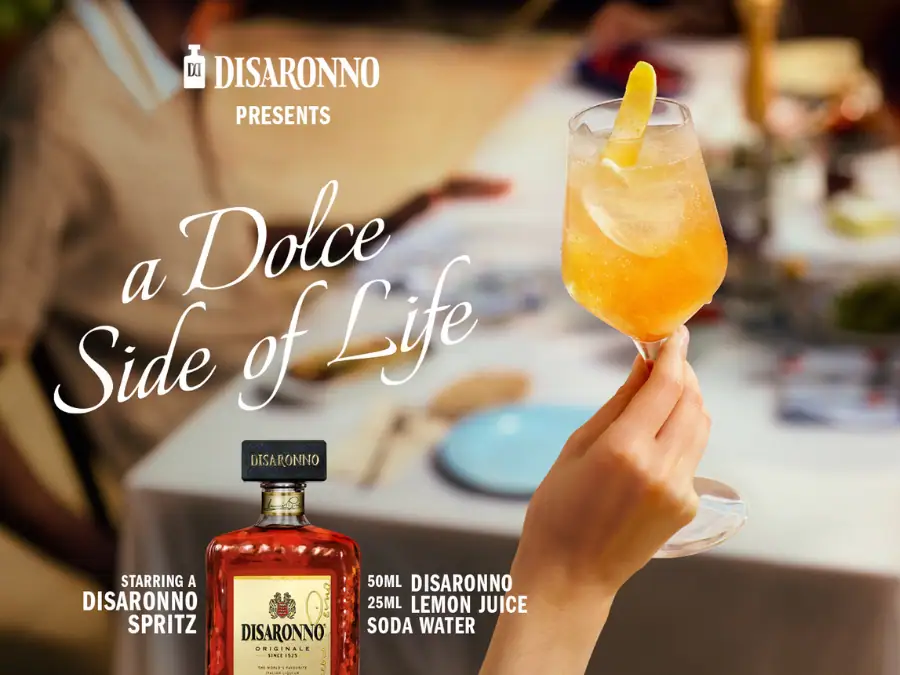
We recently launched our ‘Dolce Side of Life’ campaign [in April], which takes the concept of La Dolce Vita from something that was almost unreachable to bringing those values to everyday moments.
One of the issues that impacts even those brands that have massive awareness is that some consumers don’t know what to do with it – even though they know the brand! Educating consumers about Disaronno in this way is where we’ve been missing things a little bit in the past.
The Disaronno sour and the Disaronno spritz serve (above) – I know we’re kind of abusing the term ‘spritz’ here! – form part of that education, as does the godfather, which is Disaronno with whisk(e)y, for the stronger palate.
One area that we’re working on, which is less sexy, is on our execution. We want to do less but do it better and focus on making sure they deliver. In my 30 years, I’ve seen great ideas fail because they were poorly executed, and I’ve seen mediocre ideas work well because they were executed perfectly. That’s what we need to focus on.
Members-only intel
Keep reading this members-only article – and every one like it
- ✓All paywalled news and interviews
- ✓Category and market data
- ✓Monthly GDI magazine
- ✓Full archive + daily newsletter
Secure checkout · Cancel any time · Company invoices available
Already a member? Log in
See all plans, incl. 10-reader and corporate
Check if your company already pays for you Your company may already give you free access.
Corporate subscribers: AB InBev, Bacardi, Campari Group, Diageo, Moët Hennessy, Pernod Ricard, Proximo Spirits, Suntory Spirits Group, William Grant and Sons.
Activate company accessNot ready yet? Get the headlines free in our daily newsletter.
Sign up free