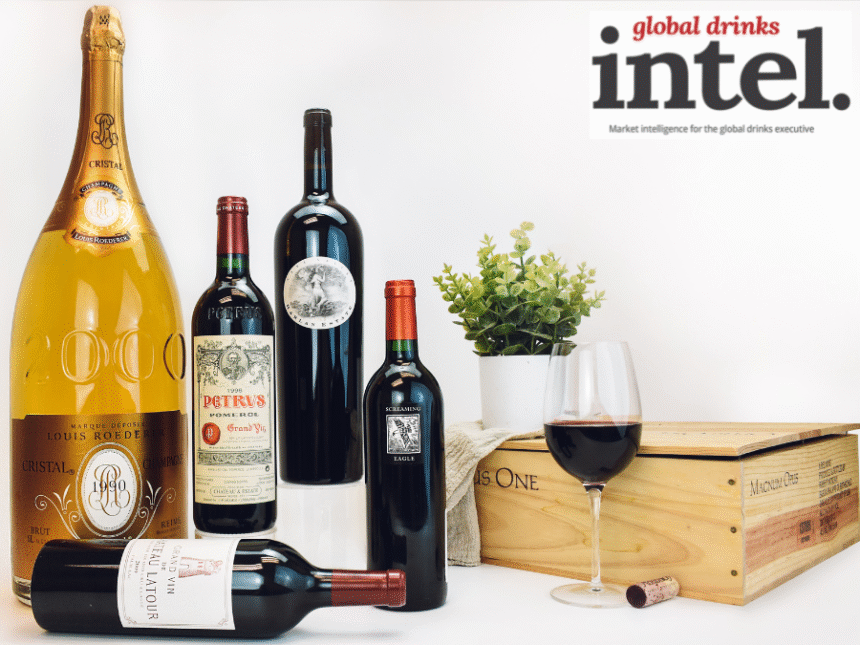
- Fine wine market dynamics – The wider beverage alcohol business might be in turmoil, but the super-premium rare wine market, while not immune to economic issues, remains mostly insulated from short-term stock market volatility
- Millennial promise – Despite concerns about younger LDA consumers abandoning wine, Benchmark sees long-term promise in Millennials and Gen Z, viewing wine as a cultural touchstone that grows stronger with a consumer’s age and affluence
- Strategic growth plan – Moves such as the purchase of Wine Spectrum and an expansion into rare spirits have allowed Benchmark to broaden its market reach, while maintaining its two-decade-earned reputation for luxury, provenance-guaranteed offerings
In recent months, the stop-start threat of tariffs by the US Government has sent waves of panic rippling across much of the country’s beverage alcohol industry.
Rare wine retailer Benchmark Wine Group is better placed than many to ride out the crisis. Based in California’s Napa Valley, Benchmark was founded by CEO David Parker (below) in 2002 after a career in high tech. The company has a presence across all three tiers of the US alcohol distribution system – import, distribution and retail – but caters to a customer base for whom price is not the primary concern.
“Navigating the three-tier system in the US is, of course, complicated,” Parker admits. “There are states in the US, such as California, where Benchmark is able to act as both a retailer and distributor. Importing is such an important facet of our business, as it allows us to work with some of the best wine producers and brokers in Europe to negotiate not only prices that are beneficial to our customers, but also provide access to older vintages and rare bottles.”
Benchmark’s retail operations account for around 70% of the company’s business, according to Parker, making it one of the country’s biggest sellers of rare and back vintage wines sought after by consumers, collectors and investors.
“While the fine wine market focuses on hard-to-get wines, primarily in the current vintage,” he explains, “Benchmark caters to collectors and investors searching for impossible-to-get wines, often from vintages no longer available and wines that were never available except to an extremely limited winery ‘mailing list’.”

Vintage year in a declining market
In 2024, Benchmark enjoyed its most successful year to date at a time when other top-end wine suppliers were cutting back or even going out of business.
“Our [Washington] DC operation has allowed us to serve East Coast customers better and was responsible for a lot of our growth,” Parker reveals. “Our broad contacts gave us access to the best products, and our attention to service, selection and bottle quality keep our customers loyal and brought us new ones.
“Our voluminous dataset and industry-leading software allow us to offer the best overall pricing for wine, and price it properly in the market. Finally, we have grown to the point where we enjoy a substantial economy of scale.”
Impact of tariffs on fine wine
Despite the US imposing a blanket 10% tariff on wines from top wine-producing countries – including Europe, Australia and South Africa, and the possibility of higher rates to come further down the track, Parker remains pragmatic.
“The current information is that tariffs will likely remain moderate,” he says. “Our customers tend to be at the higher end of the net-worth spectrum and have some tolerance for modest price appreciation.”
Benchmark’s extensive inventory also provides the company with some breathing room. “Benchmark has an incredible inventory that was in the US ahead of the new tariffs and will remain unaffected for the time being,” Parker says. However, he acknowledges the finite nature of these supplies. “Like all inventories, it is, of course, finite.”
Parker doesn’t believe tariffs alone will dictate purchasing behaviours among Benchmark’s predominantly high-net-worth customer base.
“While the volatility of the investment markets may make consumers at all (price) tiers more cautious in their purchases, rare wine is viewed by a large portion of high-net-worth families as an investment that tends to trade out of synch with the markets. Therefore, volatility in equities and bonds may, in fact, drive greater purchases of rare wine.”
Despite the financial market turbulence and anguished business news headlines in recent months, Parker insists Benchmark’s business model is uniquely insulated.
“We purchase most product domestically, but do rely on international sources for some of it,” he reveals. “While the long-term size of tariffs is not yet clear, the first shipment we have brought in under this programme has seen the tariffs partially subsidised by our transportation company.”
Wine Spectrum purchase a strategic fit
A key driver in Benchmark’s 2024 success was its October acquisition of Sonoma-based Wine Spectrum, a wine retailer that was founded in 1990 and specialises in connecting customers with high-scoring new-release wines.
“Wine Spectrum gives us an opportunity to provide a service to our current customers, as well as a way of bringing in new customers,” Parker reveals. “It also brought in a team of people with great customer experience and skills which are key to discerning clients with very high expectations.”
Will younger LDA generations warm to wine?
Despite growing industry fears about Millennial and Gen Z consumers drifting away from wine, Parker sees this generational challenge differently.
“While the majority of our customers are currently Baby Boomers or Gen Xers, with some of the ‘Greatest Generation’ still active as buyers and a great many more as sellers, a recent study showed that 30% of our sales by dollars were to Millennials,” he reveals. “Two per cent were to Gen Zers, but this is clearly a generation in transition, with half not legally able to purchase alcohol and few with discretionary income yet.”
Parker acknowledges that wine’s appeal often grows with age and financial security. “Wine should not be thought to be competing with seltzers and celebrity-endorsed tequilas, but to be waiting for that consumer to move to the next choice,” he argues.
In his view, wine holds a unique cultural and historical appeal. “Wine is not simply an alcoholic beverage, but a food product that is historically tied to the place and people it comes from. It is a deep part of the culture of those people and places.”
Parker believes wine becomes a lasting preference for many consumers. “Very few people who discover wine, its complexity and life-enhancing characteristics, tend to move away from it and ‘go back’ to beer, cider, spirits, non-alcoholic beverages or cannabis as a primary product.”
Beyond Bordeaux – Changing top-end tastes
In terms of purchase trends, Parker does see some substitution toward cult wines from the US due to tariffs, but he tempers expectations.
“At the high end of the market, those wines are made in very small quantities,” he says. “They’re also stylistically different, so can’t completely replace international wines.”
Away from the thorny issue of tariffs, Parker notes some reversals and surprises: “Burgundy and champagne enjoyed a long period of price appreciation,” he adds. “While there’s been a substantial correction recently, the top brands are quite a bit more valuable than they were a few years ago.
“There’s also been a resurgence of port and California cabernets from the 1970s. Among collectors, Australian wines, with the exception of Penfolds Grange, seem to have fallen out of fashion.”
Building for the long term
Looking ahead, Benchmark’s DC operation is expanding rapidly, particularly into rare spirits, and the company’s deep data analytics inform its pricing strategies and acquisitions. The firm also continues to invest in infrastructure and sustainability.
“We recently moved to a state-of-the-art, climate-controlled warehouse that allows us to streamline our logistics. At the same time, we reduced lease and utility expenses, as well as our carbon footprint.”
And it doesn’t stop there. “We continually add features to our site through software upgrades,” says Parker. “We’ve also made updates that help automate shipping further and provide customers with more options at lower costs, with fewer overheads for our team.”
As the fine wine category battles with an increasingly challenging landscape, Benchmark Wine Group’s measured confidence and methodical growth stand apart. Whether through strategic acquisitions, smart inventory management or a nuanced understanding of consumer behaviour, Parker and the Benchmark team continue to prove that in both wine and business, depth and vision yield lasting returns.
This article is available to Global Drinks Intel members only.
Click below for details on how to join the Global Drinks Intel community.
Already a member?
Log in here to read the article in full.
If you work for any of the following corporate subscribers to Global Drinks Intel, head here to activate your access.
- AB InBev
- Bacardi
- Campari Group
- Diageo
- Moët Hennessy
- Pernod Ricard
- Proximo Spirits
- Suntory Global Spirits
- William Grant & Sons