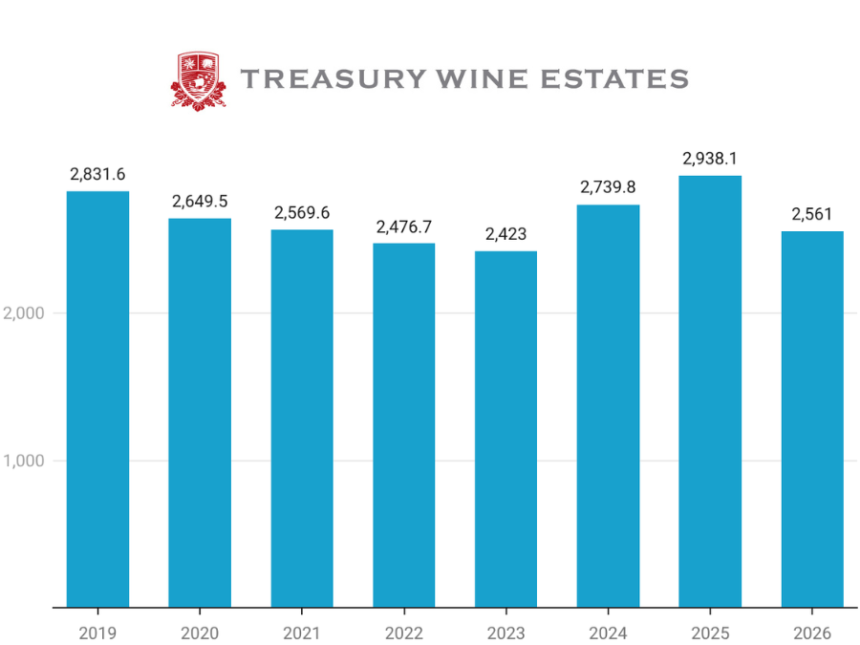
- Sales in 12 months to the end of June down 11.2% to AUD2.56bn (US$1.81bn)
- Second-half sales decline by an estimated 4.8%, following H1’s 16.6% slide
- Progress in “aligning our supply chain to our vision for a simpler TWE” highlighted
Treasury Wine Estates has targeted the year after next at the earliest for a return to sales growth as the group’s fiscal 2026 closed down by double digits.
The near-17% sales decline booked from the first half was softened somewhat by a better H2, resulting in an 11% fall in the top line in the 12 months to the end of June. Over the full year, Treasury flagged reduced shipments across all three of its divisions – Penfolds, Treasury Americas and Treasury Collective.
As well as posting declining shipments, the three units also came in down in value terms for the year: Americas was the worst-performing, down by 17.6% due in part to the previously reported disruption on the distribution side in the US for Treasury. At the same time, “softer wine market conditions” were flagged in the US, although the second half was “stronger”, the company said.
Penfolds, meanwhile, declined by 6.8% in value sales despite impressive depletions in China (+34.7%). “Strong consumer demand” for Penfolds remains in the country, coinciding with the diversion last year of parallel imports – meaning shipments into the country from unauthorised sources – to “authorised distribution channels”. Also of note for Penfolds was an unspecified size of dip in shipments for the brand’s “ultra-luxury tiers” last year as the group works through its strategy of reducing its customers’ inventory levels.
Finally, Treasury Collective, home to the company’s lower-priced marks, fell 11.3% in value in fiscal 2026 as a weaker performance for ‘premium’ brands in the Americas – 19 Crimes was in decline in the region – melded with sales decreases for ‘commercial’ brands in Australia, New Zealand and Europe.
“Fiscal 2026 was a year of … significant change for Treasury Wine Estates,” said CEO Sam Fischer. “While our financial performance reflected evolving market conditions and the proactive measures to ensure brand and channel health, we made substantial progress towards reshaping the business for long-term success.
“The growth in depletions globally, led by China, was particularly pleasing, reflecting … strengthening demand power. During the year, we took action to rebalance customer inventories in China and the US to protect brand health … . We are also making strong early progress in aligning our supply chain to our vision for a simpler TWE, and accelerating initiatives to improve performance in the Americas.
“While there is more to do, we are confident these initiatives will position TWE for improved and sustainable growth over time.”
Looking forward, the company said that sales growth is expected “from fiscal 2028, with customer inventory rebalanced”.
Just over two months ago at its Investor Day, Treasury outlined plans to cut the size of its portfolio from 76 brands to “less than 30”. The intention echoes Constellation Brands’ 2025 desire to withdraw from wine’s “mainstream”, an approach that came to fruition in April last year through the sale of a raft of brands to California’s The Wine Group.
Members-only intel
Keep reading this members-only article – and every one like it
- ✓All paywalled news and interviews
- ✓Category and market data
- ✓Monthly GDI magazine
- ✓Full archive + daily newsletter
Secure checkout · Cancel any time · Company invoices available
Already a member? Log in
See all plans, incl. 10-reader and corporate
Check if your company already pays for you Your company may already give you free access.
Corporate subscribers: AB InBev, Bacardi, Campari Group, Diageo, Moët Hennessy, Pernod Ricard, Proximo Spirits, Suntory Spirits Group, William Grant and Sons.
Activate company accessNot ready yet? Get the headlines free in our daily newsletter.
Sign up free