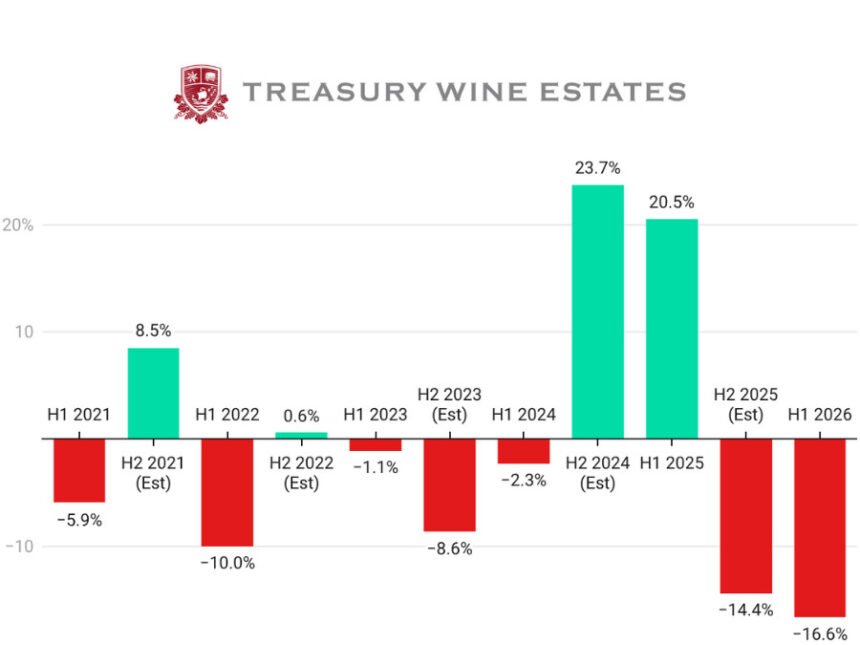
- Sales from six months to end of December decline by 16.6% to AUD1.3bn (US$917.2m)
- In line with previous half-year’s estimated top-line slide of -14.4%
- ‘TWE Ascent’ programme targets per-year cost improvement of AUD100m “across a two-to-three-year time period”
Treasury Wine Estates has promised a “focus on modern refreshment… supported by disruptive innovation” in the months ahead, following a particularly troublesome latest half year.
Six months on from posting a 6% lift in sales from the 12 months to the end of June – a performance hindered by a near-14.5% sales slump in the second half of fiscal 2025 – the Penfolds owner said today that H1 2026 (to the end of December) tumbled by just over 16.5%. The weak showing had been flagged on at least two occasions in recent months; first came news in early December of an impairment charge for the US business, followed a fortnight later by confirmation of a plan to “transform” its operating model.
Noting that the marked decline was in line with the guidance shared at the end of last year, Treasury highlighted that its depletions – meaning product shipped to the final seller – had remained healthy in “key markets”. Flagship brand Penfolds, for example, was up in depletions terms by 17% in its main market of China, and by 3.5% in Australia, over the half year. The group’s Treasury Americas unit delivered a near-2% rise in depletions – albeit when excluding California, where distribution issues have hit hard over the last six months.
Despite the bright spots, the “softer category trends” referenced in December combined with the “restriction of shipments contributing to parallel import activity and the cycling of elevated shipments in the [year-prior period]” as reasons for the sales slide.
All three of Treasury’s business units registered sales declines in the half-year. Penfolds fell by 10.5% due to the aforementioned high figures a year earlier (after China had dropped its raised tariffs on Australian wine in March 2024) as well as the parallel import-related restrictions. Treasury Americas slumped by 28.4%, while Treasury Collective – home to the lower-priced brands in the portfolio – was down by 14.4%.
“Today’s results come at a time when we are already making meaningful progress with the decisive actions required to return Treasury to a path of sustainable, profitable growth,” said CEO Sam Fischer, overseeing his first set of results since assuming the position at the start of October. “Our focus is firmly on the future to strengthen execution and ensure we build a stronger, more resilient business for the long term.
“Encouragingly, we are seeing our key brands continue to perform in the marketplace and resonate strongly with consumers, reinforcing confidence in the strength of our portfolio and our ability to deliver improved performance as we execute the transformation of the business.”
On the operations review first announced in December, the group set out a timeline for what it called ‘TWE Ascent’, the first phase of which commenced in December. Running until March, a review of the portfolio and overall operating model will run alongside a closer look at current costs. Phase two, from April to June, will comprise a “detailed future state design and implementation workstreams”, before the third phase (from June) will see the transition to a new operating model.
This article is available to Global Drinks Intel members only.
Click below for details on how to join the Global Drinks Intel community.
Already a member?
Log in here to read the article in full.
If you work for any of the following corporate subscribers to Global Drinks Intel, head here to activate your access.
- AB InBev
- Bacardi
- Campari Group
- Diageo
- Moët Hennessy
- Pernod Ricard
- Proximo Spirits
- Suntory Global Spirits
- William Grant & Sons