


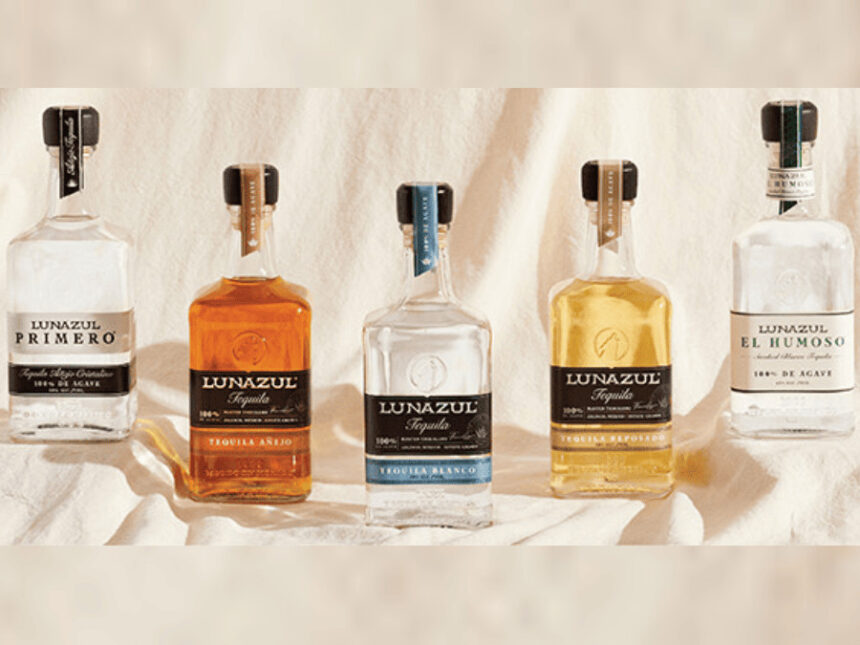
To get the lowdown on what’s happening on the ground in Tequila, Global Drinks Intel spoke to Francisco Quijano, who’s better placed than most to tell the category’s story.

Global Drinks Intel: What’s your history in Tequila?
Francisco Quijano: I’m the CEO of Tierra de Agaves, the distillery for Lunazul, which I’m also the master distiller for. We’ve been producing Lunazul for 15 years in partnership with Heaven Hill. Tierra de Agaves is owned by the family of Francisco Beckmann, formerly the co-owner of Jose Cuervo. Back in the 1990s, Francisco decided to split from his brother and built this distillery with the idea of creating a small-batch tequila brand. I joined in 2007.
Prior to that, I was director of operations for Sauza Tequila, which is where I got my training and education in the production process.
GDI: Where does Lunazul sit on the price ladder?
FQ: We’ve really created our own price point. We sit between the top of the mid-tier and premium. Tequila pricing state by state is so different – we want to stay relevant versus the competitive set, so we’re priced differently across the US intentionally.
We’ve taken a lot of price increases over the last few years to eliminate the sentiment that Lunazul is one of the lower-priced 100% agave Tequilas. Our goal is to be at US$23.99. You’ll start to see us take price a little bit in the coming months to get us closer, but that’s the goal.
GDI: How has competition on the ground in Mexico changed over your time in the industry?
FQ: In the US, the category’s been growing at double digits and that’s been an attraction for many small landowners in the state of Jalisco. They think that planting agave now will be good business in seven years when the harvest comes. Agave is unique in that it has a very long botanical cycle and there’s no other commercial use for agave than making Tequila. When there’s a surplus in the system, that could mean losses for the growers, because your agave will not wait.
There will never be a balance between agave availability and tequila demand – It just doesn’t happen. The lines may cross at certain parts of the cycle, but they’ll never balance. Today, we’re at an inflection point, with plenty of young agave reaching full maturity and it’s more than the industry can take. That means the price of agave is going down substantially quickly.
Over the last three or four years, there wasn’t enough agave to supply the tequila demand. Again, a lot of growers will jump into the agave business. Then, when they reach full maturity, the system turns around.
We never learn the lessons from history. We’re pushing for contracted agriculture only. We try to create incentives for growers to engage with a distiller through a contract that guarantees a fair price. We’re far away from that vision, but we’re working on it.
GDI: At the same time that the price of agave is declining, we’re seeing Tequila’s popularity continue to soar. Why is there a downward trend in agave value when consumer demand is heading upwards?
FQ: This new trend in agave availability and price only happened very recently. If we were talking three months ago, I’d have said that the gap was rising to an unsustainable level. That’s why many ultra-premium brands have been thriving. Those big names with $40-$100 bottles can afford to pay higher prices. But things are changing – a lot of mid-tier brands with lower production costs will become more competitive.
The changes ahead are interesting. I see huge competition in ultra-premium Tequila over the next two to three years. My guess is they’ll switch their pricing strategy down if they want to stay in consumers’ minds.
This could be the moment for Lunazul. A lot of consumers have realised that such a luxury type of tequila is just not worth it. We believe the best years for Lunazul are ahead.
GDI: Isn’t there a sweet spot?
FQ: You have to go back to the structure of our industry. There are almost 2,000 Tequila labels on the trademark database, yet there are only 165 registered distillers. When you don’t have your own distillery, then you’re playing poker on the spot market. When there’s a surplus of agave, everything looks good. But when there’s a shortage of agave, you’re going to be paying a high price.
There are distilleries producing 20-plus different Tequila brands. Can they stay focused on the formulation of each one of their customers? My answer is not a chance.
Lunazul has its own distillery that doesn’t produce for any clients and more importantly, it has an agave estate. We have a very solid structure.
All the newcomers will be welcome in surplus agave cycles. But in the mid-term, when the cycle turns upwards again, they’ll have issues if they don’t invest in agriculture and in infrastructure. The only way to sustain a good tequila brand is by growing your own agave. Agave is not a commodity, it’s a painstaking thing to deal with!
GDI: How is Lunazul performing in the US?
FQ: In the past year, Lunazul passed 1m cases. We think we’ll hit above 1.5m in the current fiscal year. We sell all that we can. If our distillery was bigger, we’d probably sell more.
One thing that’s different about Lunazul is where our sales come from. Most people assume the top markets for Tequila – California, Florida, Texas – are top markets for us. Our biggest market is North Carolina, followed by South Carolina, Georgia and then Texas. We’re very established in not-established Tequila markets.
We’re working on how to replicate that model in those big Tequila markets in the US – that’s our challenge ahead.
GDI: What are you doing right in those markets?
FQ: It’s really been word of mouth, thanks to the flavour profile and the packaging. We’ve also been competitive on price – we were never the cheapest 100% agave Tequila. Our sales tactic has been around: “You really should be paying double for what you’re getting in the bottle.”
GDI: Where do you believe the category will be in ten years from now?
FQ: Global brand owners started looking at Tequila about 20 years ago. Today, we have all the major global suppliers with a stake in our industry, the majority with well-established brands and distilleries, even agave-growing operations. That’s when we started to see tequila becoming more global.
When Brown-Forman took over Herradura, for example, the brand was in 80 different countries around the world a year later. We have the powerhouses of our industry with a stake in Tequila, so real international sales are coming.
We also have to keep innovating to compete with other spirits categories. The standards on Tequila are tight. We have to work with the Consejo Regulador del Tequila [Tequila Regulatory Council] to promote a more diverse way of producing Tequila. So, within the next ten years, I hope to see a more open set of rules to foster creativity and innovation.
I’m not complaining about the standards., I would just like to be much more creative.
GDI: Does your job feel like work?
FQ: I’m not a good example! I sometimes lose my professional focus – Tequila for me represents a way of living.
Can vodka keep tequila off the top spot in North America? – Category Intel