


This article appears in the April issue of Global Drinks Intel magazine. For details on how to subscribe, click here.
Restricted agave supply coupled with unpredictable costs has led large Tequila producers to plant their own blue weber to meet rocketing demand. Richard Woodard reports.
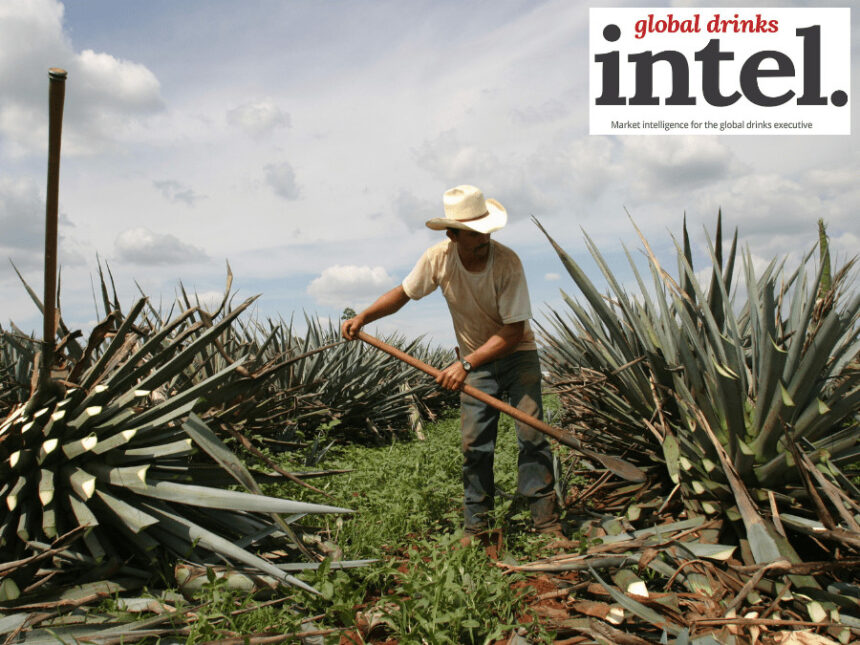
Amid the celebrity glitter and the luxury bottles that encapsulate the 21st Century Tequila boom, it’s easy to forget that this is a drink reliant on the long-term supply of a farmed product planted in strictly delimited parts of Mexico.
Actually, it’s not so easy to forget that, if you’re a Tequila brand owner who’s been waiting patiently for blue weber agave supply pressures to ease and prices to fall, but it’s all been in vain because of the remarkably persistent demand in the dominant US market.
This is “a recurring topic and quite painful”, acknowledges Michael Merolli, CEO of Pernod Ricard’s 'House of Tequila' division, which covers not only the Olmeca, Altos, Avión and Código 1530 brands but also the company’s broader Mexican portfolio, including mezcals Del Maguey and Ojo de Tigre, as well as Abasolo Whisky.
Everyone has a different take on - and prediction for - the agave dynamic. “It’s starting to improve,” says Merolli, highlighting the heavy planting of agave from six or seven years ago that is about to come on stream. Like others - Rooster Rojo and Kah owner Amber Beverage Group, for instance - Pernod has been planting its own agave to mitigate the classic production cycle of shortage followed by glut.
“It has been very cyclical, so we don’t want to be so reliant on that,” says Merolli. “We need to have something that's really more secure and stabilised. We’ve been suffering too much from the cycles of the past.”
Like Merolli, Mia Simpson Culp, MD of Tequilas at Brown-Forman (owner of Herradura and El Jimador), is beginning to see greater agave supply hitting the market. She says: “Agave costs are below their peak, though it's easing at a slower pace than we expected, due to the higher demand within the category. This creates a natural tension.” Meanwhile, at Campari Group, CEO Bob Kunze-Concewitz also foresees “substantial additional capacity” coming online for the company’s priority Espolòn brand in the second half of this year.
Historically speaking, agave supply pursued a relatively predictable and repetitive cycle of shortage-glut-shortage, but strong recent consumer demand, combined with inflation and rising costs, has confounded that natural dynamic.
Agave shortages impact smaller brands disproportionately
“Generally, in times of high prices for raw agave, farmers plant more crops, which would tend to lower wholesale prices due to eventual overproduction,” explains Marina Wilson, president of Espanita Tequila Co. “This, however, was the case while the demand for Tequila didn't experience such dramatic growth, a recent phenomenon that makes price predictions especially challenging.”
While the situation is tricky for all involved, Wilson warns that smaller brands will be disproportionately impacted, especially if they don't have their own agave plantings and are reliant on the spot market. “If the high-cost environment persists," she warns, many small brands will be priced out of the market, not being able to compete with large producers, who can control raw material costs more efficiently.”
Larger brand owners may only now be learning the wisdom of controlling agave supply; others have understood this for far longer. The Vazquez family, for example, has been farming agave in Jalisco for four generations, meaning that Cazcabel Distillery MD Uziel Vazquez is unconcerned by his own prognosis that agave prices will not fall until as late as 2025. “We have no issues with supply, and are not relying on spot market pricing like so many other brands,” he says. “We've planted enough agave to see us through to 2032, whatever the demand.”
Premium-and-above on the rise outside US and Mexico
Another complication comes with the early signs - albeit off a very small base - of premium-and-above Tequila growth in markets outside the US. “We’re starting to see more demand emerging from markets globally, with a particularly strong interest in Australia, Colombia and the UK,” says Diageo's global Tequila & Don Julio brand director, Guilherme Martins.
“We're also seeing this demand play out differently from a cultural perspective in each location, whether it’s Mexico embracing Tequila with food, China embracing our ultra-premium products - ultimately, there is no one formula for growth, which makes it such an exciting time to be in this category.”
Likewise, Raffaele Berardi, CEO of Fraternity Spirits, which owns the Corralejo brand, sees a “strong trend” for Tequila in Europe especially, while Amber Beverage Group recently appointed a Rooster Rojo brand ambassador to cover the continent’s southern markets, with a focus on Greece, Spain and Italy.
Mauricio Vergara Herrera, the chief operating officer of Bacardi-owned Patrón (and D’Ussé Cognac), widens the scope further. “Tequila is the fastest-growing category in key influential markets around the world, such as the UK, Australia, global travel retail, Canada and other markets in Europe and Latin America,” he says.
“Australia is one of the markets that carry a lot of influence in Asian markets and, with Tequila becoming more and more popular, together with other global trends, we expect Asia to follow the global and growing popularity of Tequila. In Asia, the penetration is lower compared to Europe, but nevertheless, we see significant potential that can’t be ignored - year-on-year, the category in Asia is expected to grow at 8%.”
US growth to slow, but remains top priority for most
This all sounds very positive, but we need to preserve a little perspective here. “The US is going to continue to grow, probably at a slower pace than in the past,” says Pernod Ricard’s Merolli. “We know that the other markets are going to catch up. They will never reach the level of maturity and scale of the US, but they're catching up for sure.”
Merolli acknowledges that Pernod’s Tequila business could be stronger in the US, adding that this has its good and bad sides - lower sales in the US allow other markets to be supplied that rivals don’t have the capacity to serve. Nonetheless, he admits that, in terms of priorities, the US is “number one, two and three”.
Similarly, Brown-Forman's Simpson Culp references “nice growth” in markets like the UK and Australia, but the brand owner has still limited the availability of its recent high-end Herradura Legend launch (US$150 a bottle) to the US only.
The same is true of Patrón El Alto, the brand’s first venture at the 'prestige' end, at US$179 a bottle. A blend of mainly extra-añejo Tequilas with some añejo and reposado, aged in 11 types of cask (mainly hybrids with American oak staves and French oak heads), its release in November last year was also restricted to US markets.
That said, Vergara Herrera believes the appetite for high-end Tequila is becoming increasingly international. “We're seeing consumers gravitate towards prestige Tequila - this is a segment forecast to double in size by 2025,” he says. “This growth is coming from both existing Tequila drinkers, as well as other spirits categories, and Champagne drinkers in high-energy occasions.
“We're seeing key cities and markets embrace the opportunity to elevate their Tequila experiences at scale. Influential cocktail cities like London or Berlin, and holiday destinations like Ibiza and Dubai, are prime examples of hotspots for the rapid expansion and growing trend for super-premium.”
If diverse global demand remains a cornerstone of Tequila’s long-term development, for the here and now - thanks to the constrained supply and rising prices - the US is (almost) everyone’s top priority. Espanita’s Wilson points out that in 2022, the country imported in the region of 338m litres of Tequila from Mexico – more than 32 times the amount imported by Germany, the category's second-largest export destination.
She highlights the 15-year transformation of Tequila’s image in the US, underpinned by helpful demographics, geographical proximity and the work of the Consejo Regulador del Tequila (CRT) in Mexico, and of the TTB in the US to facilitate the trade in Tequila - not to mention the huge marketing investments from individual brands.
“There's a totally new level of appreciation of Tequila among American consumers, which translates into booming sales and growing demand,” says Wilson. “Until these trends fully develop in other markets, the producers will remain largely attuned to supplying the needs of the US market.”
Well, most of them will be. Somewhat counter-intuitively, Cazcabel has only recently entered the US market after initially prioritising other countries, as the company waits for its US$37m distillery at Atotonilco El Alto to be completed. Two years ago, Cazcabel was present in a dozen or so export markets, but the total should hit 50 by the end of June, with a strong focus on Europe and Asia.
“Three years ago," says Vazquez, "our international team spent their time ‘selling’ Cazcabel and the need for quality distributors to get ahead of the trend and expand their agave offering. Now, they spend their time listening to distributors sell their businesses to us as our best option in their market.”
Agave supply and the looming presence of the US may be turning the globalisation of the Tequila boom into a long-term play for brand owners, but there’s every sign that things are now moving inexorably in only one direction: up.
This article appears in the April issue of Global Drinks Intel magazine. For details on how to subscribe, click here.