

This article was initially published in the February issue of Global Drinks Intel magazine. For details on how to subscribe, click here.
Thirsty for new consumers, the wine category is moving on from its traditional positioning by embracing innovative infused variants. Chris Losh reports.
Certain 2020s drinks trends are already well established – organic and sustainability, for instance, or innovation and no- & low-alcohol. While wine is well positioned to cash in on the first two trends, it struggles with the latter two.
In a category where tradition and heritage are important, innovation rarely stretches much further than a change of oak use or a new label. As for no/low, wine is a long way behind both beers and spirits.
Yet one subcategory addresses both these issues: aromatised, or infused, wine. This branch of wine pushes boundaries, lowers ABV and – crucially – talks to consumers that traditional wines sometimes struggle to reach.
Flavouring wines, of course, is nothing new. The Romans did it a couple of millennia ago – largely because their viticulture and winemaking weren’t up to much, so tipping in honey and herbs helped to make bad wines drinkable.
Aromatised wine-based cocktails – A 21st-Century strategy
Flavoured wines of the 21st Century, however, are driven more by strategic thinking than production necessity.
“Nowadays the customer constantly wants to try new products and drinks,” says a source at one large wine producer. “For us, the category of aromatised wine-based cocktails has become quite important.”
It’s also enormously creative. From cherry to lime to grapefruit and peach, there are dozens of flavours out there – and that’s before we even get onto cocktails and pre-mixes.
Few of these drinks qualify as alcohol-free. The IWSR Drinks Market Analysis believes less than 1% of the market is accounted for by products under 0.5% ABV. However, 80% of them are between 3% and 7.5% ABV, and in a world where the trend is towards less alcohol, not more, that provides real opportunities.
According to IWSR, the largest markets are Spain, Mexico, Thailand, the US, South Africa and France. All bar the US are predicted to see growth over the next four years. The category as a whole is expected to see CAGR of just over 4% over the period, which is significantly better than table wine in most mature markets.
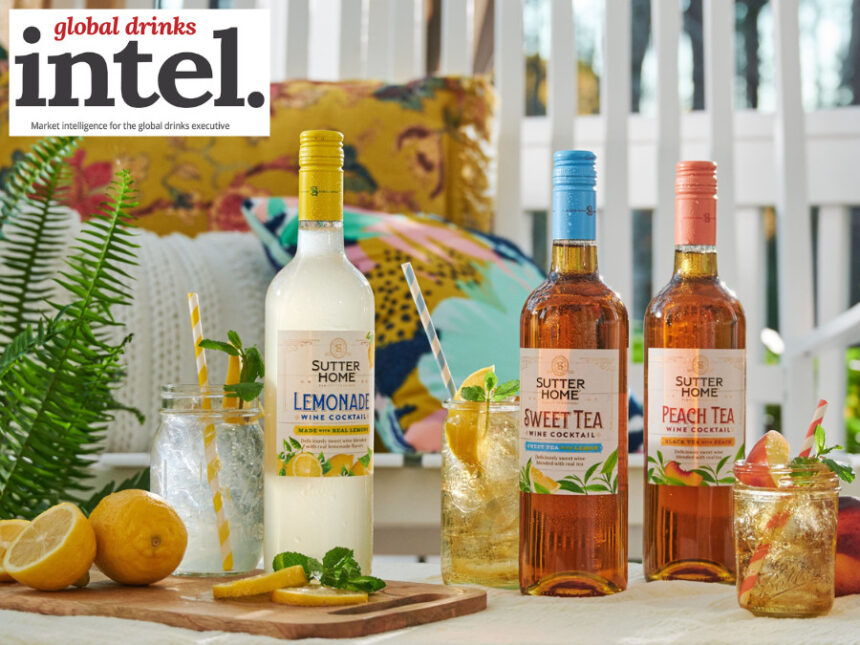
Certainly, the growth levels for new arrivals that get it right can be impressive. Trinchero Family Estates’ Sutter Home Fruit Infusions line, for example, has maintained double-digit value growth every month since it launched in March 2021. Accolade Wine’s Echo Falls Fruit Fusion extension, meanwhile, is worth GBP46m (US$58m) globally a year.
Enticing new consumers with sweeter offerings
Most infused wine producers say their products are aimed at younger, often female drinkers. “For many, it is their first foray into the wine aisle and they’re looking for something with a sweeter taste profile,” says Accolade’s head of brand & digital marketing for EMEA, Peter English.
Castel Frères’ UK & Ireland export director, Alban Lignier, agrees. “Our VeRy range has been a success because it can help younger LDA consumers enter the wine category,” he says. “It makes the wine easier to understand – even in France!”
Lower ABV offsetting higher sugar levels for fruit infusions
Sweetness is a common thread since it makes aromatised wine approachable to inexperienced drinkers who struggle with ‘difficult’ elements such as dryness or acidity. While having a high sugar level doesn’t tick too many healthy lifestyle boxes, this can be offset to an extent by lower alcohol levels. Certainly, for older drinkers, a 6% flavoured wine can seem like a healthy option compared to a 14% Shiraz or a gin & tonic, particularly if the drink is lengthened further with a mixer.
Diva di Sera, a recently-launched two-SKU brand from Italian producer Perlino, puts health and quality of sourcing at the heart of its pitch, even adding an element of regionality. Its white and red expressions are made by infusing Moscato with mango and cherry, respectively.
Perlino is proud of the authenticity of its natural fruit flavourings – nothing artificial is added and the company sources the mango it uses from India. This makes the wines not just easy to drink and low in alcohol, but also natural, while also providing wine-like provenance cues. This could be a strong combination for younger drinkers who want a reassuringly natural product from ‘somewhere’ rather than ‘anywhere’, and for older wine drinkers looking for something lower in alcohol and less formal, but with a wine-like sense of place.
That said, while the lower-alcohol and wine base can pull in traditional wine consumers, for many of these products they are not the target audience.
Drawing in the younger, ethnically-diverse consumer
Yannick Maret of French flavoured-wines website rose-pamplemousse.com says his customers are “not wine lovers. They are people who want aperitifs with different wines and a low degree of alcohol”.
Accolade’s Peter English, however, says that Echo Falls’ (younger LDA) consumers in the UK, the brand’s biggest market, “often serve it in a wine glass and view it as a wine occasion – whether that’s catching up with friends or unwinding in the evening”.
While young women might be the most obvious target market, they’re far from alone, as Trinchero’s marketing director for Sutter Home, Jennifer Hohman, points out. “Early indicators suggest that our Fruit Infusions are reaching younger and more ethnically diverse consumers compared to the average wine shopper”, she says. While 44% of the brand’s flavoured wine consumers are Millennials (aged 21–44), an eyebrow-raising 49% are from a non-white ethnicity, suggesting that the subcategory has the opportunity to talk to groups that don’t usually feel comfortable with traditional wine.
Non-traditional wine consumers demand innovation
The beauty of selling to non-traditional wine drinkers is that they come with few preconceptions. They’re not just open to innovation – they demand it.
“Current buyers of flavoured wine are likely to be the type of shopper who frequently seeks out new things to try,” says Hohmann. “By offering them a steady cadence of new flavoured wine options, we help keep them engaged in the category over a longer period of time.”
Castel Fréres has embraced this more than most, with 11 SKUs in the VeRy range alone. New flavours are being trialled, added and removed all the time.
That said, colour-wise, pink is very much the ‘hue du jour’, particularly in France, where the drinks grew out of the rosé/pamplemousse boom of the 2010s when 20-somethings started mixing rosé with grapefruit syrup. And, rather like traditional rosé, while it would be wrong to describe flavoured wines as specifically seasonal, most producers say the majority of their beverages perform better in the warmer months.
Plugging into the cocktail occasion
An interesting development is the growing use of flavoured wines as a base for cocktails. VeRy teamed up with top French mixologist Christopher Gaglione from Paris cocktail bar Solera, to create a range of high-end recipes for bars and consumers to make at home for six expressions in the range.
Grands Chais de France, meanwhile, has a range of classic pre-made cocktails, created with aromatised wine and CO2, including Pink Fizz, Kir Royale, Bucks Fizz, Mimosa and Bellini.
These are all examples of ways in which wine can claw market share back from categories such as fruit ciders and hard seltzers – and also offer an opportunity for non-Prosecco producers to fight Italy’s ubiquitous sparkler.
Hit and miss flavour alternatives – CBD, ‘medicinal’ herbs and tea
Most aromatised wines, as we’ve seen, use fruit as a flavourant, but there are other flavour-infusing options too. Attempts to blend wine with cannabis extract CBD have been patchy. The latter is a dominant ingredient, and its bitter, earthy and herbal flavour is hard to mix. Some CBD-infused wines are full-strength, while others are alcohol-free. This is a subcategory that hasn’t found its feet yet.
Of equal interest in the sub-0.5% ABV segment is flavouring wine with other functional products, such as ashwagandha or lemon balm, that have beneficial “medicinal” properties, but more mixable flavour profiles. UK producer, Wild Life Botanicals, which claims to infuse its “unique English bubbly with an uplifting elixir of vitamins, minerals and botanicals each chosen for their health-giving properties”, has even patented the slogan ‘Bubbles with Benefits’. It’s a nascent but growing category.
Finally, there are drinks where wine is a junior partner in the blend. Copenhagen Sparkling Tea was founded by Danish sommelier Jacob Kocemba, who was looking to create a gastronomic no/low drink that does the same job as wine.
“They’re mainly for the wine connoisseur who enjoys premium food and beverages,” he says. Kocemba’s creations are elegant and expensive, sold mostly in high-end restaurants and hotels in 40 countries.
It seems, then, that the wine category is moving on from its traditional positioning because it has had to. Whether it is pulling in new consumers or fulfilling different drinking occasions for existing ones, the old red, white or rosé options are no longer enough.
This article was initially published in the February issue of Global Drinks Intel magazine. For details on how to subscribe, click here.