- From Europe to Australia, limoncello is leaving its digestif days behind and finding a permanent footing in the spritz category
- NPD is a key category driver, with all sizes of distilleries getting creative. Extensions include new flavours, creams, zero-alcohol SKUs and RTDs
- Brand owners are starting to look at how they can stand out in an emerging, homogenous category and become synonymous with limoncello as markets mature – although there’s a long way to go, even in Italy
- Despite these ambitions, volumes remain small in beverage alcohol terms, and category awareness needs more work, particularly at the consumer level
When ordering a whisk(e)y at a bar, it’s rare for the consumer not to be asked: ‘Which one?’ Limoncello brand owners are looking for similar recognition for their wares.
The meteoric rise of limoncello from quaint digestif to blockbuster cocktail ingredient has been well documented. Its role in the spritz craze alongside its crowd-pleasing flavour, affordability and charming yellow colour have all led to the category’s popularity peaking in recent years – and brand owners are confident in an upward trajectory.
“The category delivered its strongest growth in 2024, exceeding many initial forecasts,” says Villa Massa global brand director Priti Punjab, citing IWSR data. “Since 2021, when the limoncello spritz trend began to gain traction, the category has sustained a CAGR of around 14%.
“Early indications suggest that 2025 may not have replicated the sharp leap seen in 2024, but the outlook remains positive.”
But as the category takes off as one homogenous Italian export, producers are vying for eyes on their specific brands – looking to hear someone order a ‘brand-name spritz’ rather than a limoncello one.
Are they trying to run before they can walk?
Italy and the spritz
Limoncello’s geographic reach has grown quickly. From a liqueur associated with free shots in Italian restaurants and holidays in Capri, the spirit is fast becoming ubiquitous with the spritz serve worldwide.
Italy is still the largest market for limoncello, accounting for 32% of global volumes – although domestic volumes in 2024 slipped by 2% (IWSR).
Micaela Pallini, the CEO & fifth generation of her family’s namesake company, says Italian consumption of limoncello as a digestif is “fading a little bit” due in part to a rising thirst for bitter liqueur amari, as well as tightened domestic drink-driving laws, which have “created some issues in the after-dinner compartment”.
However, limoncello is booming in the on-premise aperitivo moment. Pallini says the spritz has been “like margarita for tequila”. This cocktail-led growth has helped “bring the bottle inside the bar [and] into the hands of the bartenders”, who experiment with it. “We’re facing a new era of discovery,” Pallini says.
Rossi d’Asiago CEO Nicola Dal Toso says limoncello’s surge in the on-premise “has certainly driven growth”, but highlights that the off-premise “remains a cornerstone of the category and continues to play a vital role in its growth and accessibility”.
As other Aperol-alternative spritzes, such as the elderflower-based hugo spritz, start to grow, are producers concerned that consumers will move on from limoncello?
“Fashion waves come and go, but some drinks stay if they have the right to be there,” says Pallini. She feels limoncello provides something more than just a new flavour for cocktails – adding sweetness and acidity, as well as lemon notes – and believes that on-premise accounts with a limoncello spritz often add other cocktails that feature the liqueur.
“The biggest challenge is a real need to educate consumers that not all limoncellos are created equal,” says Punjabi. “Villa Massa is a ‘Liquore di Limone di Sorrento’, the highest quality classification, made exclusively with 100% PGI lemons from Sorrento. There’s a superior difference – and you can taste it.”
Italy’s Perlino, owner of the Villa Cardea brand, is seeing a shift in purchasing behaviour already, according to marketing manager Elena Branda.
“Premiumisation is clearly impacting the category,” she says. “Consumers are increasingly willing to pay more for limoncello made with superior lemon varieties, authentic Italian provenance and more refined production methods.
“Average prices in the category are rising, and value growth is increasingly driven by higher-end expressions rather than entry-level products. Premiumisation is therefore elevating limoncello from a simple traditional liqueur to a more sophisticated, lifestyle-oriented spirits segment.”
Chance for domestic brands in US
In 2024, the US posted a volumes increase of 3%, making it the third-largest market for limoncello globally (IWSR).
In export terms, the US is obviously murky territory at present and Pallini is putting “fewer expectations” on the country in 2026. “The market is suffering,” she says. “The drinks industry is under a lot of stress. Distributors are being hit hard. So it’s a difficult market, not just because of the tariffs.”
For US brands, however, or those with a unit operating locally, the story is different.
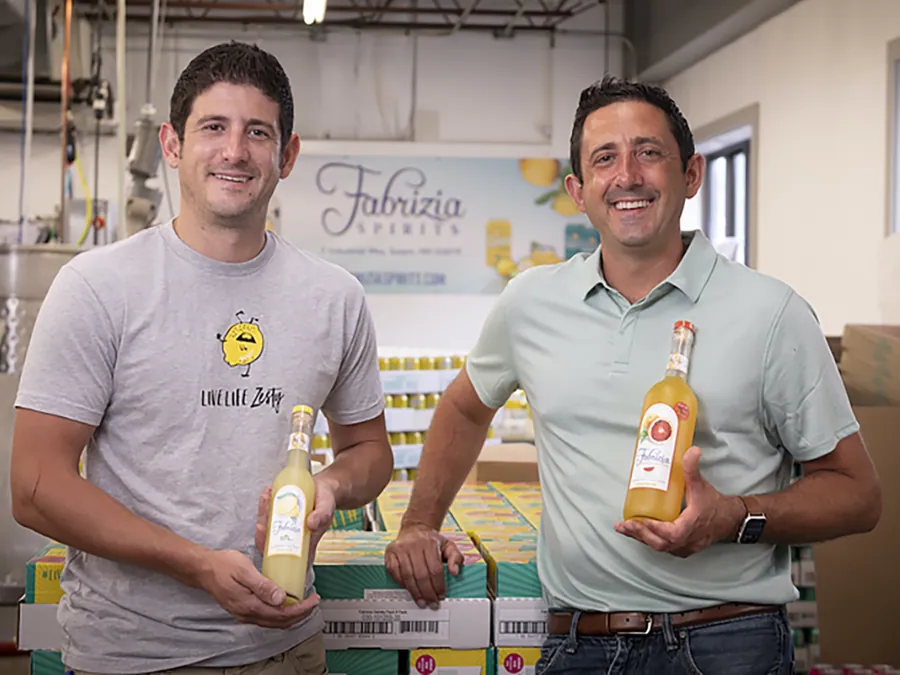
“A major renaissance has happened in the US limoncello category, where it’s completely standard for an Irish pub – or any on-premise establishment – to have a limoncello spritz on their menu,” says Fabrizia Spirits founder Phil Mastroianni (below, right).
When he and his brother Nick created Fabrizia 18 years ago in Boston suburb Salem, the liqueur was barely seen outside of Italian restaurants. Fabrizia’s range is now available in 50% of US states, and accounts include the likes of Walt Disney World Resort.
Mastroianni credits Campari Group with bolstering the spritz movement, but says “the real tipping point” came from Americans seeing limoncello in piazze while on holiday in Italy and wanting to drinks the spirit at home.
Will limoncello soon be replaced with another trend in the US? Mastroianni thinks not. “The flavour profile sticks,” he says. “People who like bitter are going to like Aperol, people who like sweet are going to like limoncello.
“At this moment, I see a prolonged, sustained growth of the limoncello spritz – compared to other things that have come and gone in our spirits industry.”
Moving forward, Mastroianni says differentiating brands in the on-premise is going to be a challenge, because “unfortunately, the word ‘limoncello’ represents everybody’s production”.
“We all have a lot more work to do to get to the point where it’s not just seen as [a generic category]”, he says. But this could be not far off – he projects it could take just five years in the US.
The first step, according to Mastroianni, is to get bartenders and managers on board through strong brand storytelling. Fabrizia has been utilising branded POS, like wine glasses, and encourages its accounts to consider using the word ‘Fabrizia’ on menus.
“These are all pretty standard tactics we all use across any of the categories,” he admits. “Ultimately, it’s going to require the customer to become discerning. That’s where the education is going to be important, through advertising, etc.”
Gaining steam in Latin America
Although the Latin-American appetite for limoncello has been small, Micaela Pallini says the EU-Mercosur trade deal signed in January could open doors. Pallini is developing its distribution in countries including Brazil, Argentina, Mexico and Uruguay. She highlights the potential in Argentina – which is a sizable and established market for Italian liqueur Fernet-Branca.
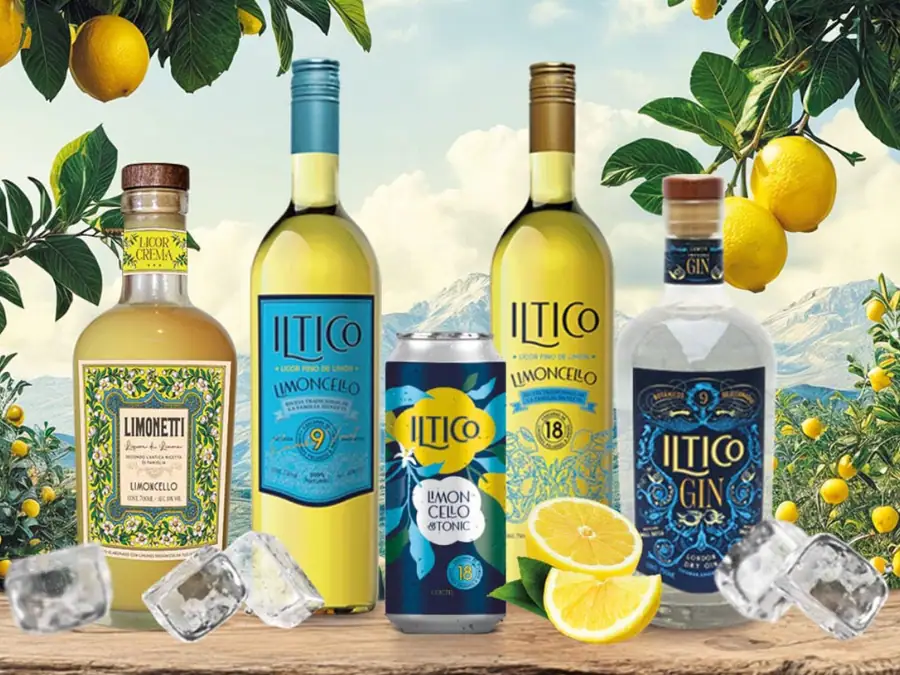
According to the commercial director at Argentina’s Iltico Spirits, Agustín Liendo, the country is moving through a similar transition to others, with limoncello progressing from a chilled digestif after meals to spritzes, dessert pairings and cream serves, as well as an ingredient in gastronomy.
“Over the last few years, we’ve seen strong interest driven by cocktail culture, premiumisation and consumers looking for more authentic, origin-driven products,” he says. “It’s still an education market, but the growth curve is very positive.”
Argentina is one of the world’s largest producers of lemons, and Liendo says around 80% of the crop for its namesake limoncello comes from Tucumán, where Iltico is based. “This gives us a very strong raw-material story and authenticity narrative,” he adds.
So what is demand like in the rest of Latin America? “In most markets, limoncello is still niche but growing,” Liendo says. “Brazil and some Caribbean tourist markets show stronger development, because of hospitality and tourism. Overall, it follows the global trend: consumers moving towards premium, craft and story-driven spirits.”
Liendo says brand differentiation is “one of the biggest category challenges” in the region, as “many venues still treat limoncello as a generic product rather than a branded spirit”.
Iltico’s strategy is “to build brand identity through gastronomy positioning, premium packaging and storytelling, education with bartenders and trade, and expanding consumption occasions beyond digestif”.
‘Australia is made for limoncello’
Like elsewhere, the limoncello category in Australia “has grown significantly over the last three to four years” across all channels, moving from the post-meal occasion to the anytime-of-day spritz serve, according to South Australia’s Ambra Spirits.
“For Ambra specifically, we’ve seen staggering growth,” says MD Finn Healey. “Over the past two years alone, we’ve more than tripled our revenue, which reflects both category momentum and consumers actively seeking out higher-quality, more authentic limoncello.”
It’s a similar growth story in Victoria for Melbourne-based brand Solbevi. Founder Stefan Di Benedetto believes “there isn’t really a market leader” brand in Australia, but Solbevi’s vision “is to sit next to Aperol and Campari in every venue around the world”.
“In venues where we are stocked, most of the time people just ask for Solbevi,” he adds. “In retail stores, people don’t ask for our limoncello spritz, they ask for a Solbevi can, which is exactly what we’re trying to strive for on the global stage. That’s the dream!”
“We absolutely share that ambition,” says Healey at Adelaide-based Ambra. “We’d love to see the day where people walk into a venue and order an Ambra spritz the way they order an Aperol spritz.”
How, then, do you become the brand that is synonymous with limoncello?
“We keep investing in our brand,” says Pallini, who hopes to one day take the word ‘limoncello’ off the brand’s labels, and is aiming for her family name to become synonymous with limoncello by 2030.
“We keep being authentic and not compromising on the quality, and we keep educating all our customers – then you have to just watch us and see how we make it happen!”
This article is available to Global Drinks Intel members only.
Click below for details on how to join the Global Drinks Intel community.
Already a member?
Log in here to read the article in full.
If you work for any of the following corporate subscribers to Global Drinks Intel, head here to activate your access.
- AB InBev
- Bacardi
- Campari Group
- Diageo
- Moët Hennessy
- Pernod Ricard
- Proximo Spirits
- Suntory Global Spirits
- William Grant & Sons