

This article was initially published in the April issue of Global Drinks Intel magazine. For details on how to subscribe click here.
The ever-innovative liqueurs category is responding to the latest drinks trends in exciting ways, with particular attention being paid to consumers’ strengthening appetite for no- & low-alcohol alternatives.
Liqueurs have enjoyed a long stint in the world of alcohol, having been noticeably around since the 13th Century – and that kind of longevity doesn’t come without a willingness to adapt to changing tastes and sensibilities.
Possibly now more than ever, the sector is having to demonstrate its agility as its more traditional serves come up against a movement away from sweet and sticky, high alcohol and glass packaging.
The main liqueur brand owners are responding to the various challenges in innovative and forward-thinking ways, reassessing their ranges, introducing new, sophisticated flavours and updating their packaging options, always with a nod to the generational desires of their consumers.
Low-alcohol tequila creams take share from full-strength shots
As highlighted by IWSR Drinks Market Analysis research director Humphrey Serjeantson, liqueurs plays particularly well to the no/low trend. “This is evidenced in the explosion of interest in low-alcohol tequila creams in Spain, which are taking share from the full-strength shot market due to their lower-alcohol and appealing flavour profile,” he says.
“This is a major trend that started with strawberry expressions and is fast moving towards mango and beyond. Some players are also launching alternatives to their mainstream product. One example is limoncello producer Pallini, which has launched Limonzero, an alcohol-free alternative. Other companies are moving into the non-alcoholic spirits sector entirely: Lucas Bols recently purchased Dutch non-alc spirits brand Fluère.”
De Kuyper also has an eye on no/low, having launched De Kuyper Zero, “four classic cocktails without alcohol, but with the same bold flavours, mouthfeel and kick” in 2021. “Before that,” notes global marketing director Godelief van Erve, “we lowered the alcohol in our De Kuyper Variations liqueurs to have a consistent offer when consumers or bartenders want to use them for mixing their cocktails. We also recommend signature drinks according to the higher demand for drinks with a lower ABV, like the Fizzy Peachtree, a very light, easy-to-mix cocktail.
‘No & low will grow to 30%’ share of cocktail market
“We believe that, long term, the share of no/low within the cocktail category will grow to 30%,” van Erve adds. “Consumption patterns are changing in both at-home and out-of-home occasions. This trend will stay. Liqueurs are generally lower in ABV than spirits and therefore a natural fit to low-ABV serves. We will take the necessary steps to keep following this trend.”
Elsewhere, Giffard, which has a presence in 60 countries, agrees that no & low is an important opportunity and, in March, launched Giffard Alcohol Free, a line inspired by its full-strength liqueurs. “This new range will bring taste and character to cocktail creation thanks to a unique non-alcoholic process of maceration of fruits and plants in vinegar,” says lead marketing director Romain Burgevin.
“The low-ABV trend gives us the opportunity to put the liqueur at the heart of the cocktail, giving it the main role instead of the high-ABV spirit.”
Zamora Co is also shining a light on no & low. Julian Fernandez, global marketing & innovation director for spirits at Zamora, points out: “Some liqueurs, for example Licor 43 and Villa Massa Limoncello and Amaretto, already have a lower ABV than whisky, vodka, rum or tequila. In addition, the explosion of RTDs – particularly in certain geographies – has allowed younger consumers to try new liquids. We see this as an opportunity for our brands that are already consumed in cocktails. As such, we developed a Licor 43 RTD for the Netherlands, Mexico and Germany.”
Flavour NPD appeals to ‘new, younger consumers’
New flavours remain the focus for many, however. Bottega has launched Ginger Bio and Pomegranate in the last two years, while Liviko is also putting its emphasis more on flavours. “At the moment, we don’t see that no & low alcohol is affecting liqueurs,” notes the company’s export marketing specialist, Gloria Hallaste. “It seems they are still new in this market, but definitely will have an impact in the future.”
Liviko is responding to other trends in its approach to staying relevant to new, younger LDA consumers. In 2021, the company created Vana Tallinn Toffee Caramel, while two years earlier it came up with Vana Tallinn Coconut, a vegan-friendly coconut liqueur. “This spring, we are adding new flavours to the liqueur and cream liqueur category,” adds Hallaste. “We are constantly developing new products and testing different flavours. We want to appeal to and attract a more trendy generation.”
Cream-based liqueurs ‘trending strongly’ in the US and Spain
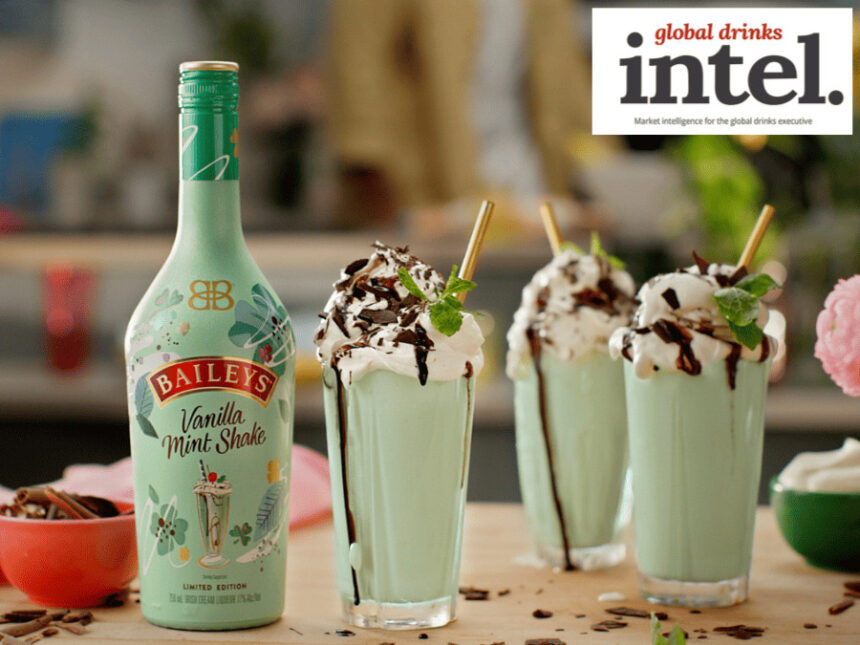
Also generating more interest in liqueurs’ creams sub-segment, which IWSR’s Serjeantson says “are trending strongly in many markets”, is the daddy of that category, Diageo’s Baileys, which in February launched Vanilla Mint Shake, a limited-time offer in North America. According to Baileys’ global brand director, Jennifer English, the extension is “a fun, adult twist on a classic treat, bringing an extra layer of indulgence”.
This was a shrewd move by Diageo, as Serjeantson has pinpointed the US as a particularly important market for creams, with demand outpacing the overall segment. Cream-based liqueurs are also trending strongly in Spain, he says, “as they are affordable, have universal appeal and work well in growing daytime/evening occasions, particularly after meals. We’ve already seen innovations in creams with reduced-sugar versions [for example, Ruavieja Cremosa Light and Baileys Deliciously Light] or non-dairy expressions [Baileys Almande].”
‘Adult-treating strategy’ helping Baileys ditch seasonal restraints
Diageo’s English outlines the Baileys approach to moving the liqueurs segment forward: “Breaking out of confined seasons, occasions and even serves is another challenge that faces the sector,” she says. “A consistent pursuit of an ‘adult-treating strategy’ has allowed Baileys to move from a seasonal brand to one that is enjoyed year-round. This brings its own challenges in ensuring we are reaching consumers throughout the year, but smart connections planning, embracing digital transformation and precision in how we create and serve up content are enabling this ambition.”
To that end, Baileys was an official partner of the Eurovision Song Contest earlier this year. Of course, the Eurovision experience – for which tickets sold out in just 90 minutes – is just one example of how the return of the on-premise has been embraced, but the channel still faces challenges. And some liqueurs brand owners have moved to help out.
On-premise timesavers: RTDs, batched and draft cocktails
“The on-premise channel has been hit by staffing shortages,” says Serjeantson. “As a result, efficiencies have been put in place, such as small-batched and draft cocktails and even RTD products, for time-saving measures.”
De Kuyper certainly stepped up to this challenge, creating batched cocktails for the channel. Van Erve explains: “We developed De Kuyper Batched Cocktails – Espresso Martini, Pornstar Martini, Mojito, Strawberry Mojito and Piña Colada – made with premium De Kuyper Liqueurs. The batched cocktails provide consistent high quality and enable outlets to serve cocktails in a short time for maximum convenience [as they face] post-pandemic challenges like fewer or untrained staff.”
Giffard, too, is committed to helping the on-premise. “We want to add value and take a leading role through educating bartenders about liqueurs and syrups and offering a qualitative and craft product that modernises the way to talk about – and use – liqueurs,” says Burgevin. “A good illustration is the Giffard ‘Tattooed Bartender’ project, which makes the link between the art of flavouring cocktails with Giffard and the art of tattoo illustration in the bartender community.”
Creating products that help the resource-stretched on-premise is a key focus, adds Burgevin. “The retrenching of staff that bars faced pushed them to find good-quality products instead of homemade preps that could be time-consuming,” he explains. “Bartenders are also increasingly using prebatch processes.”
The shuttering of bars and pubs famously led to a huge rise in home bartending and although the on-premise is back up and running, many consumers have retained an at-home interest. Zamora’s Fernandez says: “We’re pleased to see this hasn’t really stopped, but it has simultaneously moved back into the on-trade. Both sectors prioritise high-quality, natural flavours and ingredients above all else.
“Cocktails like the Carajillo in the Americas (equal parts of Licor 43 and espresso coffee over ice, often shaken) or Villa Massa Limoncello Spritz in Central Europe have increased their popularity among both Millennials and Gen X consumers.”
The liqueurs brand owners are certainly keeping up with the times and there’s little doubt that the segment’s modernisation is continuing apace.
This article was initially published in the April issue of Global Drinks Intel magazine. For details on how to subscribe click here.