

Vinasse – or dunder, as it’s known in the Caribbean – is a thick, acidic and nutrient-rich liquid left over after rum production that if not properly managed, can wreak havoc on ecosystems. According to the West Indies Rum & Spirits Producers’ Association (WIRSPA), the by-product poses “the central environmental challenge for cane spirits production”.
The trade body, which launched its inaugural ‘Sustainability in the Caribbean Rum Industry’ report at the end of June, represents rum distillers’ associations across 15 ACP (Africa, Caribbean & Pacific) countries.
“As with spent lees in the whisk(e)y industry, vinasse is produced in very large volumes during distillation and has a high organic load, making it one of the most challenging byproducts to manage,” explains WIRSPA CEO Vaughn Renwick. “If released untreated, it can deplete oxygen in waterways and damage aquatic ecosystems.”
While not confined to Caribbean rum production, Renwick says dunder management is “especially important” in the region, due to “sensitive freshwater resources, fragile coastal ecosystems and limited land for waste disposal” across many Small Island Developing States (SIDS).
From waste stream to resource
Historically, dunder management focused on disposal, including applying the nutrient-dense mixture directly to agricultural land. In recent years, however, the industry’s focus has shifted to treating dunder as more of a resource than merely a waste product.
“The emphasis today is much broader, focusing on recovering value rather than simply disposing of it, but also paying more attention to managing the nutrient content before applying it to fields,” Renwick says.
“Greater awareness has been driven by stronger environmental regulation, advances in treatment technology, climate and water security concerns, and the recognition that circular-economy solutions can deliver both environmental and commercial benefits.”
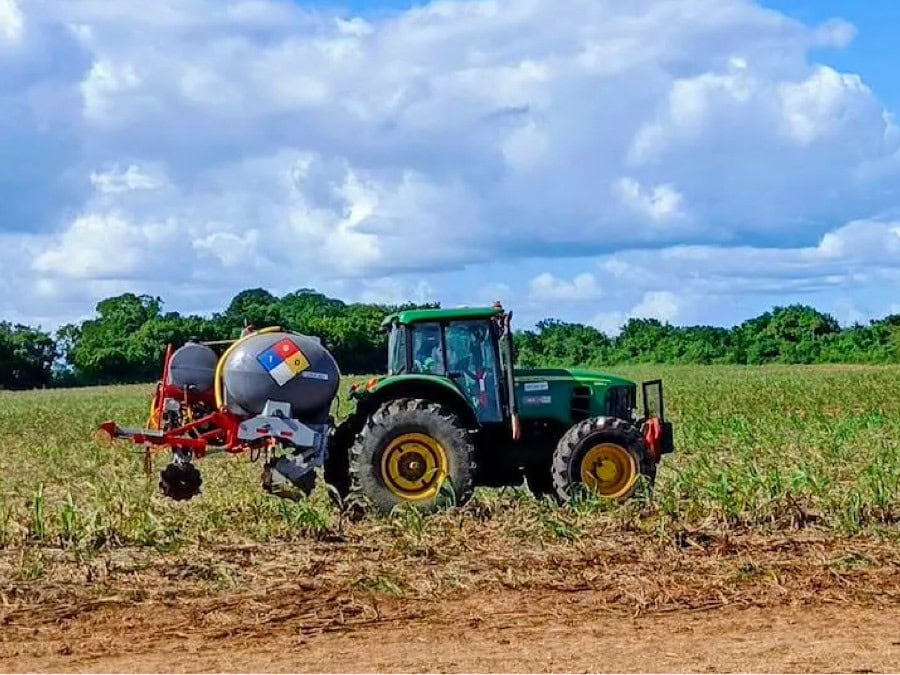
In the Dominican Republic, Edrington has invested “significantly” in a vinasse-concentration facility that produces biofertiliser (being applied by tractor, above) as well as recovering process water for reuse at its Brugal rum distillery.
Brugal began trialling the use of vinasse as a biofertiliser “on a relatively small scale” in 2023, increasing its use each year. The company expects “almost all” the vinasse generated by the distillery this year to be repurposed as biofertiliser.
“Vinasse is rich in organic matter and nutrients such as nitrogen, phosphorus and potassium, which helps to improve soil health and water retention, and enhance crop productivity while reducing reliance on synthetic fertilisers,” explains Brugal’s MD of ultra-premium & strategy, Eileen Livingston.
As well as using treated dunder as fertiliser, some producers have invested in technology to convert the nutrient-dense liquid into gas through a process called ‘anaerobic digestion’. This can then be used to power machinery, thereby reducing any reliance on heavy fuel oil.
Brugal has installed two anaerobic treatment plants, which produce enough biogas to supply “more than 50% of steam demand” at its facilities. Leftover liquid from the process can then also be used as fertiliser.
Elsewhere in the Dominican Republic, Ron Barceló claims to produce “nearly all” of its alcohol from renewable energy generated from a mixture of dunder and bagasse (the solid waste from rum production). Across all of the privately owned company’s plants, 100% of waste is now recycled or “valorised”.
In 2024, Campari Group-owned J Wray & Nephew spent US$65m on a dunder-treatment plant at the New Yarmouth Distillery in Jamaica. The facility produces water that’s used for irrigation and “concentrated molasses solids”, which are used for animal feed.
The move followed the Aperol brand owner’s construction of a $7m dunder-treatment facility at the Appleton Estate factory in St Elizabeth in 2020.

Stronger regulations
From a regulatory standpoint, governing bodies are also wising up to the need for proper dunder management. WIRSPA’s Renwick describes “a clear trend towards stronger environmental oversight of distillery effluent and vinasse management”.
In Jamaica, for example, the National Environment & Planning Agency (NEPA) imposes “strict conditions” on spraying vinasse on agricultural land – such as prohibiting its application during heavy rain to prevent runoff and groundwater contamination.
But the regulatory landscape is by no means uniform across the Caribbean, as Renwick points out. “Many of the large states have well-developed permit systems governing the treatment and land application of vinasse,” he says. “Elsewhere, the approach may rely more on general environmental legislation, or case-by-case approvals rather than detailed, vinasse-specific regulations.”
Moving forward, WIRSPA believes that regenerative loop models will be the shape of things to come.
“As regulatory expectations tighten and resource constraints become more pronounced, circular economy systems are likely to become a defining feature of sustainable rum production,” it concludes in this year’s sustainability report.
“By reframing byproducts as assets rather than liabilities, Caribbean rum producers are strengthening environmental performance while reinforcing the agricultural roots of the industry.”
Members-only intel
Keep reading this members-only article – and every one like it
- ✓All paywalled news and interviews
- ✓Category and market data
- ✓Monthly GDI magazine
- ✓Full archive + daily newsletter
Secure checkout · Cancel any time · Company invoices available
Already a member? Log in
See all plans, incl. 10-reader and corporate
Check if your company already pays for you Your company may already give you free access.
Corporate subscribers: AB InBev, Bacardi, Campari Group, Diageo, Moët Hennessy, Pernod Ricard, Proximo Spirits, Suntory Spirits Group, William Grant and Sons.
Activate company accessNot ready yet? Get the headlines free in our daily newsletter.
Sign up free