

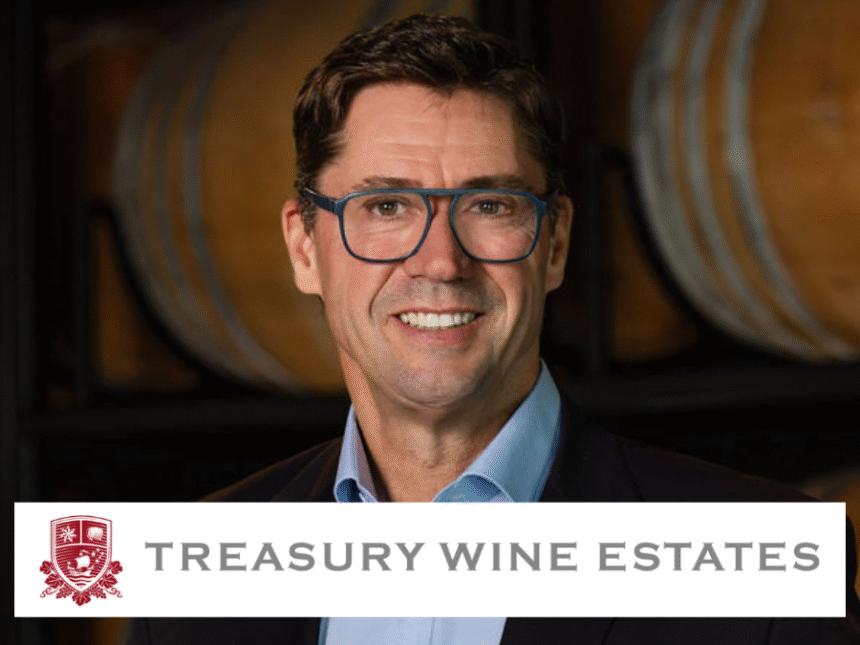
The recently-appointed CEO of Treasury Wine Estates has delivered his prognosis of the group’s condition, coinciding with confirmation of “weaker market trends in the US and China”.
In a pre-scheduled investor call today (17 December), Sam Fischer (above), who took over from Tim Ford at the end of September, shared current performance expectations that factored in “near-term” concerns alongside his own findings. The presentation came two days after Treasury paused its share trading, pendng the update, which comes at the mid-point of fiscal 2026 for the group.
Among the immediate concerns is the moderation of wine consumption generally in the US. Despite having previously stated the impact was being felt most keenly by its lower-value Treasury Collective business unit, the group admitted today that conditions for “luxury wine” in the US have also “moderated in recent months”.
Over in China, meanwhile, this year’s recalibration by the country’s authorities of extravagant consumption curbs has slowed the growth rates for the Penfolds flagship. Consequently, inventory holdings by Chinese customers sit “above optimal levels”.
“Treasury is taking deliberate strategic measures to maintain brand strength and healthy sales channels across key markets,” the company said.
Detailing his view on the group, Fischer, who joined from Kirin Group’s Australasian division, Lion, and previously was a regional president at Diageo, credited a “quality business with strong foundations for sustainable, profitable growth”. At the same time, however, he flagged the need for a “streamlining … of the broader portfolio” alongside greater “precision” around “where we play (in portfolio terms) and why (our) luxury focus is right”.
Elsewhere, Fischer highlighted the existence of what he called a “complex” operating model that displays “points of duplication”.
Following the scene-setting, the company used the call to unveil ‘TWE Ascent’, a three-point programme that Treasury’s medium-term approach. Alongside an evolution of the portfolio to “take account of category, consumer and competitor trends”, the group will also “transform” its operating model. Finally, an optimisation of operating costs, which includes the removal of duplication at operational level, should “release material cost benefits to reinvest in growth, mitigate impacts of portfolio rationalisation or drive margin”.
Back in February, Ford, who had been CEO since mid-2020, confirmed the abandonment of plans to divest of the lower-value portfolio after “offers received for these brands did not represent compelling value”. Four months later, a redraw of the organisational structure resulted in the creation of the Treasury Collective, a business unit that sits alongside Penfolds and Treasury Americas.