

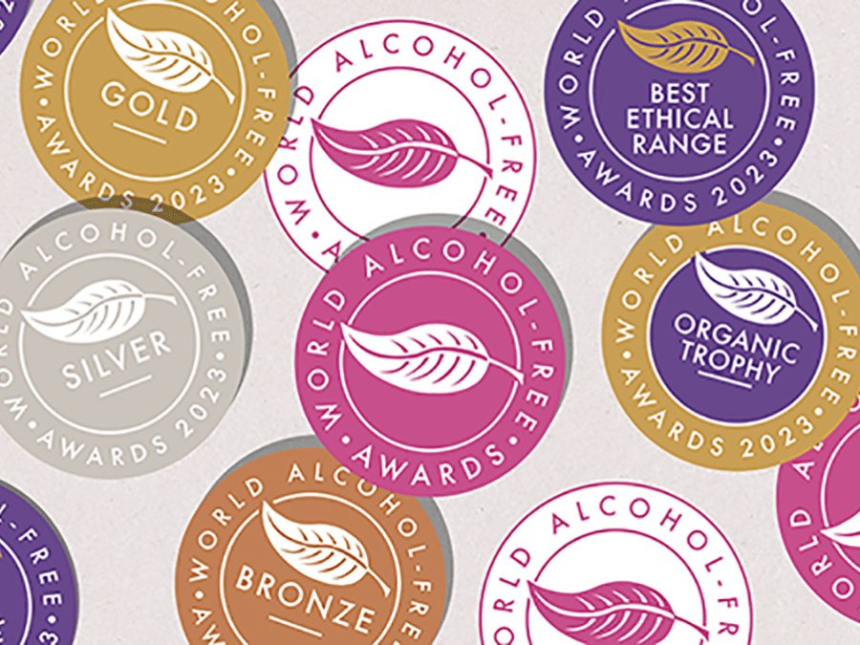
Last year saw the launch of the annual World Alcohol-Free Awards, highlighting the best products in the 0%-to-0.5% ABV beverage segment. With the window now open for entries to this year’s awards, founders Christine Parkinson and Chris Losh share their thoughts on this highest profile of areas in the beverage alcohol industry.

Global Drinks Intel: What prompted the creation of the World Alcohol-Free Awards?
Chris Losh: In 2022, I was sitting on panels with people from across the wine trade at the London Wine Fair. At the end of each panel, I asked them what trends they’re seeing for the next two or three years. I expected them to talk about prosecco, rosé, Greek whites, whatever.
Independently of each other, every single one of them said the same thing, which was no- & low-alcohol. What became very clear was that they didn’t know much about it – They knew it was a coming trend and that the public was interested in it, but their knowledge was not that good. I thought that what was required was something that gave them the ability to pick with knowledge and confidence.
I spoke to Christine, who’s been working in this field for a lot longer than I have, and discovered there wasn’t a competition that covers just alcohol-free. It seemed that the time was right for something that’s completely focused and judged by genuine experts, so the results carry weight both in the trade as well as with consumers.
GDI: What surprised you from last year’s entries?
Christine Parkinson: We’re certainly still in the early stages of this as a category, so you’ve got lots of brands that are reformulating on an annual basis. There was a definite sense of an upward trajectory of quality. It was also obvious that there was a gap between brands that hadn’t sorted themselves out and those that had recalibrated and reformulated. It was that dynamic aspect that really came home.
Another thing was, how ever broad we thought the range of drinks would be, it turned out to be broader. Last year, we started with around seven main categories, then within that, there’d be a sub-category and then sub-categories for each sub-category. It’s constantly going to be evolving as it goes, because people are always experimenting. That’s what makes it such an exciting category.
Before we started, we weren’t sure what the overall standard would be like, but it was much better than we expected – and consistently better. That’s the sign of a category that’s starting to find its feet.
GDI: How do you square a notoriously traditional industry like beverage alcohol with a trend that appears to be consumer-led?
CL: There are two parallels here: You’ve got alcohol brands that are launching alcohol-free line extensions, and then you’ve got the segment equivalent of craft breweries that are creating alcohol-free products from a vision in their heads of something they want to make that doesn’t have an alcoholic equivalent.
For the most part, the big alcohol brand owners are the ones getting the listings. What we’re hoping to see is that they don’t smother the smaller brands, which are very creative and often really interesting. You want to see them opening the door and then these guys coming in behind them, resulting in a really exciting category that has both big brands and quirky, artisanal producers all playing in the same field.
GDI: But they’re not making more shelf space.
CL: The challenge hasn’t been in the production or even in the consumer demand, it’s in getting it through the gatekeepers.
Here in the UK, multiple retailer Asda has been running a ten-week gondola end from mid-November to the end of January of alcohol-free products. That’s a big statement. That’s the kind of thing where, if it goes well, other retailers will pick up on it.
Retailers tend to be quite cautious – If something’s more or less working, they tend to be reluctant to change. But, the number of consumers who are keen to experiment with alcohol-free – or at least cut down their alcohol consumption – is compelling. That hasn’t been realised in mass retail yet, even to an extent in the on-trade.
There’s a long way to go and we’re at the start of it. In, say, two years time, this could look like quite a different landscape.
GDI: Is alcohol-free at the stage where it can draw up an ideal consumer profile yet?
CL: If we were talking ten years ago, it would have been about people who were not drinking alcohol ever. That’s shifted – The majority of category growth is going to come from people who drink alcohol but want to cut down. These products allow consumers to do that without defaulting to Coca-Cola, for example.
It covers a wider range of consumers than alcohol does. It’s easy to get caught in the hype surrounding alcohol-free because there are a lot of bullish statements, but a good deal of that is justified when you look at the potential. Alcohol-free changes the narrative quite significantly.
CP: The vast majority of producers of these drinks haven’t yet got their head around how to approach consumers who’ve never drunk alcohol and therefore don’t relate to things like provenance cues. There’s a huge area that’s still virgin territory.
GDI: Who’s marketing and positioning alcohol-free well?
CL: I think Diageo have done a really good job with Guinness 0.0. Pitching it in amongst [the Guinness sponsorship of rugby’s] Six Nations last year was quite shrewd. Then, there’s Asahi’s sponsorship of [English soccer team] Manchester City with Asahi Super Dry 0.0%. Positioning the extension in that kind of environment and normalising it works well. You could almost miss it, but you don’t – they’re not making a big deal of it.
CP: What was prevalent in the early days was big wine producers deciding they needed something non-alcoholic, but not putting their own name on it. We’re now seeing brand owners put the brand name front and centre and they’re not afraid to do so.
GDI: Is the alcohol-free segment doing itself a disservice by pitching its price at the equivalent of the full-alcohol version?
CP: You have to ask the question about why it should be priced differently. If the assumption is that the only valuable part of an alcoholic drink is the alcohol, then it would be fair to say that non-alc is doing itself a disservice. But if you accept that there is value in the terroir, or ingredients, or the brewer or winemaker or distiller’s skill, then absolutely not.
Besides, the majority of non-alc drinks cost more to produce than alcoholic drinks. In wine, or with certain types of beer, you have to make the alcoholic version first, and then throw away 10% of it using expensive equipment and techniques. If you’re making an alcohol-free spirit, you have to develop the same flavour intensity using botanicals steeped in water rather than alcohol, which draws out much more of the flavour compounds than water.
You have to put context with that. The communication – and education – is perhaps where that disservice is being done.
CL: There’s a guy in Oregon who opened a cellar door for his distillery. He says it’s the best thing he’s done, because people come in and learn how it’s made. They’d thought you start with water and add a bit of flavouring, but this is an artisanal distillery that happens not to be making an alcoholic product.
I suppose a lot of people just think if it’s alcohol, it must be expensive, and if it’s not alcoholic, it should be as cheap as Pepsi, which is clearly madness. These are serious, adult drinks in the same way that, say, bourbon is.
Entries for this year’s World Alcohol-Free Awards must be submitted by 9 February. Head here for more details.
Preparing for 2024 – The beverage alcohol consumer trends – Consumer Intel