

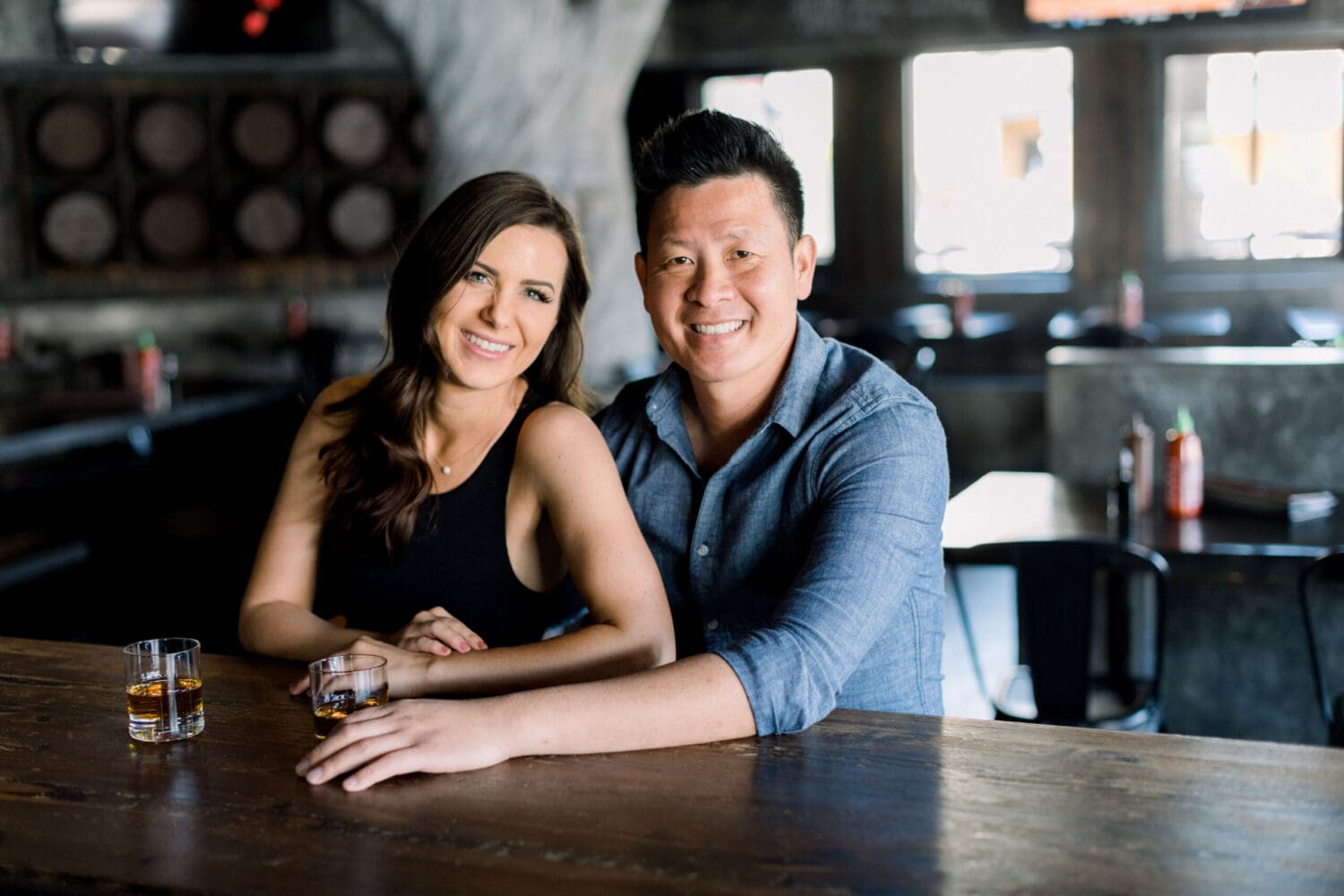
Brittany and Steve Yeng, the founders of Skrewball Peanut Butter Whiskey, discuss the rapid ascent of their brand with Global Drinks Intel’s Alex Oldroyd
Steve and Brittany Yeng have had a whirlwind three years in which they brought two children and a highly successful spirits brand into the world, while also navigating the turmoil of the Covid-19 pandemic. The adventure continues with preparations for the next phase of the development of their Skrewball Peanut Butter Whiskey, restoring its on-premise sales in the US and beginning its international expansion.
Their story is one of managed chaos as they overcame an array of different hurdles, coupled with exponential growth in demand, while all the time being on a steep personal learning curve about both the drinks industry and the people around them. They were no strangers to uncertainty and making choices out of necessity, though. Steve spent his early years in a Thai refugee camp where his family had fled from the genocide in Cambodia. He contracted polio when he was one, which paralysed his right leg. It was a tough existence, including “literally standing in line for food, standing in line for water”. Steve learned English from charity workers. “I have really fond memories of those guys who tried to help us out,” he says. This goodwill culminated in the kindness of an American family who sponsored Steve’s family to move to San Diego — and, in their quest to nourish him, introduced one skinny little boy to peanut butter.
‘We’re most happy together’
Brittany met Steve at elementary school and they started dating in high school. She went on to earn an undergraduate degree in biochemistry, a masters in chemistry and then a law degree, leading to a job in pharmaceutical patent litigation. Whiskey may not have been top of mind when she set out on that pathway, but it turned out to be a useful combination for setting up a whiskey business. Meanwhile, Steve and his brother opened a restaurant with something of a peanut butter theme, serving “peanut butter and fried rice, peanut butter and sake, peanut butter and wings”. It was successful and expanded to two more venues. Steve became known as the Peanut Butter Guy, but there was one particular item that stood out. “I was taking real peanut butter, mixing it with whiskey and I noticed how, gosh, there were days when the three venues would sell $10,000 in shots in one day,” he says.

With the seed of the idea sown, a change in family circumstance pushed them to start the brand. Their first child arrived and they realised that they were really just passing each other by in the early morning as Steve arrived home from the restaurant and Brittany headed out to work to deal with East Coast clients. She had enjoyed their time building up the restaurants and wanted to do something like that again. “You’re hyper-focused on building something and we really wanted to come together to do that again,” Brittany says. “When I was helping Steve with the restaurants, you know, there’s a special connection, marrying your business partner and being able to wholly understand what the other person’s going through and support them.” Steve adds: “We’re most happy when we’re together, so she quit her career and we tried to bottle peanut butter whiskey. I thought, you know, it can’t be that hard; you just take some real peanut butter, get some whiskey, put it in a jar and slap a label on it — it turns out that peanut butter is the single hardest ingredient to ever recreate.”
Doors were slamming
Brittany says her father’s reaction when she gave up her law firm job was extremely supportive, but she “could see the fear in his eyes”. So began a very difficult period in their lives. Steve says: “There were many sleepless nights. I think I aged, what? I don’t know, at least 28 years in the last three. There are fun times, but some of the most miserable times too.”
Skrewball was always self-funded and there were times in the early days when they struggled for cash; they were always overdrawn, their electricity was turned off and they lived paycheck to paycheck. Part of the reason they were self-funded was that people didn’t want to invest because it was hard to really believe in peanut butter whiskey as a potentially successful concept. Once they’d proved the concept, they were able to generate cash to fund the business even though raising investment would have been easy at that stage. Steve says ironically of the people who were sceptics at the start “after we took off, they’d be like, ‘Oh, here you go, I’d like to invest now’,” likening them to people who talk a good story about Bitcoin but never bought in.
Peanut butter combines sweet, savoury and salty flavours with a creamy complex texture that is hard to replicate. Real peanuts create issues with separation and filtration when they’re mixed into a liquid. Steve and Brittany tried a number of R&D specialists to help develop the liquid. Some didn’t call back and the ones that did said they couldn’t do something like that, pointing out that peanut extract and, even peanut protein bars, really taste nothing like peanut butter, so it was unlikely their product ever would. With every door shutting on them, Brittany decided to have a crack at it herself, drawing on her chemistry degree to experiment in the garage behind their kitchen.
Having created the liquid, they ran into more closed doors. First of all, there were the suppliers. Steve says: ‘There were times when I had big decisions to make, with glass or other production stuff that was crucial for our business, and suppliers wouldn’t even return our calls.” They appreciate that suppliers operate a model that requires scale, but they were shocked that they struggled even to get into a conversation to buy things like labels, packs, bottles and cartons. One supplier that sticks in their minds said they could supply the product in question and made an appointment to discuss their requirements. However, when they flew to the meeting, they were left standing in the lobby disappointed and then spent their daughter’s first Thanksgiving scrambling for an alternative.
At the outset, the Yengs had their own distillery which enabled them to perfect the formula and blending. The early days entailed turning their hands to everything from forklift driving to shrink wrapping. Now they outsource, but even that was tricky. Brittany jokes: “People thought we were ruining their whiskey, while others thought we were ruining their peanut butter.”
Once they managed to get suppliers lined up, the Yengs looked for a designer to help with some of the creative aspects. One was sympathetic but asked them: “You seem like a really nice couple and this is such a tough industry, are you sure you want to leave your career to do this?” Steve says: “It’s a nine out of 10 fail rate in the liquor industry in general, but we have a freaking peanut butter whiskey on top of that and no one really believed in us.”
Again, Brittany stepped up, taking on design duties. Skrewball as a concept is the misfit, the black sheep. The label design combines the top of a peanut butter swirl with liquor dripping on it to form a black sheep surrounded by a sea of white (sheep). Explaining the black sheep, Steve says: “When you’re the black sheep, you’re supposed to be hiding in the corner. Instead, you’re standing front and centre, leading the pack and you’re proud to be a black sheep, proud to think for yourself, proud to stand for what’s right. So, essentially, everyone has a Skrewball in them.”
‘Once-in-a-generation’ brand
This philosophy is reflected by Skrewball’s employees, ‘the Krew’, which Steve characterises as a group of black sheep who share the same beliefs. The original group of four employees were people who enjoyed life and were the right kind of mavericks to form the heart of Skrewball culture. They had all previously worked in Steve’s restaurants as bartenders, but none of them had any direct experience with spirits brands.
Distribution initially presented further closed doors, so the Yengs went out selling the whiskey themselves, Brittany often with her daughter in a baby carrier. Steve and his brother were well regarded in the local restaurant community and they got some local listings very quickly. Skrewball was selling well enough in those accounts to get noticed by Vern Underwood and his son Chris, owners of Infinium Spirits and of the large California distributor Young’s Market, since merged with the even-larger RNDC. Vern clocked Skrewball’s potential instantly, seeing straight through the apparently unusual flavour combination to the undeniable consumer reaction. Steve believes Vern saw a holistic picture of the brand, how people fell in love with the brand and the product itself, and also liked the fact there were real people behind it.
Vern’s interest in the Yengs was personal and they speak of him with awe and gratitude. Steve says: “They were legends in the industry and so, you know, he’s like, ‘Hey, this type of brand would maybe come around once in a generation’ and we’re like, ‘Are you on medication?’” When Vern stepped in to help them, he told them: “I come into work every day at my age because I get to make someone’s dream come true.”
Once the Yengs came under the Underwoods’ wings, Skrewball really took off. High-profile press coverage generated inbound inquiries from on-premise accounts wanting to stock the brand and it flew off the shelves. The Yengs signed with Infinium as their third-party distributor, getting much-needed access to operational advice, contacts and a national salesforce.
Skrewball’s arrival came at a time when Infinium had lost some independent brands that had reached scale and gone on to partner with multinationals. This meant the Yengs’ first presentation to the national salesforce was something of a challenge — not only because it was the first time doing something like this for the Yengs, who were used to working with a team of four, but also because the salesforce was under a slight cloud of disappointment and a little harder to engage.
Steve pulled a couple of amusing stunts to present his brand’s image of fun and backed it up with the full story behind the brand and what peanut butter meant to him. The salesforce left that meeting believing in the brand, they got behind it and Skrewball became the most successful brand launch in the history of US spirits (at that point in time). Steve says: “I think we were the fastest to 250,000 nine-litre cases ever for a premium product and we were the fastest to half a million cases.” Skrewball’s price point is $28-$30 at retail.
One factor contributing to Skewball’s rapid growth was the decision to launch nationally, getting into 50 states in six months. This is unusual for an independent brand, but it was a conscious decision driven by the need to stay ahead of any potential competition. Brittany says: “Usually you would want to expand in your own market and expand very slowly, but there was pressure, there was something to this that we didn’t want to be copied.” As it turns out, there have been copies — there are around 45 peanut butter-flavoured products on the market, some even with sheep on the logo and most using artificial flavouring. The Yengs say they are gratified that Skrewball regularly wins blind tasting tests, while the brand itself stands for something people can identify with. In the meantime, they have patent protection for their peanut processing techniques.

Steve continues: “We were hoping to be the fastest to a million cases; we were getting such a momentum — that’s when Covid-19 hit.” Brittany explains: “The on-premise was a huge part of our business. A lot of brands, especially something like ours, you have to taste it to believe it. At a bar, it’s people paying for their own sampling, so that was a huge play for us.” The brand has very broad appeal across demographics and its combination of flavours makes it versatile with food or with other liquids, both sweet and savoury. Some combinations throw back to more traditional snacks like the peanut-butter-and-jelly sandwich that many American kids grow up with, while ingredients like ginger and lime riff on popular Asian cuisines. While mixologists often don’t like to use flavoured products, preferring to create the flavour themselves, peanut butter is quite difficult to work with (as the Yengs discovered), so they have embraced Skrewball.
As for many other brands, Covid-19 forced a pivot to the off-premise. While that wasn’t sufficient to sustain Skrewball’s pre-Covid-19 momentum, it has not been blown too far off track; the brand recently passed the million-case annual sales mark, expanded into Canada and became the official partner of the Buffalo Bills NFL team. Meanwhile, the opportunity in the on-premise is returning now. Brittany says: “We started in the on-premise, so now the on-premise is opening up again, the biggest upside is going back to our roots and really building that platform.”
Pay-it-forward philosophy
When Covid-19 hit last year, it was important to the Yengs to remember that their journey started in a restaurant. Brittany says: “While we’re, from a business side, looking at the off-premise, we made sure our team was still focused on giving back to the on-premise.” Steve adds: “When Covid happened, everyone was out of a job, so Brittany and I emptied our bank account, we donated half a million dollars right away to the service industry.” But it wasn’t just about cash, it was also about sourcing where they had better access. Steve says: “We were putting care packages together at our house and handing them out.”
The Yengs soon realised they felt a need to help mitigate the overwhelming sadness surrounding the pandemic, so they built the ‘sheep wagon’ and Steve and the Krew drove across America to visit charities in 40 states, donating everything from hand sanitiser to basketballs. More recently, they have been working with Women of the Vine & Spirits, an organisation dedicated to pushing the wine, beer and spirits industry toward a more diverse, equitable and inclusive era. Brittany helped the organisation’s CEO Deborah Brenner launch Badass Bartenders, a community for female bartenders to help with a variety of career progression challenges.
The Skrewball brand is about fun, says Brittany, but the Yengs want to promote these broader issues on a personal level. At the heart of this is their own background which has ingrained in them a natural philosophy to give something back. Brittany sums it up: “Everyone that has helped us the most has never asked for anything in return. A lot of our success has been taking these gifts and passing it on, you know, paying it forward.”
With the momentum now rebuilding behind the brand, it might seem natural that it could outgrow its founders and they might look to sell it. Brittany makes it clear that Skrewball is “not for sale right now”, with Steve quickly adding, “and I don’t think it’s ever going to be”. There are plenty reasons for this, not least that they are still having fun, they’d rather be their own boss and see themselves as integral to the brand. They have built out the administrative infrastructure to support the business as it grows, bringing in Carl Carlson, a veteran of Young’s Market and Infinium, as CEO at the beginning of 2020. Prior to that, Brittany had been managing the corporate side of the business. She still handles operational work from contract negotiation to marketing and innovation, while Steve takes on various sales aspects, working with the national accounts and sales teams. Carl overlays his industry experience and connections, manages the distributor relationships and works with the Yengs to develop the team. Steve describes Carl as a coach who has really helped raise the skill set of the team.
The brand has been a great success, but Steve says there have been “many, many mistakes” along the way. “I wish I had a mentor, someone to help and guide us” at the outset, says Steve. However, Brittany says they’ve embraced the failures and never allowed a mistake to make them too afraid to pursue the next move.
The journey has taught the Yengs a lot about the people around them and, while they are critical of those who slammed doors in their faces, they are very grateful to those who helped and supported them, starting with family. Brittany’s mother in particular has played a vital role in enabling them to manage a fast-expanding brand alongside a fast-expanding family. Brittany puts the last three years in perspective: “I’ve seen the very best in people and the very worst in people and it has been an incredible experience because of that. It’s those opposites, in seeing the worst in people that you appreciate the good things — like when we first met Vern. Now that was incredible.”
Alex Oldroyd is managing director of Fluxion Advisors, which provides strategic advice, primarily around M&A, to drinks companies. Prior to that, she spent five years in investment banking, having spent most of her career in equity research during which time she was regularly rated the number one drinks analyst.