Global Drinks Intel: What excites you in beer, given your level of familiarity with the category?
Michel Doukeris, CEO of Anheuser-Busch InBev: The first thing is that we’ve corrected a narrative, which for whatever reason, had built over the last seven-to-ten years, that the beer industry was not growing or that beer was losing share of throat to other beverages. We did that by collecting all the data from all countries and the data shows that beer is growing globally and is gaining share. The first thing that excites me a lot is that the growth of the category is already there. We know that as we invest, we are able to accelerate this growth and realise the category’s full potential.
The second thing is that we’ve built this global footprint over the years and today we have very strong positions in the places where most of this growth will come from – that’s Latin America, Africa and Asia. Our brands are very well positioned across these markets, so we’re well placed to lead the growth in the industry.
My third point is we have unbelievable brands. I’m biased, but just look at Stella Artois, Corona, Jupiler, Leffe – These brands have very long-term relationships with consumers. As we invest in these brands and as we provide more options for consumers, the growth is there. We’ve been proving this – earlier this year, we announced that we’d achieved an all-time high in (full-year) revenues for the company (US$59.38bn).
The industry is continuing to grow, our leadership advantages are in place and we have the brands to invest in to continue to drive the category and to be an engine for organic growth. We want to be a company that is as well-known for organic growth as it was for inorganic growth.
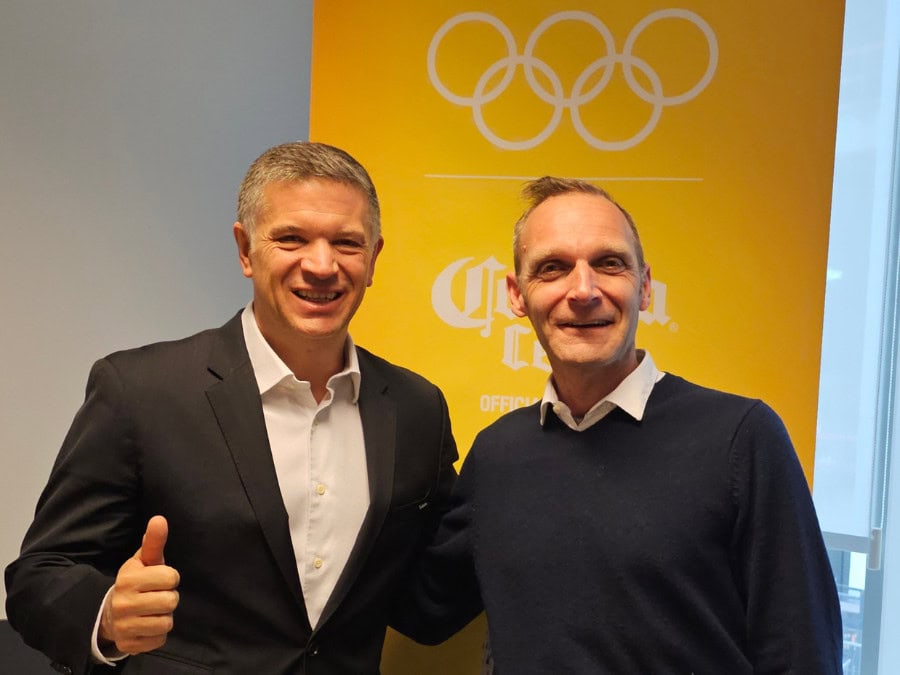
GDI: You recently announced Corona Cero’s sponsorship of the Olympic Games – Is this an indication of a pivot more towards promoting no- and low-alcohol or are your brands’ partnerships with particular sports ring-fenced?
MD: Our brands have what we call centres of gravity. Each brand is more associated with a specific type of sport or audience. The fact that we are doing this with Corona Cero is because it’s a great opportunity. We said we will lead and grow the category and a growing part of it is no-alcohol. Placing a big bet on that by giving visibility to this product and expanding its distribution is a very neat opportunity.
That said, this should not influence the partnership we have for Michelob Ultra with Copa America or for Budweiser with FIFA. The type of consumer and the consumption occasion that FIFA brings talks more to Budweiser. In this case, we thought that Corona Cero will have a very good link with what the Olympic Games are.
Our brands have what we call their swimming lanes and they’ll continue to be in their lanes.
GDI: How comfortable are you with sponsoring an event that only happens every four years?
MD: The Olympics happen every two years if you think about the Summer and the Winter games.
GDI: You’ll be going just as hard on the Winter Olympics with Corona Cero?
MD: Yes. But, this is not the only platform that Corona activates on. A big platform for Corona centres around the beach and outdoor occasions. So, Corona also sponsors the World Surf League, which has events year-round that happen every year.
Corona also recently cut a deal with Tripadvisor. The brand is all about living in the moment, and there are few occasions that are more about living like this than when you’re travelling on vacation. So, this is a year-round partnership. Within the swimming lanes, there are many platforms and The Olympics is just one platform for Corona.
GDI: What advice would you give to other brand owners should their brands experience the same kind of controversy as Bud Light did in the US last year?
MD: I honestly don’t think I’m in any position to give advice to people. I’m a simple person, a beer guy.
GDI: You’re also CEO of the world’s largest brewer.
MD: If anybody ever asks for my advice, then of course I’m there to support them.
We always take a long-term view on everything that we do – this situation was no different. The safety of our people is a very important part of that long-term view. When you think about safety in a situation like the war in Ukraine, that’s their physical safety. The situation in the US was about their welfare – people were concerned about losing their jobs, so we protected the jobs not only of our direct employees but also of our wholesalers. We extended financial support to keep their people employed and work through the period with their minds in the right place.
The long-term view means we continued to invest in our brands, which are the most important assets we have. We didn’t take investment out, we actually increased them so we could keep our brands healthy and interacting directly with consumers.
We also prioritised our partners – we have the NBA, the NFL, Folds of Honor – to make sure that we maintained normalcy and business continuity together with them so we could continue to support the communities where we operate.
Over time, this approach has proved to be very effective. People know who we are, they know what we really stand for and despite crises that happen here and there, and occasional turbulence in the business, in the long term, we continue to be absolutely confident in our capabilities and the brands we have. We’ll continue to invest for the company for the next 100 years.
GDI: Given your level of seniority, and given the size of AB InBev, who do you see as your competition?
MD: (laughs) You know what’s a big competition? The Olympics!
This article is available to Global Drinks Intel members only.
Click below for details on how to join the Global Drinks Intel community.
Already a member?
Log in here to read the article in full.
If you work for any of the following corporate subscribers to Global Drinks Intel, head here to activate your access.
- AB InBev
- Bacardi
- Campari Group
- Diageo
- Moët Hennessy
- Pernod Ricard
- Proximo Spirits
- Suntory Global Spirits
- William Grant & Sons