

Global Drinks Intel: When did you start with Anheuser-Busch InBev?
Michel Doukeris, CEO of Anheuser-Busch InBev: This is going to be a memory exercise! I joined AmBev in 1996, through a trainee programme selection process. My first job was in an area called planning intelligence and marketing. Like analysts, I crushed data and produced reports in regional planning and marketing in Curitiba in the south of Brazil.
GDI: Did you ever get to play the drums at the morning meetings of the on-the-road sales team?
MD: At one point in time, I was the company’s longest-serving manager of what we called the direct distribution operation! My wife used to love that I was working from 06:30 to 19:00 or 20:00, Monday to Friday, and from 06:30 to 17:00 on Saturdays. I did that for around ten years.
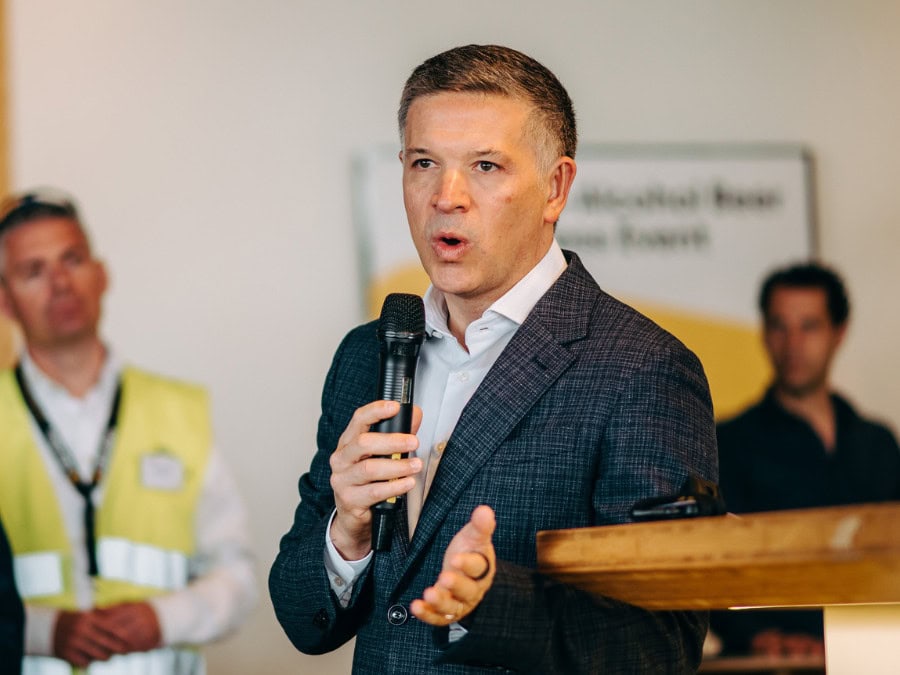
GDI: Fast forward to 2021, when you took over as CEO from your compatriot, Carlos Brito, who’d been in post for 13 years. How would you describe your chapter?
MD: If you oversimplify, you think about (Brito’s tenure as) a period in which we grew very fast globally through acquisitions. There was a series of mergers and acquisitions that happened, first with Interbrew (with whom AmBev merged in 2004 to form InBev), then with Anheuser-Busch (in mid-2008), then with Grupo Modelo (in 2012) and then with SABMiller (in 2016). These allowed us to create the incredible global footprint and the company that we have today. That was one phase that you can associate with Brito in a way, because he was there at the time.
The chapter we need to build now – and we share this with our investors – is from inorganic to organic growth. We already have a very large footprint; now we need to maximise it to allow the beer category to grow at the pace and with the vitality that we know the category has. We also need to make sure we take advantage of this ecosystem that we’ve built and find some other ways to monetise it – this is very important for us in the way we’re digitalising the company.
Then, of course, it’s a never-ending exercise in optimising the business so we can have the best outcomes.
To deliver organic growth, we want to grow the category, digitise our entire ecosystem and always optimise our business, which is part of our DNA.
GDI: How close do you feel to what’s happening ‘on the ground’ in beer?
MD: This depends on how each person reacts but through the years, I’ve always introduced myself in the same way: The first thing people need to know about me is that I’m a beer guy. It’s a happy coincidence, maybe even a little bit of destiny, that I work in beer.
Since forever, the beverage that I’ve liked the most has been beer. It doesn’t matter whether it was on the first day I joined the company as an analyst or now as CEO, if I have free time or friends visiting at home, our fridge gives up beer because that’s what I drink.
People sometimes look at me and wonder if what I’m saying is for real, but I drink beer every day and always have done. That doesn’t mean I drink ten beers a day – a lot of times, I drink no-alcohol beer. It’s because of this that I’m always watching everything that’s happening with beer.
I’ll give you an example – I met a friend who I hadn’t seen for a long time yesterday, in a restaurant. I couldn’t stop looking at the other tables, particularly at a couple who ordered Stella Artois 0% and then moved on to Leffe Blonde 0,0%.
My wife tells a story about when we went shopping for groceries one Saturday – I would always drive and carry the groceries. While she was choosing the groceries, I was in the beer aisle, watching the customers and replenishing the shelves. My kids have photos of when they were four or five years old, having part of their weekend fun replenishing beer on shelves.
Unfortunately, on this particular Saturday, my wife was robbed in the supermarket. For years after, she would say to me: “You were there with the beers and I was alone when they robbed my wallet.”
I’ve always been watching what’s happening. When I’m with my family, I’m with my family, when I’m doing sport, I’m doing sport and when I’m working, I’m working. But when by any means I see a beer consumer, a beer truck or a beer aisle, I can’t take my eyes off them – it’s the way I’ve been conditioned.