The onboard beverage market has become a major draw for brand owners, cruise line operators and, more recently, leading domestic cocktail bars looking to broaden their reach internationally. According to the latest Cruise Food & Beverage Trends Report by trade website Seatrade, the food and beverage sector onboard the world’s top six cruise lines is now worth more than US$2bn annually.
This figure is only likely to grow as the wider cruise ship business puts the disruption of the Covid-19 pandemic era behind it and sails full-steam ahead. Last year, about 31.7m people took a cruise holiday – an increase of 7% versus 2022, according to industry body the Cruise Lines International Association (CLIA).
The growing appeal of cruise holidays
Over the next four years, industry capacity, a key metric, is forecast to grow by 10%, with 36 new ships scheduled to come into service over the same period. Seven new vessels are making their maiden voyages in 2024 alone, including Princess Cruises’ Sun Princess, Cunard Line’s Queen Anne and Royal Caribbean’s Utopia of the Seas.
Crucially, cruise holidays are no longer the preserve of older travellers. According to CLIA’s research, 36% of cruisers are now aged under 40 and Millennial generation is the most interested in taking a cruise vacation.
To capitalise, cruise lines are ditching their stuffy image, offering shorter cruises, focusing on delivering experiences rather than itineraries, and investing in more upmarket F&B outlets. Higher-end bars are a huge part of this industry drive to appeal to younger holidaymakers, with tiered beverage packages typically sold to guests when they book.
In recent years, cruise ship bars have undergone a remarkable transformation, evolving from simple, utilitarian spaces into sophisticated, immersive experiences. A combination of factors, not least increased passenger expectations, but also advancements in design and technology, and a growing emphasis on culinary excellence, have driven this evolution.
The evolution of the cruise ship bar
Gone are the days of cramped, dimly lit bars serving only basic cocktails. Today, cruise ship bars often boast breathtaking views, innovative décor and a wide range of speciality drinks. Some of the more impressive examples include rooftop bars with panoramic vistas, underwater lounges with floor-to-ceiling windows, and themed bars inspired by everything from classic literature to exotic locales.
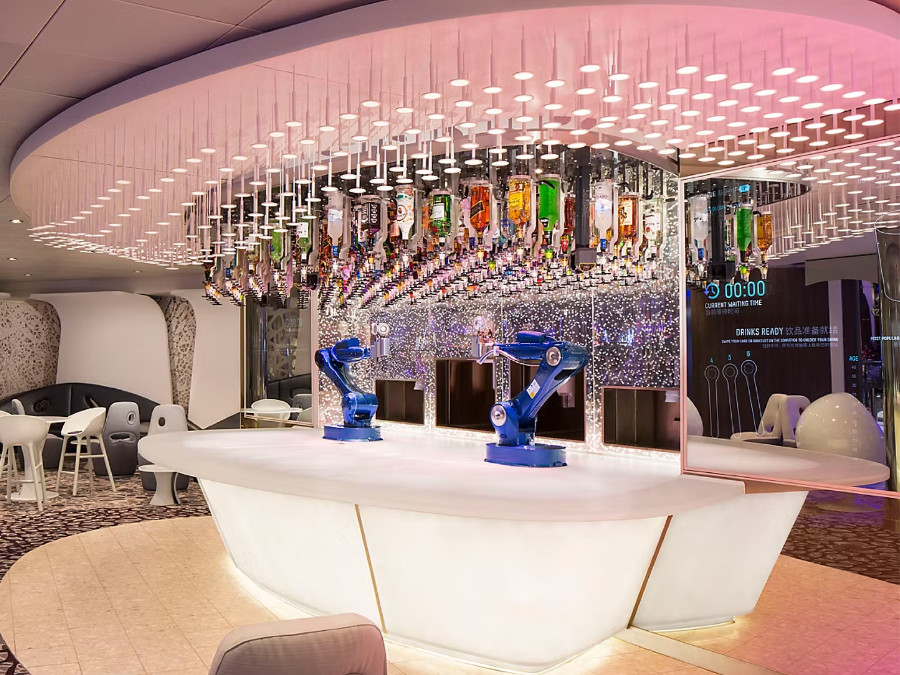
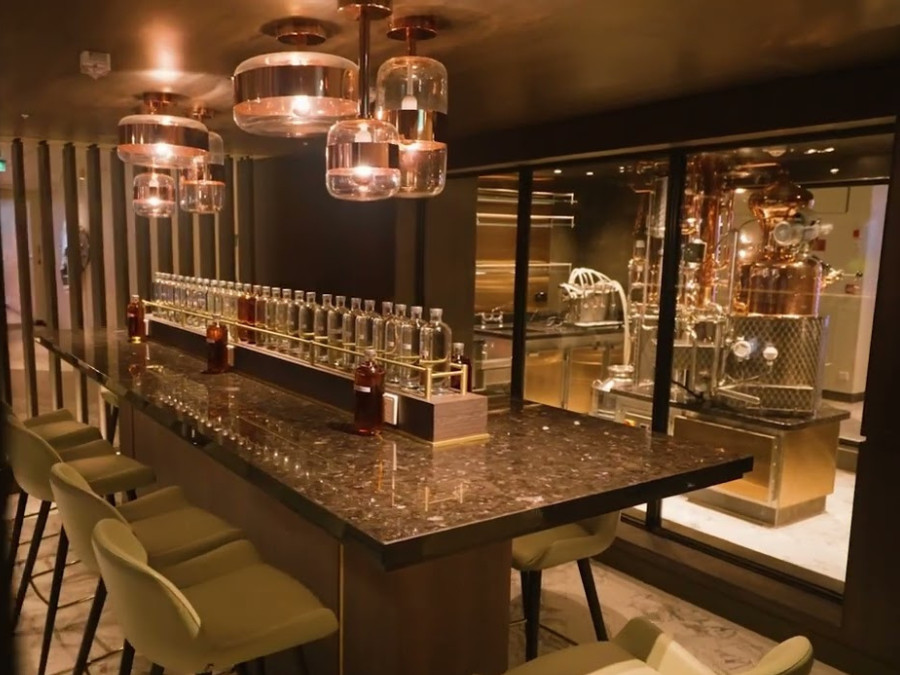
Eye-catching examples from the past decade include Royal Caribbean’s Bionic Bars (above) with robotic bartenders on Quantum of the Seas and Harmony of the Seas; Norwegian Cruise Line’s Svedka Ice Bar, where everything from the walls to the glasses is made of ice; and more recently, Anderson’s Bar on P&O Cruises’ new 5,200-passenger Arvia, which boasts an onboard custom-made rum distillery.
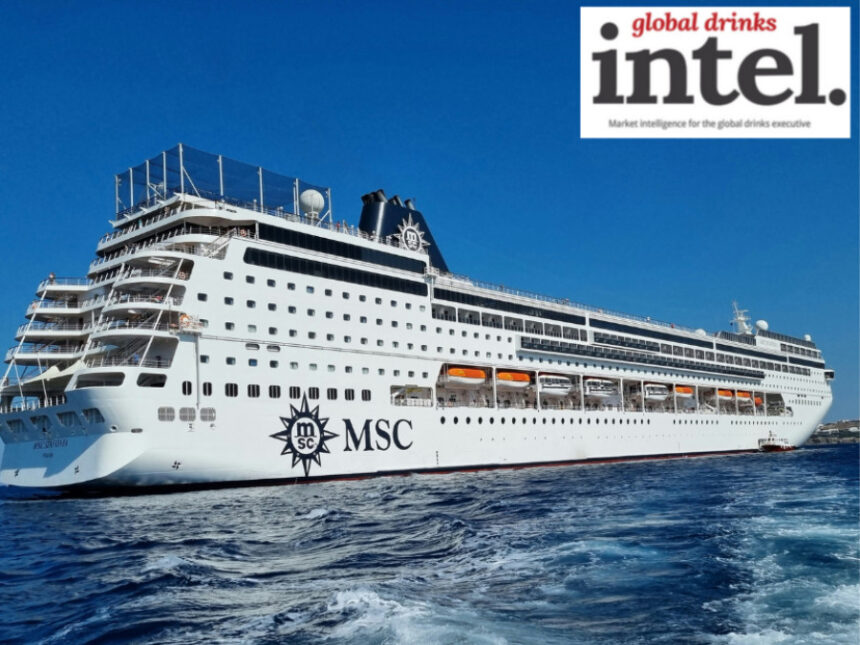
In April, MSC Cruises, the world’s third-largest cruise line with a 22-ship fleet, shook up this rapidly evolving scene further by launching a new beverage programme called ‘World’s Greatest Bars’. The initiative’s goal was simple: to partner with cocktail bars ranked highly in the influential ‘World’s 50 Best Bars’ list to create onboard pop-up venues serving guests some of their most popular signature drinks, for six months.
Established in 2005, the World’s 50 Best Bars is a prestigious annual competition that aims to recognise and reward exceptional bars based on a variety of factors including cocktail innovation, atmosphere, service and overall guest experience.
Bringing the world’s top bars onboard
The two bars selected to partner with the MSC Cruises programme are both based in Barcelona: Sips and Paradiso. Founded in 2020 by Marc Álvarez and Simone Caporale, two iconic figures in the bartending world, Sips garnered international acclaim for its innovative cocktails and exceptional service. The venue was ranked first on last year’s list, offering guests “evolved mixology” within a “social and fun atmosphere”.
No.4 in last year’s 50 Best Bars ranking, Paradiso was founded by Italian mixologist Giacomo Giannotti. A speakeasy-style bar, Paradiso is in a historic building that was formerly a bakery in Barcelona’s fashionable El Born district. The bar’s décor evokes a sense of mystery and intrigue, with dim lighting, velvet curtains and antique furniture. Its cocktails are renowned for their creativity and complexity, with bartenders using techniques including molecular gastronomy and fermentation.
“We’re thrilled to have onboard such exciting bars, Sips and Paradiso, two ranked as some of the best in the world,” said Jacques Van Staden, the then-F&B VP at MSC Cruises, when the ‘World’s Greatest Bars’ programme was announced. “These bars are incredibly hard to get into right now, so we’re excited that our guests can get a taste of the action.”
For the six-month pop-ups, senior teams from Paradiso and Sips trained MSC Cruises bar staff on the two ships chosen, MSC World Europa with Paradiso and MSC Euribia with Sips.
No attempt was made to recreate the look and design of either bar, given the restrictions necessitated by the cruise ship environment, such as the lack of physical space and strict maritime safety regulations. Nonetheless, bespoke glassware from each bar was used, along with branded aprons for bar staff and branded drinks menus.
The Sips onboard menu featured the bar’s classic primordial cocktail – a fruity and smoky whisky cocktail built around Johnnie Walker Black Label alongside ruby port, calvados brandy and crème de cacao, served in a signature glass.
Paradiso’s onboard drinks list, meanwhile, included the kriptonita with its electric flower garnish – a bittersweet gin cocktail made with Tanqueray Ten, shiso, lemongrass, Sichuan pepper, chocolate bitters, grapefruit and riboflavin, which literally makes it glow in the dark – and solera presidente – a sweet, velvety rum cocktail made with Zacapa 23-year-old rum, oloroso sherry, banana liqueur and Fernet-Branca, served with a cotton candy garnish.
The cruise bar trends to watch
The challenges of operating an efficient and profitable onboard cruise line beverage programme are numerous, from the lack of physical space, strict maritime safety regulations and diverse clientele, to supply chain issues and staff recruitment. Yet this niche on-premise sector continues to grow in importance and sophistication each year.
- No/low options on the rise
The growing number of Millennial and Gen Z holidaymakers eschewing alcohol is leading to a radical overhaul of beverage packages. In this year’s Seatrade Cruise Food & Beverage Trends Report, a survey based on 74 cruise line F&B managers’ responses, more than 46% cited a growing trend toward no- & low-alcohol beverages.
In May, luxury cruise line Seabourn announced a new zero-proof mixology programme called ‘Zero @ Sea’. The initiative offers alc-free creations such as the ginger blossom – Seedlip Groove 42 non-alc spirit, elderflower and ginger ale – and the ginny ‘n’ tonic -botanical non-alc spirit Optimist Bright, elderflower and grapefruit.
- Onboard production
Despite the cost and logistical challenges, cruise lines are increasingly upping their craft spirit and brew game by installing onboard breweries and distilleries.
As well as the forementioned P&O Cruises micro-rum distillery onboard Arvia (above), the British line boasts a working gin distillery operated by Devon-based Salcombe Distilling Co onboard its Iona vessel. Carnival Cruise Line, meanwhile, was the first US cruise ship operator to install an onboard micro-brewery – on the 3,954-passenger Carnival Vista in 2016; five of its ships now feature micro-breweries. Other cruise lines have followed suit, for example, MSC Cruises’ flagship MSC World Europa, which had its maiden voyage in late 2022, boasts the glass-fronted Oceanic Craft Brewery, which has even produced beer made from desalinated seawater.
- Own-label spirits raise the quality bar
Own-label spirits are an increasing focus for many cruise lines, offering brand differentiation, incremental sales and an enhanced guest experience. The quality of these exclusives is also rising – Holland America Line was this year awarded a gold medal for its De Lijn Gin at the Tales of the Cocktail competition in New Orleans.
Introduced in 2022 to commemorate the company’s 150th anniversary, De Lijn Gin is crafted with a blend of “Dutch-inspired, cold-distilled” botanicals. The cruise line also offers its guests its own pilsner beer, HAL Pils, which is brewed by the Seattle-based Pike Brewing Co.
Fred Olsen Cruise Lines livened up its onboard spirits offering in January by joining the trend of ageing spirits at sea. The company has partnered with English brewer and spirits producer Adnams to mature a 9-year-old whisky onboard its Borealis cruise ship for a final year of at-sea ageing. The cask will then be taken to Adnams’ distillery to be bottled and then be made available for Fred Olsen’s cruise passengers to buy.
This article is available to Global Drinks Intel members only.
Click below for details on how to join the Global Drinks Intel community.
Already a member?
Log in here to read the article in full.
If you work for any of the following corporate subscribers to Global Drinks Intel, head here to activate your access.
- AB InBev
- Bacardi
- Campari Group
- Diageo
- Moët Hennessy
- Pernod Ricard
- Proximo Spirits
- Suntory Global Spirits
- William Grant & Sons