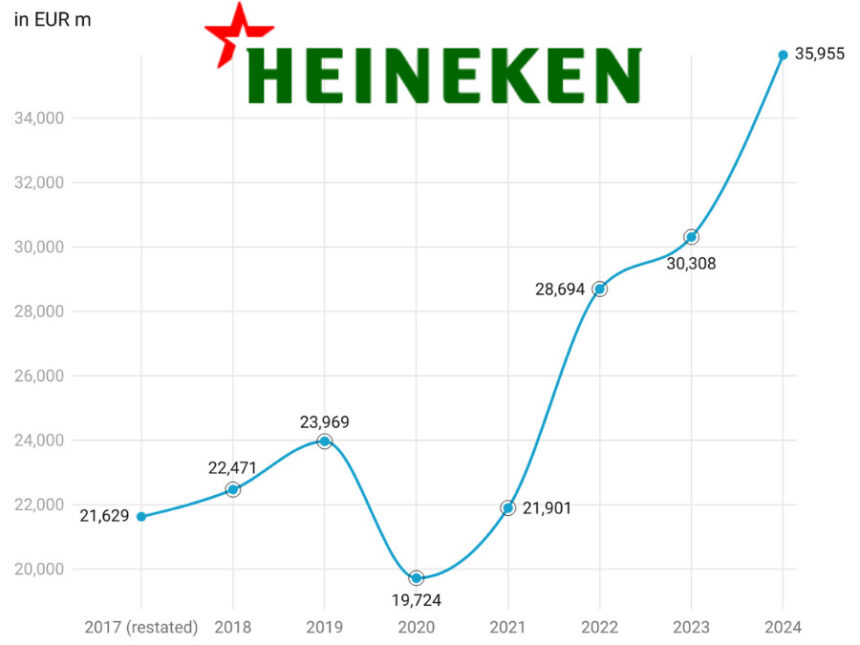
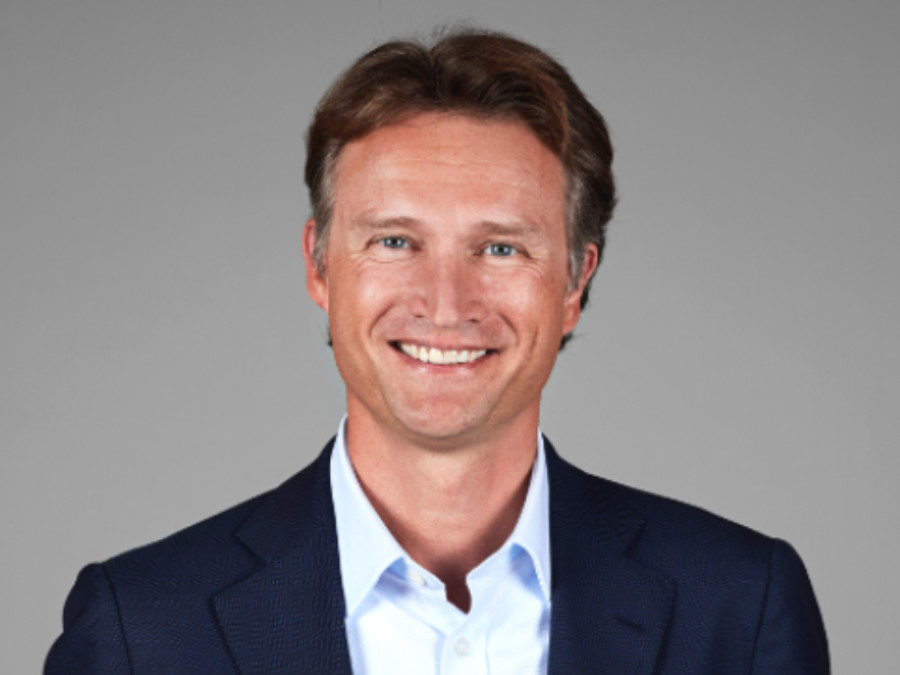
Earlier today, Heineken reported its group sales for the 12 months of 2024. Immediately afterwards, Global Drinks Intel editor Olly Wehring spoke to the group’s CEO, Dolf van den Brink, to hear more about Heineken’s standout performance.
Sales growth of any kind in today’s trading environment is to be applauded, so you must be very pleased with last year’s 5% rise.
I’m very happy with the results. Volume is the ultimate yardstick of whether the consumers are with you. Having volume growth across all four regions is very important. We saw our mainstream beer volumes at slightly under 2%, premium – where we are the global market leader – up 5%, the Heineken brand grew 9% and Heineken 0.0, where we are also the global market leader, up 10%. The quality and consistency of our volumes makes me proud.
Then, there’s getting all the financials right – 5% organic revenue growth and 8.3% profit growth – supported by a major step up in investments; our marketing expenses, for example, were up double digits. We’ve also increased our digital technology investments and we’re building three new, greenfield breweries, in Brazil, Mexico and Dubai (the latter announced in November).
In the end, it’s about the consumer. Seeing them choosing our brands, in particular our premium and 0.0 brands, makes me super proud.
There must be a fly in the ointment somewhere.
When you have a global footprint, there’s always macroeconomic disruption somewhere. It’s great to get the volume growth, but when you have hyperinflation, like in Ethiopia, you have to work hard. I’m proud of the way the Nigeria team has dealt with the big currency devaluation there, but that’s a theme you need to focus on. We need to get a better top-to-bottom-line hard currency conversion in some key markets – that has our attention.
We’re not yet satisfied with the modest growth in Europe. We believe this category can and should grow more. After a couple of years of fierce price increases out of necessity – input and energy costs have been going up – we were deliberately moderate on our pricing last year, because we want to allow the consumer to catch up. That’s happening now, but we need to continue along the path of moderate pricing and sequential improvements in volume. That’s what we’re trying to do.
What do you see as being the growth drivers in the medium-to-long term in a market as established as Europe with a brand as established as Heineken?
I’ve been in the company for 27 years and almost five years as CEO. In that time, premium beer has kept growing, no matter what’s happened.
In low- and no-alcohol, we believe we were the first mover back in 2017, when we launched Heineken 0.0. We invested in a technological breakthrough that allowed us to make the 0.0 recipe, which I believe both friend and foe acknowledges was the first 0%-ABV beer that tasted like the real thing. We didn’t put it on a secondary brand, we gave it credibility by putting it on Heineken. We priced it in-line with regular Heineken and we put our whole marketing machine behind it – our activity with Formula One is 100% dedicated to Heineken 0.0. We’ve also invested in making it socially acceptable.
When you do that for five to eight years in a row, the flywheel really turns. In 2024, Heineken 0.0 was up 10% and is by far the largest 0% beer on the planet – Since its launch, we’ve calculated the brand has captured 40%-plus of the absolute global growth of 0.0. That’s about four times our fair share and we’ll keep our pedal to the metal.
With our strategy of building the 0.0 category and continuing to invest in premium while taking better care of our big mainstream proposition – Kingfisher in India, Tecate in Mexico, Amstel in Brazil and South Africa – now we’re really starting to get the balance right.
Is there a worry that Heineken 0.0 could outgrow the 0%-ABV beer segment and lose the driver of competition?
I don’t know if that would be a bad thing! I also don’t think it’s necessarily true. In the US, for example, Heineken 0.0 is the number one proposition, but there’s a lot of competition, from big legacy brands to pure, native 0%-ABV beers.
The more our competition invests, the faster this segment is going to grow. As long as we keep growing from already being in such an advantageous position, then that works for us.
I also believe that the cannibalisation is very low. It’s really about developing new occasions; A Heineken consumer may want a regular Heineken on a Friday night, maybe on a Thursday. On a Monday night, or at lunch with colleagues, they can go for a Heineken 0.0.
You’ve talked in recent months about “materially stepping up” the group’s marketing spend. Are these increases sustainable?
If you want to grow, you need to invest in that growth. There has been so much disruption to the category by externalities, such as Covid and the energy price shock in Europe. Not only do we need to allow consumers to catch up by moderating our pricing in some places for some time, we also need to invest in our brands and in our innovation.
In 2022, we had a huge step up in marketing. We had to pause in 2023 because of everything that was going on, then there was a big step up last year. In our outlook statement for this year, we’ve indicated that once again, we intend to grow our marketing expenses ahead of revenue.
We’re really in ‘invest’ mode, but we’ll do it balanced, focused and consistently. Only doing this for one or two years in a category like beer doesn’t make sense. Being a 160-year-old family company – we now have the fifth generation of the Heineken family – we really are in a position to make these long-term investments.
What are your priority areas as CEO, going forward?
Well, we’re certainly not where we want to be yet – We’re more hungry. We still see a lot of opportunities. We want to make sure that not just Heineken grows, we want the category to be healthy and thriving all over the world, driven by innovation and the development of new segments.
When you have the honour of leading such a legacy company, it’s about preserving the magic and being a custodian of that magic, while transforming the company. That’s what we’re trying to do. I’m proud of how the company is coping with a lot of that while staying true to the essence of who we are.
There’s something special about beer – It’s different to other FMCGs, there’s a craftsmanship side to brewing. I still personally go every year to the graduation of the new master brewers! This is not just a product; This is beer.
The same applies to brand building. A lot of FMCGs are very functionally driven, but beer is very emotion-driven. So it’s a different sort of brand building. We’re reinventing it to make it future-fit but tapping into what has been special about it across all those generations.
This article is available to Global Drinks Intel members only.
Click below for details on how to join the Global Drinks Intel community.
Already a member?
Log in here to read the article in full.
If you work for any of the following corporate subscribers to Global Drinks Intel, head here to activate your access.
- AB InBev
- Bacardi
- Campari Group
- Diageo
- Moët Hennessy
- Pernod Ricard
- Proximo Spirits
- Suntory Global Spirits
- William Grant & Sons