

- Category stagnation – Global travel retail wine and spirits sales have stagnated over the past eight years, with 2025 sales below pre-Covid pandemic 2018 levels
- Middle East disruption – The US–Israel and Iran conflict has severely disrupted the Middle East’s GTR channel, with little prospect of a short-term recovery if hostilities continue
- Chinese spending dilemma – Outbound overseas Chinese travel has surged in 2026, but spending among younger Gen Z and Millennial travellers remains weak
- Hybrid retail formats – Airport retail is evolving, with F&B concepts increasingly being integrated into traditional retail spaces
By any standards, 2026 has already proved a highly challenging year for the global travel retail industry, a sector inured but still highly vulnerable to external shocks both man-made and natural.
After a broadly positive 2025, which saw global airport traffic climb 3.6% to 9.8bn, the outbreak of war in the Persian Gulf in February this year has proved a destructive and destabilising factor to both tourism and aviation this year. Indeed, Airports Council International (ACI) has revised its 2026 traffic forecast downwards from an initial 10.2bn to around 10bn passengers.
The Middle East crisis has exacerbated existing challenges for the industry, most notably falling average transaction values and the weak recovery of spending by outbound international Chinese travellers post-Covid-19 pandemic – a group the travel retail industry long depended on as its chief growth engine.
Duty-free liquor sales stagnate
Data from Generation Research, a long-standing provider of macrostatistics for the global travel retail channel, reveals that in 2025, sales of wine and spirits totalled US$11.8bn, a year-on-year increase of only 1.6%. The category still enjoys a 15.5% market share, but it trails a long way behind fragrances and cosmetics (32.2%), the channel’s hero product sector.
Figures collated by the company from 2018 highlight alcohol’s long-term struggle for GTR growth, even before Covid-19. Despite rising passenger numbers and inflation, wine and spirits saw year-on-year growth of just 7.2% in 2018 ($12.2bn in annual sales, 15.4% category market share), compared with 23.5% for channel leader fragrances & cosmetics ($33.5bn, 39.9%).
Chinese spending headwinds
Much of wine & spirits’ current GTR difficulties lie in the weaker spending of mainland Chinese travellers, despite a boom in outbound travel.
The strong yuan and the spread of visa-free policies for Chinese nationals are forecast to encourage mainland travellers to take 165m to 175m cross-border trips this year, up from an estimated 155m in 2025, according to the South China Morning Post.
South Korea, Vietnam and Thailand are tipped to be three of the most popular overseas destinations for Chinese travellers. However, weaker-than-expected spending by tourists from the country in South Korea and Thailand has contributed to disputes between airport retailers and landlords over high rents.
In late 2025, Korean travel retailers Shilla and Shinsegae walked away from their retail concessions at Seoul’s Incheon International Airport after suffering substantial losses. The crisis prompted the airport authority to launch an emergency re-tender, with domestic rivals Lotte and Hyundai stepping in under a revised rental model featuring substantially lower minimum per-passenger rates.
Similarly, King Power, the anchor concessionaire at Bangkok Suvarnabhumi and other Thai airports, threatened to withdraw from its major airport concessions in June 2025. Airports of Thailand responded with a revised concession agreement, offering King Power reduced per-passenger minimum guarantees and a two-year contract extension to help offset the impact of disruptive terminal refurbishments.
Changing spending behaviour by Chinese travellers also lay behind one of 2026’s biggest travel retail stories – DFS Group’s decision to pull out of the airport channel.
In 2025, DFS Group, a division of LVMH, was the 12th-largest travel retailer worldwide with estimated annual sales of around EUR1.6bn ($1.9bn), according to trade title The Moodie Davitt Report. This total was 62% lower than in the early years of the pandemic, a slump primarily driven by weaker Chinese spending.
Consequently, in January 2026, LVMH announced it was conducting an ongoing strategic review of its DFS store portfolio and – in the memorable words of CEO Bernard Arnault – intended to exit its travel retail business “slowly but surely”.
The following months saw DFS pull out of a string of blue-chip airport concessions, some of which the operator had held for decades – the list included Hawaii’s Daniel K Inouye International in Honolulu, as well as the US west coast gateways of San Francisco and Los Angeles airports.
Away from the States, DFS departed its travel retail operations on the Japanese holiday island of Okinawa in June. The long-standing business comprised stores at Naha Airport and a downtown T Galleria Okinawa outlet in Naha, the island’s capital, both of which were snapped up by rival travel retailer Avolta for an undisclosed sum.
In the same month, DFS sold its travel retail businesses in Hong Kong and Macao to China Duty Free Group, China’s biggest travel retailer, for a reported $395m. The agreement included major downtown store locations in some of Hong Kong and Macao’s premier shopping districts.
Avolta consolidates its lead
While DFS bade farewell to many long-standing retail locations this year, Swiss giant Avolta, the global market leader with annual sales of around EUR10bn in 2025, consolidated its position in spectacular fashion, with a string of tender wins.
North America proved a very successful hunting ground, with the operator either winning or extending contracts at Toronto Pearson Airport in Canada; Monterrey, Mazatlán, Acapulco and Ixtapa-Zihuatanejo airports in Mexico; as well as Norfolk, Jacksonville, Palm Beach, New York JFK (Terminal 8), Atlanta and San José airports in the US.
In Asia Pacific, Avolta has arguably reached even greater heights. Last December, it secured a landmark concession win at Shanghai Pudong’s Terminal 1, spanning an extensive 8,000sq m of retail space. The deal made Avolta the first international operator in a generation to enter mainland China’s airport duty-free sector, giving it a foothold in a market notoriously difficult for foreign players to penetrate.
Subsequently, the retailer also secured notable contract wins in Japan – at Naha Airport and Kansai International Airport in Osaka – as well as in India with a seven-year concession at Netaji Subhash Chandra Bose International Airport in Kolkata.
Hybrid retail stores here to stay
Much of Avolta’s recent success can be traced to its merger with Italian F&B giant Autogrill in 2023. The move allowed the operator not only to streamline costs and create massive purchasing power, but also to bid for comprehensive airport tenders, offering airport authorities bundled retail and dining solutions.
Pore over annual airport reports and a post-pandemic trend emerges – F&B revenue growth rates consistently outperform retail ones. Since 2024, Avolta has rolled out hybrid stores at airport hubs, such as Madrid and Milan Malpensa, that offer a mix of local gastronomy with travel essentials and luxury retail under single concession agreements.
Avolta’s push into hybrid airport stores – a format also championed by rivals including Gebr Heinemann and France’s Lagardère Travel Retail – is creating significant opportunities for wine and spirits brands. The model is also welcomed by beverage alcohol companies such as Henkell Freixenet, the world’s largest sparkling wine producer, which sees hybrid stores as a way to meet consumers’ growing appetite for experiences.
“We see the evolution towards hybrid F&B and retail concepts as a very positive development for the category and a significant opportunity for sparkling wine brands,” says the group’s head of GTR, Ramón Olive. “Sparkling wine is inherently associated with celebration, social occasions and moments of enjoyment, which makes it particularly well suited to these environments.
“What makes these concepts especially attractive is their ability to combine product discovery and purchase in a single consumer journey. Travellers can experience a brand through a by-the-glass serve, a food pairing or a dedicated activation, and then be inspired to purchase it for themselves or as a gift.”
Middle East global travel retail caught in the crossfire
Despite the presence of several predominantly dry states, reflecting the region’s large Muslim populations, the Middle East has traditionally been a major duty-free market for alcohol.
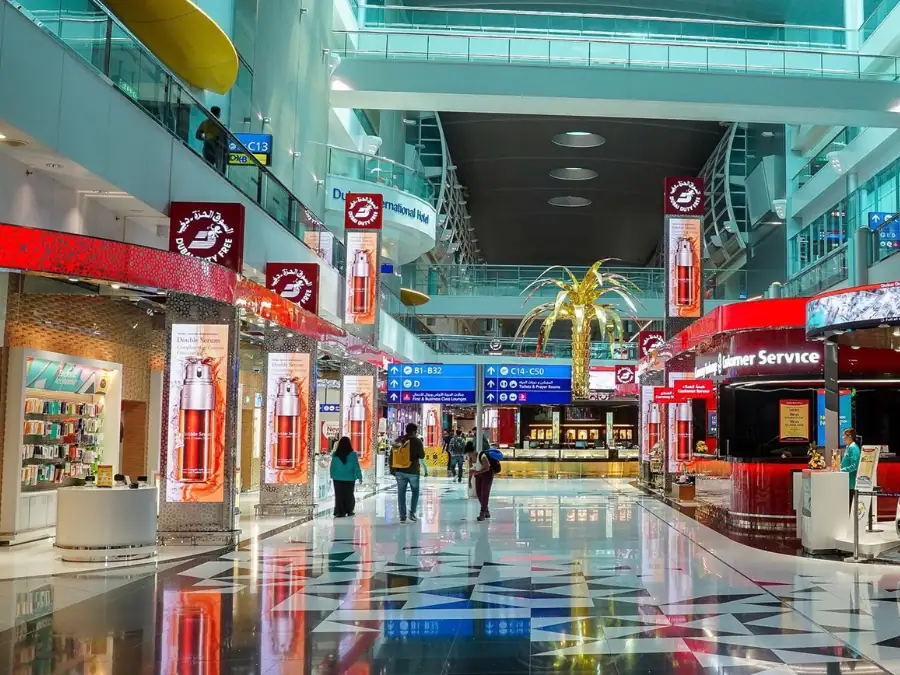
Growth has been supported by rising international tourism, millions of expatriate workers from the Indian subcontinent, and high volumes of transit traffic through regional hubs including Dubai Duty Free (above), Hamad International and Abu Dhabi’s Zayed International.
Last year, Dubai Duty Free, the region’s largest travel retailer, generated liquor sales of more than US$290.6m, selling over 4.7m bottles of whisk(e)y and more than 876,000 bottles of wine in the process.
Unsurprisingly, the US-Israel war with Iran has proved disastrous for this significant GTR drinks market. “The Middle East has clearly been the biggest challenge for the channel this year,” admits Rufus Parkinson, regional MD of GTR at William Grant & Sons, the owner of the Glenfiddich and The Balvenie single malts.
“We’ve seen disruptions to passenger flows, uncertainty around travel patterns and operational complexities that have affected both retailers and brands. Our approach has been to remain agile and focus on the markets and consumer segments where demand remains resilient.”
The initial outbreak of hostilities resulted in one of the most severe disruptions to international aviation since the Covid pandemic, with airspace lockdowns across Iran, Iraq, Syria and other parts of the Gulf, and thousands of flights being cancelled at the region’s hub in the early weeks of the crisis. Jet fuel prices surged, and airlines operating long-haul Europe-to-Asia routes were forced to reroute around active war zones, adding hours to flight times and pushing up ticket prices.
By August, Gulf carriers, such as Emirates, Qatar Airways and Etihad, had managed to restore a substantial portion of their scheduled network, but capacity remains constrained compared to pre-war levels. Inbound international tourism to the wider Middle East region is still depressed, with demand moving to other regions, notably Western Europe, South-East Asia and North America. Hundreds of thousands of expat workers in the Middle East have either left or been repatriated to their home countries, although the vast majority – 24m to 25m nationals – have stayed put.
The region’s major GTR operators, such as Dubai Duty Free and Qatar Duty Free, are tight-lipped about the impact of the conflicts on their balance sheet. But in a webinar organised by the Middle East & Africa Duty Free Association (MEADFA) and the Duty Free World Council in June, MEADFA CEO Abdeslam Agzoul admitted that during the peak conflict months of March and April, the association’s members had lost “hundreds of millions” of dollars. This total will have no doubt risen much higher after months of further sporadic military activity and resultant disruption.
While Gulf operators continue to bear the financial brunt of persistent airspace closures and cancelled routes, megahubs along alternative transit corridors are reaping the benefits. Airports like Istanbul, ideally positioned as a geographic bridge between East and West, have seen a surge in rerouted long-haul passengers.
Indeed, according to new ACI data, Istanbul Airport has now overtaken London Heathrow as Europe’s busiest airport. In July, 8.15m passengers passed through the hub in Türkiye’s largest city (Heathrow recorded 7.86m passengers, with Middle East routes down 20.2% year on year), providing a lucrative boost to anchor concessionaire Unifree Duty Free.
This could serve, then, as proof that even in global travel retail’s most volatile year, worldwide passenger demand rarely disappears. It simply finds a new route.
Members-only intel
Keep reading this members-only article – and every one like it
- ✓All paywalled news and interviews
- ✓Category and market data
- ✓Monthly GDI magazine
- ✓Full archive + daily newsletter
Secure checkout · Cancel any time · Company invoices available
Already a member? Log in
See all plans, incl. 10-reader and corporate
Check if your company already pays for you Your company may already give you free access.
Corporate subscribers: AB InBev, Bacardi, Campari Group, Diageo, Moët Hennessy, Pernod Ricard, Proximo Spirits, Suntory Spirits Group, William Grant and Sons.
Activate company accessNot ready yet? Get the headlines free in our daily newsletter.
Sign up free