


The Mediterranean eating- and drinking-out culture is constantly evolving. While upholding the region’s renowned gastronomic heritage, bars, cafés, bistros and tavernas continue to adapt to shifting social habits and changing consumer needs.
It should be of little surprise that the region is home to 15 of ‘The World’s 50 Best Bars’, a ranking that celebrates some of the world’s most innovative and forward-thinking cocktail venues. As mounting economic pressures place growing strain on both the industry and consumers, however, the on-premise must pay close attention now more than ever to emerging trends to adapt accordingly and ensure long-term viability.
NIQ’s ‘Outlet Index’ provides a valuable lens to this end: the comprehensive database maps and segments all on-premise outlets across the market. One of the most significant shifts it highlights is the rise of all-day dining.
Consumers are increasingly choosing to eat out across a wider range of dayparts; in doing so, they’re pushing on-premise outlets to rethink what was once a clear distinction between establishments focused on lunch or dinner service and those offering more casual, throughout-the-day dining experiences.
Traditional, clearly defined venue types are gradually giving way to more fluid formats, leaving consumers with an ever broader and more diverse range of eating options. Breakfast and brunch offerings are becoming more prominent, expanding opportunities for those seeking to dine or snack away from the home throughout the morning. At the same time, evening and night-time bars and clubs are broadening their food propositions, evolving from menus once centred primarily on small plates and snacks towards more substantial dishes capable of supporting a complete meal.
Beer is king
Overall, beer remains the most important category across the Mediterranean region, chosen by 41% of users on a routine visit, while soft drinks rank second. Wine, by contrast, tends to be more popular on event-led occasions (29%), with cocktails and spirits following at 19% each.
A closer look at individual markets reveals a more nuanced picture. In Croatia, France and Spain, for example, beer still dominates, reaching as high as 65% in Greece.
When it comes to soft drinks, the landscape becomes considerably more varied. The category retains its second place in both Croatia and Spain, but in Greece it slips behind wine, likely reflecting how deeply it remains embedded in everyday casual drinking culture.
Similarly, in Italy, coffee culture has a pronounced influence on consumer choices. Indeed, coffee and other hot drinks rank first overall, with beer coming in second. Soft drinks only appear in fifth place, preceded by wine spirits – demonstrating the continued strength of the aperitivo moment.
In Türkiye, too, hot and soft drinks are growing in prominence, chosen by nearly half of all on-premise visitors. This likely reflects a combination of factors, including a strong coffee culture and a tendency among consumers to moderate or avoid alcohol consumption for religious reasons. When Turkish on-premise users do consume alcohol, they tend to do so with clear intention, as the leading category (36%) is whisk(e)y.
Brand owners and operators must take this distinct preference into account when shaping their strategies for the market.
When the sun’s still shining
Another notable on-premise shift emerging from NIQ’s research is a move towards earlier dayparts. Mediterranean culture was once known for its extended daily rhythm, with late-evening meals and drinks continuing long after much of Northern Europe had already wound down for the night.
Since the pandemic, however, consumers have been increasingly choosing to dine and drink out earlier in the day. According to NIQ‘s ‘Reach’ research, earlier outings have increased by 15 percentage points (pp) in Türkiye and 9pp in Greece.
This may sound like a stark departure from the Med’s traditionally late outings, but earlier on-premise occasions aren’t as radical a break with local culture as they might appear. In fact, this shift can be seen as an expansion or evolution of the aperitivo culture, often associated with Italian lifestyle but also present across other Mediterranean cultures, such as the tardeo in Spain.
Now increasingly more common across the region (and beyond), earlier eating and drinking occasions are blurring the boundaries between categories once firmly anchored to specific moments in the day.
The spritz, for instance, long regarded as the archetypal aperitivo drink, is now just as likely to be treated as an evening cocktail. Meanwhile, beer – traditionally the centrepiece of a night out at the pub in many markets – is also being repositioned as an aperitivo choice, comfortably straddling both pre-dinner and social drinking occasions.
Operators and brands need to pay close attention to these shifting tendencies to ensure they not only offer the right categories to their customers but also deliver them in ways that align with the distinct occasions in which they are consumed.
Mixing things up
Of all the trending categories, cocktails warrant the closest attention, having grown significantly across the region, often at the expense of more traditional alcoholic beverages. Rum, vodka and tequila-based serves are among the most commonly chosen across numerous Mediterranean markets, with Greece and Spain showing a strong preference for the former, while Italy’s appetite for gin remains strong.
At the same time, longer serves now transcend the aperitivo moment and are gradually being embedded into the broader cocktail occasion, opening new opportunities for soft and lower-alcohol beverages to be integrated into the same repertoire.
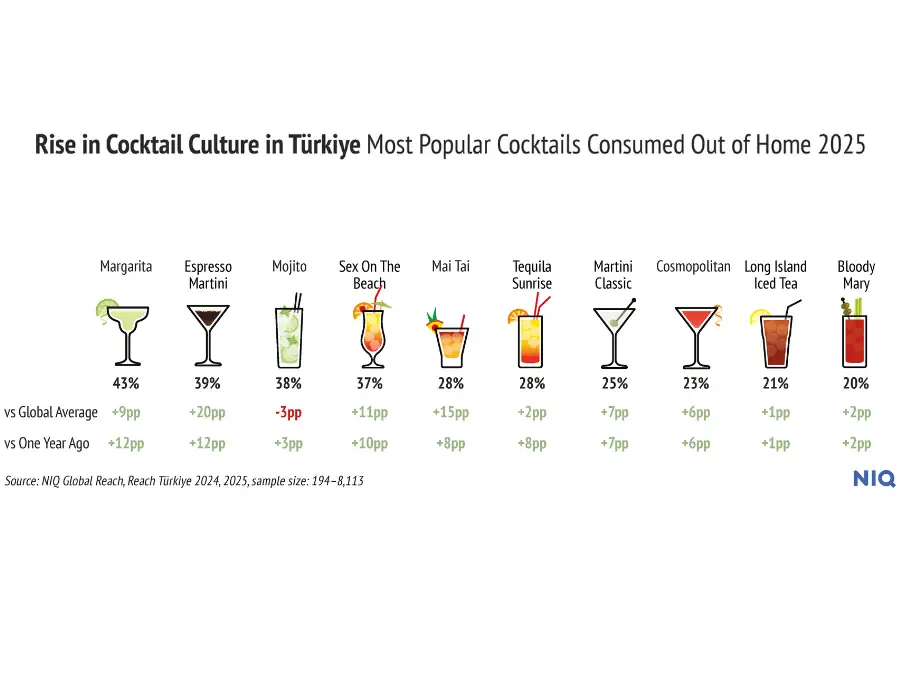
The cocktail occasion is particularly dynamic in Türkiye, where consumers are steadily expanding their choices with a growing range of serves. Some of the most popular options – the margarita and the espresso martini – have grown by a remarkable 12pp year on year, and even a long-established favourite like the mojito has seen a solid increase of 3pp.
Bartenders as ambassadors
The growth of cocktail culture across the Mediterranean has undoubtedly been fuelled by the modern cocktail revolution first seen in more established mixology markets such as North America and the UK.
With an emphasis on fresh ingredients, complex techniques and premium experiences, this societal phenomenon has also transformed the role of the bartender, elevating the profession to a high level of consumer respect that can be compared to that of Michelin-starred chefs. Whether on or off the floor, bartenders are now true ambassadors in the channel and carry a significant degree of influence over people’s drinking habits.
According to NIQ’s latest ‘BarSights’ survey, nearly nine in ten bartenders make at least one drink recommendation to a guest during every shift; recommendations that consumers are often willing to follow.
Guests increasingly look to bar staff not only for suggestions on what to drink, but also for guidance and education around new categories and serves. This positions bartenders as an effective bridge between brands and the end consumer, making it essential for brand owners and operators to ensure these workers are aligned on the right messaging – and equipped to leverage that expertise throughout service.
Also enhancing the appeal of bartenders is the increased theatricality of drink preparation, particularly in higher-end venues. Bar staff look to deliver not only beautifully presented serves, but do so with flair and panache, adding an experiential layer that goes beyond the drink itself.
For on-premise visitors, such extra value is worth the high price of the cocktail, as it enables them to extend the experience onto social media and complete the ‘phygital’ loop that defines the path to purchase nowadays.
In this sense, the growing importance of the cocktail category can also be seen as a response to the rising demand for affordable luxury in the on-premise. As financial pressures mount across the Mediterranean, cocktails offer consumers a distinctive way to maximise their budgets: they’re indulgent yet accessible, entertaining in the moment and capable of a second life online through shared images and videos.
This might well be one of the most revealing insights into evolving consumer needs and desires. In an increasingly challenging operating environment, an experiential dimension that seamlessly integrates the physical and digital worlds is no longer optional, but central to creating value and remaining competitive.
NIQ’s suite of research services combines to provide brand owners and operators with an unrivalled and holistic view of the Mediterranean on-premise sector. ‘Reach’, for instance, illuminates eating and drinking behaviours across global markets, offering insights and benchmarking for targeted outreach. NIQ’s consumer research can also deliver exclusive insights into consumer habits and preferences in the on-premise, helping businesses to craft successful strategies and gain market share.
Head here to learn more about NIQ’s capabilities across the Mediterranean on-premise, or click here to email NIQ’s EMEA MD, George Argyropoulos.
Members-only intel
Keep reading this members-only article – and every one like it
- ✓All paywalled news and interviews
- ✓Category and market data
- ✓Monthly GDI magazine
- ✓Full archive + daily newsletter
Secure checkout · Cancel any time · Company invoices available
Already a member? Log in
See all plans, incl. 10-reader and corporate
Check if your company already pays for you Your company may already give you free access.
Corporate subscribers: AB InBev, Bacardi, Campari Group, Diageo, Moët Hennessy, Pernod Ricard, Proximo Spirits, Suntory Spirits Group, William Grant and Sons.
Activate company accessNot ready yet? Get the headlines free in our daily newsletter.
Sign up free