In the second part of our interview with the German Wine Institute’s head of marketing, Steffen Schindler talks strategy, with the country’s positioning of its Generation Riesling project, as well as the paucity of brands and the opportunity in no- & low-alcohol.
Who do you identify as your main competitor?
An example of how to do it right is New Zealand – They sell their wines all over the world, and they’ve never got involved at the basic price levels. That’s what we’re aiming for; we want to get out of entry-point price levels and establish ourselves in the mid-price segment.
Are you concerned by the lack of interest in wine exhibited by the younger consumer?
This is a huge problem for the wine industry in general. We’ve undertaken market research with younger consumers outside of the wine regions in Germany – Berlin, Hamburg, Munich, for example. The conclusion was that alcohol isn’t the problem; wine is the problem. Wine is far too complicated for young people, and we as an industry – especially here in Europe – put wine on a pedestal.
Wine doesn’t fit into their daily lives when they want to drink alcohol. Younger drinkers want to enjoy alcohol on the go, such as at festivals. That means it has to be packaged in a way that makes it easy for them. We don’t do that; we talk about the type of glass and the correct temperature, and package in a large bottle that needs a corkscrew. It’s not the taste of wine that turns them away, it’s everything around wine.
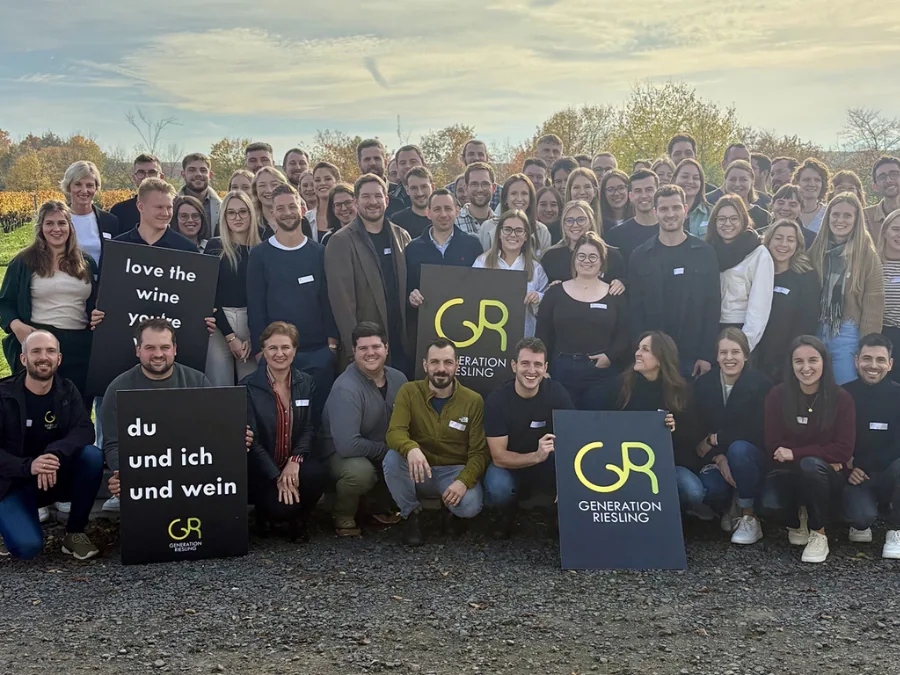
You’ve long been promoting Germany’s younger winemakers, through Generation Riesling (above). Does this approach continue to prove successful?
The concept has helped us a lot, both internationally and domestically. Our first tasting with Generation Riesling was around 20 years ago in the UK, where the perception of German wine was that it was sweet and cheap. We chose the name Generation Riesling because riesling was the only positive cue that we had in the country at the time.
Then, our first tasting in Germany was in Berlin in around 2010. There were wine buyers there who had no idea that German wine was so young and so dynamic. After that, we started running events for consumers at events like music festivals. The winemakers looked like the consumers – they both dressed the same, they both listened to the same music and they’re both digital natives! Since then, we’ve worked with Rolling Stone magazine and co-hosted events with young musicians.
So, while we’ve helped them to showcase their wines, they’ve helped us to change the image of German wine.
Is the sweeter taste profile of German wine an opportunity to engage with younger consumers?
In the 1980s, German consumers started to be told that wine had to be dry to work with food. That was pushed so far that if you wrote about wine and liked sweet wine in Germany, then you weren’t taken seriously. Today, in terms of production, around half of all German wines are dry.
What role do brands play currently for German wine?
We don’t have many very strong German wine brands. We have two or three traditional ones, such as Blue Nun and Black Tower, but they’re international brands. I’m not even sure if people today still associate those brands with Germany.
Domestically, many companies have tried to launch German brands – it’s worked very well in sparkling wine, but we’ve never had really big brands in still wine. We hardly ever see brands being advertised on radio or TV. That’s a real problem for our industry. That’s why we need the German Wine Institute; at least we have some marketing budget!
I think one of the problems is that consumers don’t think brands are authentic. They’d rather have a wine that has a story and a family behind it.
What can you do to try to change that?
We can’t. We’re not responsible for selling the wine! We do include branded wine in our communications, but it’s really the brand owners’ job to change that.
What opportunity does the rise of no- & low-alcohol offer German wine?
We’re convinced this is a huge opportunity, but when you talk to our producers, some of them are still quite hesitant. They don’t see it as ‘real’ wine.
In Germany, the consumption of non-alcoholic wine is increasing. We’re now at 2% of the whole wine market is non-alcoholic. In the sparkling segment, it’s 10% – considering that Germany is one of the biggest sparkling wine markets in the world, that’s a huge opportunity.
Globally, more people are looking for lighter styles of white wine – the red wine boom is over. Germany has been producing these lighter, more aromatic white wines for the last 2,000 years! We have the perfect wine for young consumers – slightly sweet and low in alcohol.
That’s something that you don’t find in many wine-producing countries!
Members-only intel
Keep reading this members-only article – and every one like it
- ✓All paywalled news and interviews
- ✓Category and market data
- ✓Monthly GDI magazine
- ✓Full archive + daily newsletter
Secure checkout · Cancel any time · Company invoices available
Already a member? Log in
See all plans, incl. 10-reader and corporate
Check if your company already pays for you Your company may already give you free access.
Corporate subscribers: AB InBev, Bacardi, Campari Group, Diageo, Moët Hennessy, Pernod Ricard, Proximo Spirits, Suntory Spirits Group, William Grant and Sons.
Activate company accessNot ready yet? Get the headlines free in our daily newsletter.
Sign up free