

Bottle design is evolving faster than production has traditionally allowed.
From increasingly complex, AI-generated concepts to rising pressure on timelines and cost control, brands today are being asked to deliver more distinctive packaging – faster, and without compromising margins.
This shift is exposing a gap between what can be imagined and what can actually be manufactured at scale.
Rethinking the economics of custom bottles
Cost remains a key barrier to custom packaging, particularly for emerging brands or limited editions.
In traditional Western markets, custom molds can exceed US$30,000 and take up to six months to produce. At Rockwood, super flint glass molds for 700-750ml bottles are $2,600, while ceramic molds are approximately $1,200 – with tooling and new custom molds ready within 45 days.
Combined with optimised production and integrated supply chains, this significantly reduces overall packaging costs while maintaining high quality standards.
This shift is making custom bottle design accessible to a wider range of brands, without sacrificing ambition.
Lead times as a competitive advantage
In many established production markets, bringing a custom bottle to life, from design and mold development through to production and bottling, can take up to 18 months.
As product cycles accelerate, this timeline is becoming increasingly difficult for brands to absorb.
By contrast, more integrated production models are demonstrating that this process can be significantly compressed. At Rockwood, for example, the full cycle can be completed in 4-6 months, from initial concept and mold development to a finished, ready-to-ship product.
Shorter lead times are no longer simply an operational benefit, they are becoming a strategic advantage in fast-moving categories.
Designing with production in mind
As bottle design becomes more expressive, the role of design teams is also evolving.
Speed of concept development is important, but so is feasibility. Generating designs that cannot be industrialised creates delays and inefficiencies.
Integrated design teams, working in close connection with production, are able to develop concepts rapidly, often within one week, while ensuring that they are aligned with manufacturing constraints and cost targets from the outset.
This alignment between creativity and engineering is becoming increasingly critical as designs grow more complex.
Integration as a driver of consistency and control
One of the most significant structural shifts in the industry is the move toward greater integration.
Bringing together design, bottle manufacturing (glass and ceramic), closure and label development, bottling, and international logistics within a single ecosystem allows for tighter control at every stage.
Rockwood’s model illustrates this approach, combining:
- In-house design
- Glass and ceramic bottle manufacturing
- Closure and label development
- Support for promotional materials and POS
- Partnerships for premium spirit supply
- A bottling facility in an EPZ (duty-free zone) near Shanghai
- Global shipping to more than 100 markets
For brands, this type of integration translates into greater consistency, reduced friction between stakeholders, and faster execution
Simplifying complexity through turnkey solution
As projects become more complex, particularly those involving multiple materials, formats and markets, the ability to manage the entire process through a single point of contact is increasingly valued.
Turnkey models allow brands to move from concept to finished product with a streamlined workflow, reducing coordination challenges and improving efficiency across the supply chain.
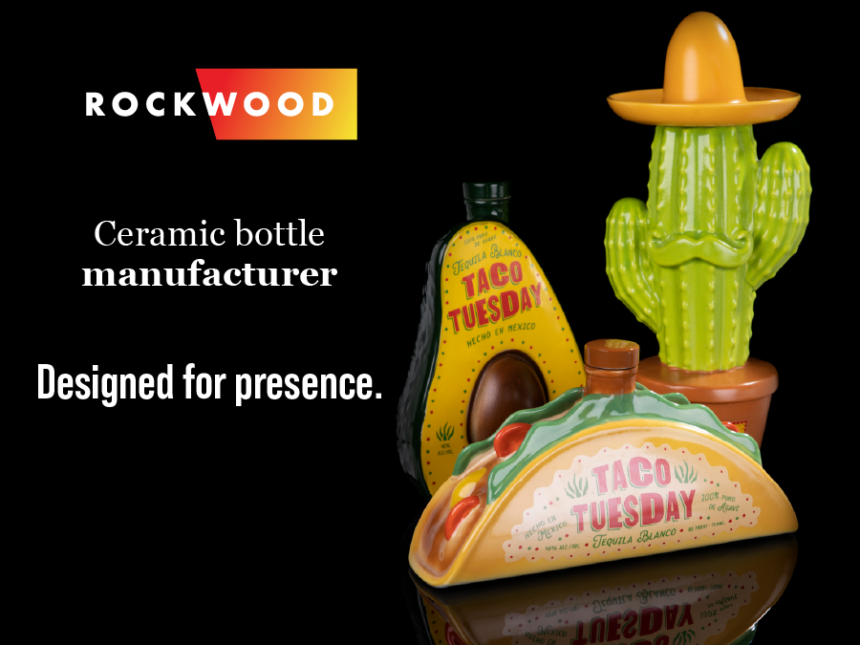
Ceramic: expanding the design vocabulary
Alongside advancements in glass, ceramic is gaining renewed attention as a packaging medium.
Unlike glass, ceramic is not constrained by transparency or the same flow dynamics during production. This opens up a broader range of possibilities in shape, texture, relief, and finishing.
Fully integrated ceramic production – from molding to hand-finishing and decoration – enables highly distinctive results, particularly for:
- Limited and special editions
- Luxury gift sets
- Sculptural, tactile designs with strong shelf presence
While ceramic bottles typically involve higher production costs, they are often positioned at a higher retail price point, supporting stronger margins and enhanced perceived value.
Bridging the gap between AI design and manufacturability
The rise of AI-generated bottle concepts has introduced a new layer of complexity.
These designs often feature intricate geometries and unconventional forms that are visually compelling but difficult to produce at scale using traditional methods.
Bridging this gap requires both engineering expertise and adapted production processes.
Advancements in mold design, such as the introduction of a three-stage mold-opening sequence, compared to the conventional two-stage process used in standard IS machines, allow for slower, more controlled release of the glass. This enables deeper contours, sharper angles, and more expressive forms.
At the same time, improvements in extra-flint glass production are making it possible to manufacture highly detailed, sculptural bottles at industrial scale, designs that were previously limited to hand-made, mouth-blown techniques at significantly higher cost.
Even within established processes such as Blow & Blow, adjustments to glass flow, cooling, and production speed are expanding what is achievable.
- Another emerging trend is the use of hybrid constructions, combining glass bodies with ceramic components or closures.
- Cohesive design language
- Precise tolerances
- Reliable sealing performance
- Consistent finishes across materials
Explore what’s possible
Click below to learn more about Rockwood’s capabilities:
You can also connect directly with Rockwood’s Founder & CEO, Henri Berthe, on LinkedIn, to start discussing your next bottle project.