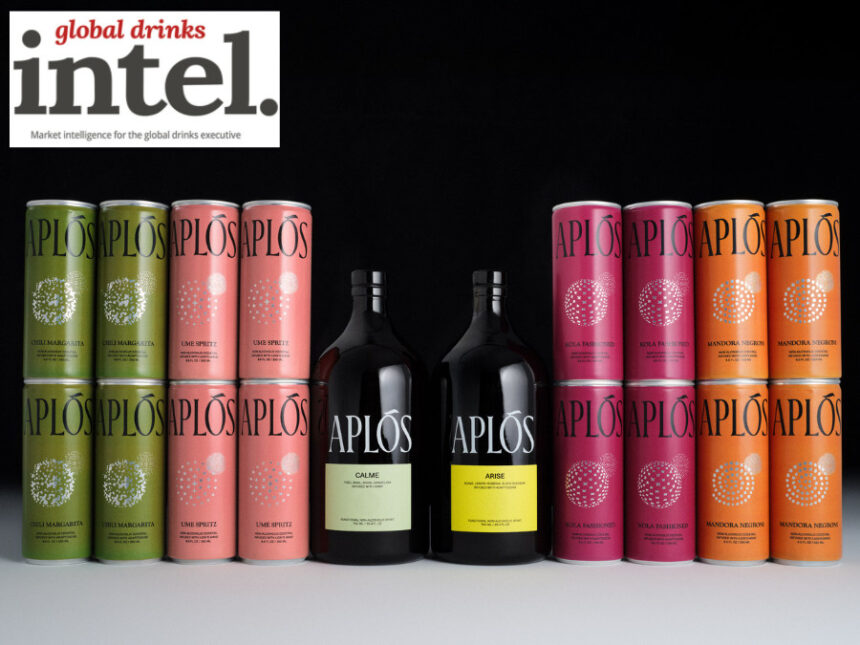
In the second part of Global Drinks Intel’s interview with the co-founder of functional non-alcoholic spirit Aplós, David Fudge shares his thoughts on the potential for non-alc in the years to come and whether the trends in alcohol today are cyclical or structural in their nature.
What’s the size of Aplós today?
So, last year, we sold north of 100,000 cases. In 2026, we hope to double that and get close to 250,000 cases. We’re available nationwide in the US through our seven distributor partners.
Presumably, the area of the drinks industry that Aplós operates in has grown faster in the last few years than you expected it to.
Even now, there’s still a certain level of scepticism – with investors in particular – of how big this category could be. A lot of them seem to look to the past to predict the future – that’s just not the way the world works.
We’re creating something new, so history rhymes, but it doesn’t repeat itself. We’re here to prove to them how big the non-alc category is.
I don’t think alcohol is going away. The narrative of pitting non-alc and alcohol alternatives against alcohol misses the point. Most consumers – and 90% of our consumers – still drink alcohol, they’re just moderating their consumption in certain occasions.
When I say there’s a realignment of the adult beverage industry, it’s really a diversification. People want more options, and what we’re seeing are consumers have an Aplós cocktail and then an alcoholic cocktail. The share of wallet is shifting to other brands, but the consumer still wants to enjoy cocktails in occasions where they’re socialising or out to dinner, or whether they’re drinking because they’re stressed or want to have fun. It’s just, do they want a cocktail with alcohol or with other functional ingredients or one that’s not functional at all?
Do you see the wider trends with alcohol as being cyclical or structural?
There are some real structural changes happening, for sure. On the distribution side, for example, you’re seeing some retailers want to go with bev-alc distributors and some want to go with more traditional food distributors. The retailers don’t appear to have figured out how to optimise the industry. It’s like there are shifting sands under us, and they relate to the distributor ecosystem.
Then, there are the changes in consumer preferences. For most of our lives, alcohol has been the default for the way that we socialise, the way that we unwind and the way that we connect. That’s no longer the case and it’s loosening every day.
That’s the systematic change that we’re in the middle of right now. It’s probably going to last another decade before there’s a settling of how that diversification may continue and grow.
Who do you consider to be the competition for Aplós?
Obviously, there are a lot of other brands in the alcohol-alternative space, but we have a singular vision that we’re focused on. This is a marathon, not a sprint, right? You don’t run a race looking to your side and behind you. We’re aware of what’s happening, but the alternative space is bifurcated between imitators and innovators.
There are brands that are trying to imitate traditional alcohol flavour profiles – We’re not doing that. We’re not creating a non-alc gin, we’re creating Aplós. We want to have the building blocks of what it takes to be a great lead spirit in a cocktail that is versatile and that mirrors how people consume a traditional spirit. We’re not reinventing consumer behaviour here, but we sit squarely on the innovator’s side in the sense that we’re creating functional non-alc spirits that have ingredients that give you an effect that’s mood-altering and that mirrors the effect you want in the occasion you’re drinking.
We have two lanes of products; one for when you want to chill out, one for when you want to go out.
What’s your exit strategy?
We’re focused on building a lasting brand that will anchor the bar of the future. We want Aplós to be a must-carry, just as Grey Goose or Don Julio are.
Ultimately, we can see a partnership, or acquisition or majority buyout with a larger player who excels in distribution and supply chain. The business of building a brand is really messy, and it’s not in the skillset of these large global drinks companies. They tend to innovate on their current brands, not create new brands. So, this is a very acquisitive industry.
The larger companies are really good at supply chain and distribution and scaling established brands. We’re in that phase of building a foundation for global scale with an eye towards a partner in the future that can help us realise that global scale with their expertise in supply chain and distribution.
This article is available to Global Drinks Intel members only.
Click below for details on how to join the Global Drinks Intel community.
Already a member?
Log in here to read the article in full.
If you work for any of the following corporate subscribers to Global Drinks Intel, head here to activate your access.
- AB InBev
- Bacardi
- Campari Group
- Diageo
- Moët Hennessy
- Pernod Ricard
- Proximo Spirits
- Suntory Global Spirits
- William Grant & Sons