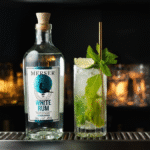
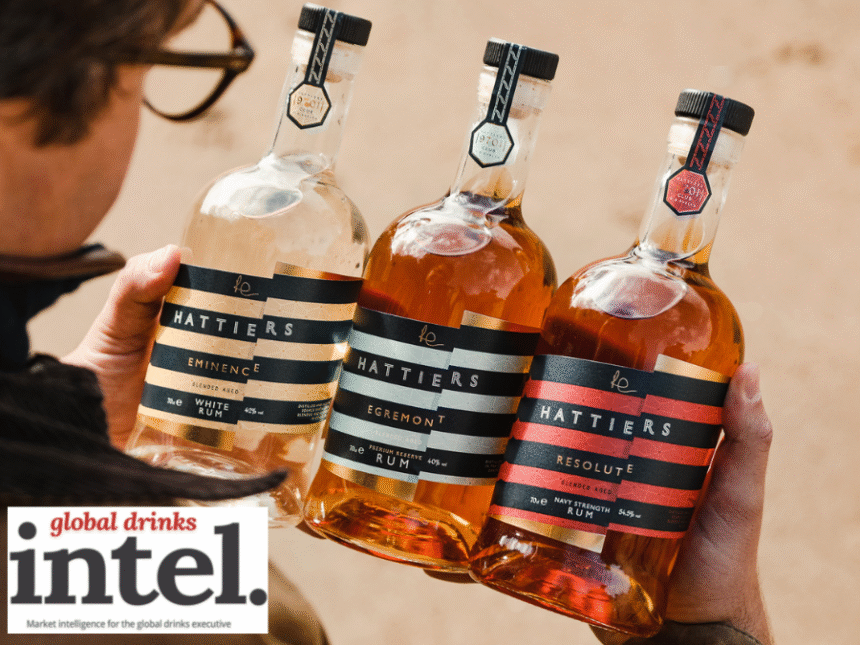
From Doctor Who prop master to B Corp-certified rum founder, Philip Everett-Lyons has built Hattiers Rum into a standout British brand and will soon close a GBP1m (US$1.3m) funding round.

Competitors can become collaborators
One of the most unexpected lessons that Hattiers Rum founder & CEO Philip Everett-Lyons has learned is that competition doesn’t need to mean isolation. In fact, some of his most valuable industry insights have come from those traditionally considered rivals.
“Your competitors very often become collaborators,” he says. “I’ve never come at this from an angle of sharp elbows… not talking about volumes we sell. That collaboration helps us navigate – it’s like our extended network.”
In a move that might raise eyebrows in other industries, Everett-Lyons hosted a lunch for UK rum producers simply to share experiences and strategies. “We just chewed the fat – what’s hard, what’s easy, where we’re winning,” he explains. “They’re not rivals. They’re fellow drinks entrepreneurs navigating the same tides.”
Everett-Lyons points out that informal networks, such as group chats among founders, have also been vital in trading supplier tips and market insights. “All these are just shortcuts to your goals,” he says.
Fundraising is brutal but vital
Scaling a spirits brand requires capital, and acquiring it demands a particular kind of endurance. Everett-Lyons describes the process in stark terms: “Raising capital in the drinks space is rarely quick. It’s never easy, but it is essential.”
He stresses that storytelling and stamina are just as critical as spreadsheets and pitch decks. “Most brands trip up not because they don’t have the product or the passion; they just run out of cash,” he says.
Fundraising is a time-consuming, high-stakes endeavour that often falls to the founder. “It’s a full-time job, not a side hustle,” Everett-Lyons says.
Hattiers has now reached a point where it’s bringing in a corporate finance team to allow the CEO to focus on strategic growth. Even in this high-stakes area, collaboration with competitors has proved beneficial. “We’ve had competitors who’ve pointed us in the direction of potential investors,” he reveals, highlighting again the power of openness within the industry.
Celebrate the small wins, always
In an industry obsessed with momentum and milestones, it can be easy to overlook the smaller victories, but doing so is a mistake, according to Everett-Lyons.
“It’s easy to get caught up in the ‘Okay, tick, what’s next?’ mindset,” he says. “But those small wins – a new distribution deal, an award, a glowing mention – they matter.”
Rather than simply noting achievements in passing, Hattiers makes a point of celebrating them. “We open a bottle of champagne and mark the moment,” Everett-Lyons notes. “These are the things that fuel the next leg of the journey.”
This mentality also reinforces morale across the team and strengthens brand culture. “Small wins stack up. If you don’t take the time to recognise them, you risk burning out before you ever break through.”
Luxury is earned, not claimed
As the spirits shelves become increasingly crowded with so-called ‘premium’ brands, Everett-Lyons is clear: real luxury cannot be self-declared. It must be earned through experience, consistency and trust.
“If I put ‘premium’ on a label, what does that mean to a consumer?” he asks. “It’s a claimed price point, not a proven one.”
Hattiers, which is on sale in the UK through ‘upmarket’ retailers Waitrose, Fortnum & Mason, Harvey Nichols and Daylesford Organic, among others, has built its reputation on the quality of its product and the relationships it has fostered with trade partners. “Let your customers and the trade decide where you sit in the market, “he advises. “They’ll tell you – eventually.”
Earning the trust of bartenders, retailers and discerning drinkers requires time and a clear commitment to quality. “You might sacrifice short-term revenue by walking away from certain listings or opportunities,” Everett-Lyons says, “but you protect your brand’s long-term positioning.”
Sustainability is now a baseline
As the UK’s first B Corp rum producer, Hattiers has long been vocal about sustainability. But Everett-Lyons now argues that the conversation needs to evolve. “Sustainability is no longer a USP. It’s the minimum,” he states. “Responsibility isn’t a badge – it’s a starting point.”
Today’s challenge is to embed sustainable practices authentically while still delivering on quality, profitability and growth. “Our customers already know we’re a sustainable brand,” Everett-Lyons explains. “Now, they want to know: what else?”
Hattiers is adjusting its messaging accordingly, focusing more on product storytelling, cocktail versatility and sourcing decisions, while maintaining its B Corp commitments in the background. “It’s not about shouting the loudest anymore,” says the CEO. “It’s about embedding responsibility into every decision – from packaging to logistics to blend selection – and letting that consistency speak for itself.”
In Everett-Lyons’ view, brands that treat sustainability as a marketing angle rather than a core value will eventually be left behind. “It’s not a trend – it’s the new baseline,” he says.
“If it’s not in your DNA now, you’re building on borrowed time.”
This article is available to Global Drinks Intel members only.
Click below for details on how to join the Global Drinks Intel community.
Already a member?
Log in here to read the article in full.
If you work for any of the following corporate subscribers to Global Drinks Intel, head here to activate your access.
- AB InBev
- Bacardi
- Campari Group
- Diageo
- Moët Hennessy
- Pernod Ricard
- Proximo Spirits
- Suntory Global Spirits
- William Grant & Sons