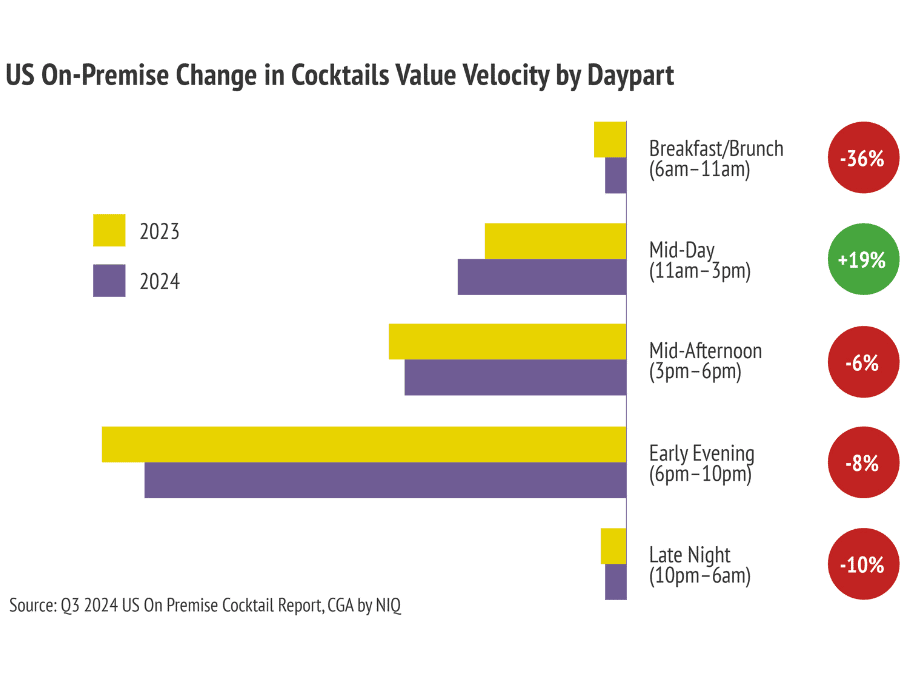
- Cocktail consumption in the US on-premise is moving towards earlier times of the day
- Mixed drinks account for 34% of total spirits value in the channel
- Cocktails deliver the highest revenue per serve, with an average price of US$13.75
- 46% of cocktail consumers favour tequila-based drinks
- The margarita is the most ordered cocktail, but the caipirinha generates the highest average spend
The cocktail and mixed drinks market is thriving in the US, particularly among younger consumers. About one in three Americans aged 21 to 54 enjoy cocktails, with even higher engagement among Gen Zers and late Millennials.
The cocktail is experiencing a wave of cultural momentum, with mixology gaining mainstream appeal and even spawning celebrity-style figures and dedicated shows on streaming platforms. This is no small feat, especially in light of the struggles faced by other beverage alcohol categories, like wine and beer, and the broader trend of declining alcohol consumption.
The cocktail category’s popularity translates directly into strong sales potential for on-premise venues. According to BeverageTrak data, mixed drinks account for 34% of total spirits value in the on-premise, generating more than US$14,000 in average outlet revenue over a 12-week period.
Cocktails also deliver the highest revenue per serve, with an average price of $13.75. This is higher than wine and neat spirits, and almost double that of beer, which shows just how critical this segment is for any on-premise business.
To fully capitalise on this lucrative market, however, operators and suppliers need to understand what motivates guests to choose a cocktail, which serves they’re gravitating towards and how they navigate the decision-making process when selecting what tipple to drink.
Cocktails in focus
Creating a well-crafted and thoughtfully developed menu is essential to unlocking the full revenue potential of the category. A significant two-thirds of cocktail drinkers are likely to consult the menu before making their choice, especially younger to middle-aged consumers.
These engaged users are not only more inclined to explore cocktail options, but are also willing to pay more for serves that feature branded ingredients, so it’s vital to clearly list what goes into each drink.
A well-designed menu may be a convenient, albeit somewhat passive, tool for driving sales, but it shouldn’t be your only strategy. When unsure what to order, 72% of cocktail drinkers turn to the bar staff for recommendations, so employees must be knowledgeable and confident in upselling when engaging with guests directly.
Once guests have consulted the menu or sought staff recommendations, there are other factors that influence their final choice (or whether they return for another round). Taste is by far the most important driver, with 71% of cocktail drinkers selecting a serve based on how they expect it to taste. Just over half also consider price, meaning that drinks’ pricing must strike a good balance between profit and affordability.
Two other key influences further reinforce the importance of providing detailed information on the menu or conveying it clearly through staff. Nearly half of cocktail drinkers say quality is a deciding factor (which they’re likely to gauge based on the listed ingredients, unless they’ve tasted a drink before).
Additionally, more than one in four are particularly brand-sensitive, meaning the appeal of specific brand names can strongly sway their choices. For operators, this underscores the need to ensure that cocktail descriptions and ingredient lists are not only informative, but enticing.
CGA by NIQ’s ‘On Premise User Survey’ (Opus) reveals that the base spirit of a cocktail plays a major role in consumer decision-making too. Drinkers tend to gravitate toward cocktails made with their preferred distillate.
Tequila leads the way, favoured by 46% of cocktail consumers, followed by flavoured vodka and whiskey/whisky, each preferred by nearly one in three LDA consumers. Classic vodka, light rum, sparkling wine, gin and flavoured or spiced rum follow closely behind.
These spirits should be staples on any back bar, as their popularity is also reflected in the top-performing classic cocktails. Indeed, the margarita remains the undisputed champion across all age groups, with a remarkable 55% of over-55s choosing the serve when drinking out. The mimosa follows, resonating strongly with under-35s, alongside other younger crowd favourites such as the daiquiri and piña colada.
Cocktail performance, however, can vary significantly depending on the metric considered. While the margarita is the most popular choice overall, for instance, it ranks in the bottom half on check (bill) value, while checks containing a caipirinha generate the highest average spend, outperforming all other mixed drinks.
When it comes to revenue per item, the manhattan and negroni stand out as the highest-priced cocktails on average, costing nearly twice as much as a sex on the beach. This suggests a strong consumer willingness to pay a premium for these classic serves.
Meanwhile, the old fashioned, though not topping any single category, delivers solid performance across the board, consistently ranking in the top six for all key metrics, making the serve a reliable and well-rounded option for any cocktail menu.
Time-of-day trends
Understanding specific drinking occasions, as well as the times of day and week when particular cocktails tend to be most popular, can be crucial when strategising cocktail offerings.
It is no surprise that Friday and Saturday are the most valuable days for cocktail sales, with Saturday seeing more than twice the number of drinks sold compared with weekdays. On average, prices are slightly higher on Saturdays and check values are at their peak over the weekend too.
But with earlier dayparts gaining an increasing share of cocktail value velocity (average spend) in the US on-premise, it is best to focus on the nuances rather than relying solely on broad averages.
Monday, for instance, may be the least valuable day of the week, but it outperforms Wednesday between 11am and 3pm, while Wednesday itself surpasses other weekdays during breakfast and brunch hours.
Thursday proves to be the most lucrative weekday across most dayparts, with the margarita and old fashioned performing particularly well, but Fridays generate the highest early evening sales of any day, and Sunday even outperforms Saturday in the first part of the day.
As for the performance of specific cocktail types throughout the week, top drinks tend to generate the most value on Fridays and Saturdays. That said, serves like the bellini, mimosa and bloody mary are more lucrative on Sundays, likely due to their association with brunch or daytime drinking. Conversely, drinks such as the julep and collins are more valuable early in the week than on weekends, so operators should focus on those if weekdays are crucial for business.
Meanwhile, less popular cocktails, along with classics like the old fashioned, spritz, whiskey sour and, particularly, the mai tai, tend to perform consistently well across the entire week.
Dissecting consumption times further, CGA by NIQ data reveals that cocktail velocity increases throughout the day, peaking in the early evening. Between 6pm and 10pm, they generate nearly twice the value of the afternoon, with almost as many cocktails sold during this timeslot as throughout the rest of the day combined.
Yet there are also opportunities to profit from the category during the day. For example, the bellini and the mimosa are more lucrative between 11am and 3pm compared with other mixed drinks, possibly because they are perceived as more suitable for daytime occasions.
At first, such varied performances seem to suggest that cocktails may not represent a strong opportunity for every business. Yet the category has one major advantage over any other alcoholic beverage: an incredibly diverse range of tastes, mouthfeels and flavours. This diversity enables operators to profit from cocktails at any time of day or week and across all regions.
Success simply depends on identifying the right drinks for each occasion and location, and on clearly defining strategic priorities – whether the goal is to drive volume with popular serves or to maximise revenue per sale.
CGA by NIQ’s suite of research services provide brands and operators with an unrivalled view of the US on-premise sector and cocktail category dynamics.
The Cocktail Sales Tracker and On Premise Cocktails Report are powered by CGA by NIQ’s unique fusion of sales measurement data and consumer research. They provide an essential and holistic overview of the cocktail category, helping businesses measure current performance and achieve future growth. To learn more about CGA’s capabilities across the US on-premise, click here.
Members-only intel
Keep reading this members-only article – and every one like it
- ✓All paywalled news and interviews
- ✓Category and market data
- ✓Monthly GDI magazine
- ✓Full archive + daily newsletter
Secure checkout · Cancel any time · Company invoices available
Already a member? Log in
See all plans, incl. 10-reader and corporate
Check if your company already pays for you Your company may already give you free access.
Corporate subscribers: AB InBev, Bacardi, Campari Group, Diageo, Moët Hennessy, Pernod Ricard, Proximo Spirits, Suntory Spirits Group, William Grant and Sons.
Activate company accessNot ready yet? Get the headlines free in our daily newsletter.
Sign up free