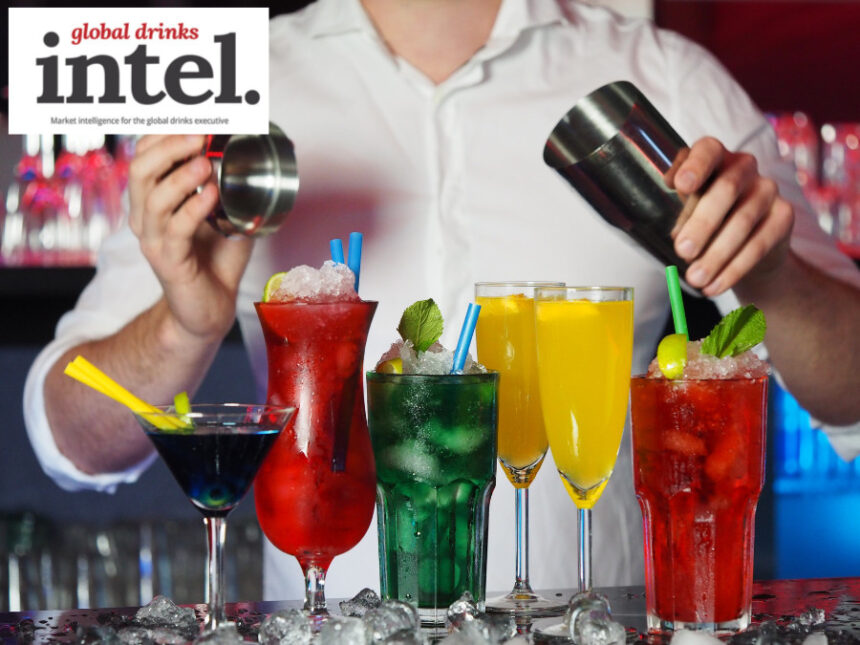
In line with the steady growth of the no- & low-alcohol beverage segment, zero-ABV cocktails are expanding their presence in both the on- and off-premise. With IWSR Drinks Market Analysis forecasting the no-alcohol category will grow over the next three years at a healthy CAGR of 7%, it seems a no-brainer that non-alc cocktails will also flourish.
Yet this consumption opportunity has challenges to overcome if it is to capitalise on its undoubted potential.
In the off-premise, many outlets are missing out by simply not listing enough no-alcohol products, argue brand owners. “There is definitely room for expansion,” according to Charlie Winkworth-Smith, co-founder of UK-based Saicho, a single-origin sparkling tea now available in 12 markets worldwide. “We’re seeing growing interest from the off-trade, but more visibility and education in-store is needed for non-alc products. This starts with the staff being aware of the range, to signage on the shelf, helping consumers navigate the offering and make a choice.”
Meanwhile, the on-premise channel also needs to raise its game, says the head of production at English brewer, spirits producer & pub operator Adnams, Fergus Fitzgerald. “It’s important for pubs to have no- & low-alcohol options across all categories, including cocktails,” he says. “Customers don’t want to feel that opting for a low-alcohol [beverage] is a compromise. That’s reflected in the quality expectations they have now.
“Smidgin Gin [which has an ABV of 0.6%] was produced with that principle in mind. It makes a great no/low gin & tonic, but is equally at home in a no/low tom collins or bramble, or anywhere you would use gin.
A question of quality
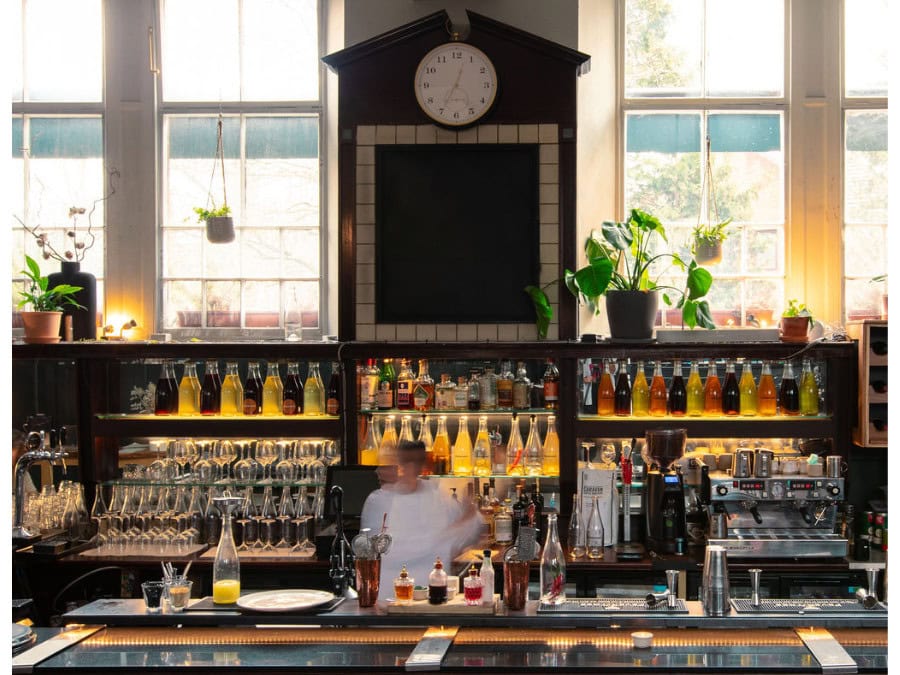
Some bar owners and mixologists have expressed concerns about the quality of many non-alcoholic beverages, pointing to their often-high sugar content and additives. Because of this, many on-premise operators look in-house when it comes to zero-ABV cocktails. Glasgow restaurant Celentano’s (above) is a good example – the Italian-inspired venue makes its own 0% vermouth, cordials, kombucha and other ingredients for its non-alc offerings.
“We only serve one non-alcoholic spirit, Pentire, which we’re currently happy with,” says co-owner & MD Anna Parker. “It’s really hard to find one that isn’t super-sweet, and we need something that will complement our food offering. We used to buy in non-alcoholic liqueur and mixers, but we now make them ourselves. They’re far fresher and more unique.”
Other on-premise operators highlight the still-fragmented nature of spirits’ no-alcohol segment along with securing repeat purchase and the creation of consumer loyalty as being particularly challenging. “While the category is still relatively young, we’ve seen increasing awareness among customers who can name-call specific non-alcoholic drink brands,” says the head bartender at New York’s The Rum House cocktail bar, Nick Jackson. “However, the market is still somewhat fragmented, with a mix of established and emerging brands. Non-alcoholic brands are developing reputations currently and this will continue to expand as there is more diverse product placement for them.”
The bar manager at Milan-based cocktail bar & fine dining restaurant Moebius, Giovanni Allario, describes non-alc as “quite young” and “non-recognisable” by the typical consumer. “Mostly, we get asked for a non-alcoholic version of a spirits category or serve,” he says.
Building body and flavour
Allario highlights another challenge – creating a cocktail with the same body and depth of flavour as its alcoholic counterpart. “Mimicking the mouthfeel and feeling of body and strength is the most difficult task,” he explains. “Often, all of this is made up for with sugar, which goes against the healthier lifestyle that today’s society is striving for. The general consumer palate is demanding less sugary drinks.”
The beverage director at New York cocktail bars Madame George, Valerie and Lolita, Marshall Minaya, concurs. “Body seems to be the most lacking feature when it comes to non-alcoholic spirits,” he says. “There’s plenty of depth in spirits like Pathfinder Amaro, but body is indeed the question I always come back to when developing a new non-alcoholic cocktail.
“I always think that something carbonated is a massive help – the carbonation will help pull out botanical traits of the non-alcoholic itself and provide a touch more body.”
Is the price right?
Critics of the non-alcoholic drinks scene often point to their relatively high price-point compared to their full-alcohol equivalent as another stumbling block for this nascent category, especially during straitened economic times.
“We’ve found that customers prefer an equal or lower cost of a non-alcoholic offering to an alcoholic equivalent,” says the general business manager of operations at Vermont-based bar Citizen Cider, Nicole Pierce. “However, this may change as offerings expand and social acceptance continues to grow. This is an interesting detail that informs recipe building because de-alcoholising a product comes at a greater cost than an alcoholic version.”
In contrast, the owner of the recently opened Portland-based cocktail bar Kaya, Katya Suh, holds a different view. “The non-alcoholic drinks we’re serving are premium drinks, crafted with high-quality ingredients and made with the same care and attention as our alcoholic cocktails,” she insists. “We haven’t received pushback as, across the board, customers know they’re getting a premium, curated beverage and experience.”
In a similar vein, Minaya says his teams rarely receive complaints from their patrons about prices. “One person did take the time to make a public statement about the price of non-alcoholic offerings at Madame George, but if he’d like to come peel and juice ginger, juice limes and juice and clarify strawberry juice with our prep team, he would be more than welcome to!”
Countering the preconceived consumer profile
‘Know your customer’ remains a basic but fundamental business principle, yet common misconceptions surrounding who the typical non-alc cocktail drinker persist. Last year, Southern Glazer’s Wine & Spirts, one of the biggest drinks distributors in the US, saw its sales of non-alcoholic beverages grow by 16%. The company’s executive VP of national accounts, Chris Williams, points out: “When thinking about non-alcoholic beverages, Gen Z may immediately come to mind. While they do represent the largest dollar growth by a significant margin, we see a nearly equal generational impact across all LDA buyers in the off-premise.”
Another fallacy is that demand for non-alc cocktails only comes from teetotallers. “I think that when this trend started, it was targeted at the non-drinker,” says the president of Chicago-based hospitality management consultancy Hospitality Works, Izzy Kharasch. “However, today it’s resonating with a larger audience. Even I find myself taking advantage of this option, not because I don’t drink, but if I was having cocktails with clients the night before, I may not want to drink, so I’ve been ordering more non-alcoholic cocktails.”
Meanwhile, Minaya says the time of the year is also a factor and highlights the different non-alc preferences of abstainers versus non-drinkers. “This year was probably our busiest ‘Dry January’, with a lot of guests exhibiting comfort and confidence in ordering non-alc cocktails and trusting that they’ll receive a quality cocktail,” he reveals.
“Overall, it depends on the reason for abstaining. Non-drinkers tend not to look for substitutes. Someone who’s pregnant, on antibiotics or otherwise taking a break, tends to lean harder into non-alc cocktails.”
Moving beyond the no-alcohol versus alcohol binary
Despite the challenges facing the non-alc cocktail segment, brand and bar owners remain confident that demand will continue to grow. “We know that consumers of non-alc spirits are looking to have the same premium experience as consuming alcohol, so cocktails without alcohol that look and taste as good – if not better – are proving very popular,” says Paul Mathew, the founder of Everleaf Drinks, a UK non-alcoholic bitter-sweet cordial made with 14 sustainably-sourced botanicals.
The head of marketing at Lithuanian sparkling tea brand Acala, Kamilė Šabūnė, agrees. “Global demand [for non-alc cocktails] is very big and represents half of Acala sales,” she says. Acala features two cocktails in its current range – Spritz and Mimosa. Šabūnė adds: “More and more, people are looking for drinks with functional benefits. At the same time, they want drinks that go well with food, as well as with a glass of fine sparkling tea for a special occasion.”
Both Mathews and Šabūnė ultimately wish for the conversation around non-alc cocktails to move beyond comparisons between the alcoholic and non-alcoholic. “Perhaps the best way to evaluate drinks is not by their categories, but by the experiences they offer,” says Šabūnė. “In today’s world, we all crave uniqueness to captivate and delight our taste buds. We feel that our meticulously crafted beverages enhance the wine and cocktail culture, delivering a comprehensive experience.”
In a similar vein, Everleaf’s Mathew adds: “We’d love to see the industry move away from non-alcoholic versus alcoholic in this discussion. We’re an award-winning drinks brand full of flavour and complexity that just happens to be non-alcoholic.
“Cocktails are as important for us as they are for any other spirits category!”
This article is available to Global Drinks Intel members only.
Click below for details on how to join the Global Drinks Intel community.
Already a member?
Log in here to read the article in full.
If you work for any of the following corporate subscribers to Global Drinks Intel, head here to activate your access.
- AB InBev
- Bacardi
- Campari Group
- Diageo
- Moët Hennessy
- Pernod Ricard
- Proximo Spirits
- Suntory Global Spirits
- William Grant & Sons