

This article has been available to Global Drinks Intel subscribers since May. For details on how to join them, please click here.
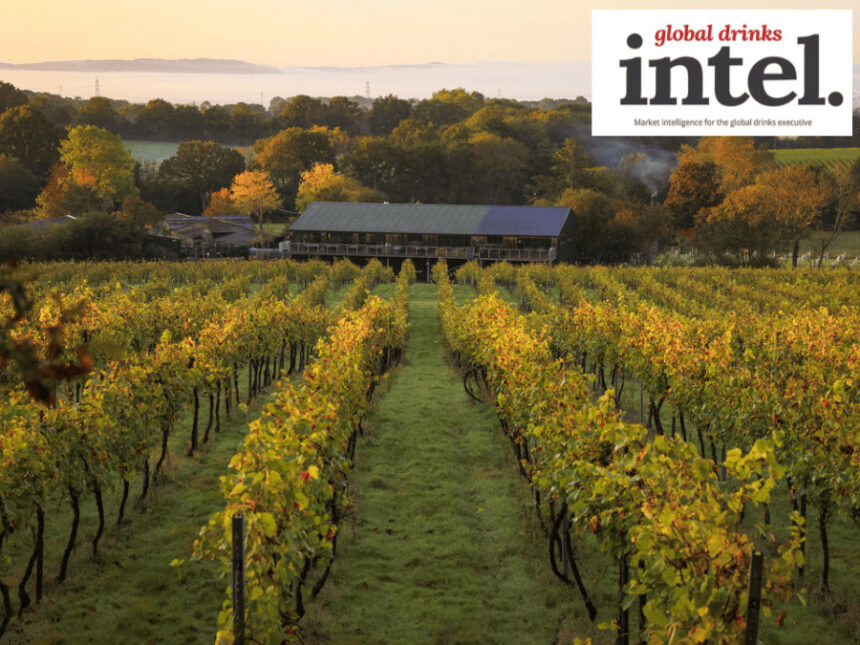
From Cornwall to Kent, English wine producers are on a roll, even though the UK market for sparkling wine has been hit by turbulence recently.
English sparkling wine is getting better with age. Major producers in the segment, such as Bolney Wine Estate, Chapel Down and Nyetimber, are gaining in confidence and building a stronger reputation, both at home and abroad. Meanwhile, the UK market itself [for both sparkling wine and Champagne] has seen declines, but continues to attract attention from many quarters, most especially from Italy’s prosecco makers.
Humphrey Serjeantson, research director at IWSR Drinks Market Analysis, says: “In 2021, locally produced sparkling wine in the UK [including both British wine and English wine] grew by nearly 20% in volume terms versus 2020. Some of this was recovery from a small decline in 2020, but the category is on a long-term growth trajectory. Volumes are expected to hit a CAGR of 6% between 2022 and 2026.”
The biggest player in the market is Kent-based Chapel Down, which it released a strong set of results for 2022 at the end of March. Sales rose 10% year-on-year to GBP15.6m [US$19.4m], led by its sparkling wines. The winery makes its fizz using méthode traditionnelle just like Champagne producers, helping to enhance its image.
In 2022, the firm’s sparkling wine sales rocketed by 53% to GBP9.6m – versus an already strong 2021 – to reach a record volume of almost 800,000 bottles. “The perception of English wine has changed a lot,” Chapel Down sales director Tom Hepworth-Bond tells Global Drinks Intel. “We’re exporting to 14 markets now and are also in global travel retail at London Heathrow, Gatwick and the Eurotunnel.”
In early 2021, Chapel Down became a pure-play winery after disposing of its beer and cider business. CEO Andrew Carter is expanding the company’s acreage as it doubles down on the continuing interest in English wine, and sparkling in particular.
Price rises and premiumisation
Last year’s sharp sales leap reflected price rises to a degree. “Our average selling prices to customers grew by 19%,” says Carter. “This was driven, in part, by prices increasing to help offset inflationary cost pressures but, more significantly, by a changing mix of sales as we focus on higher-priced traditional method sparkling wines. Consumers are looking for premium drinks brands that are exciting, fresh and have real provenance.”
Carter knows a thing or two about brand premiumisation having previously held top jobs at both Treasury Wine Estates and Bacardi. He has lifted Chapel Down’s brand profile through a deal to become the ‘official sparkling wine’ of the England & Wales Cricket Board last year, adding to a long-time sponsorship of the Oxford-Cambridge men’s and women’s boat races, which attract global audiences. For May’s coronation of King Charles III, the company created a limited-edition vintage sparkling wine.
Chapel Down is also leading the export charge, helped by having vineyards [owned or under long-term contracts] that by 2024 will cover 1,000 acres. Exports remain small at GBP456,000, but grew by over 160% last year and are earmarked for future development. “In the export channel, we focus almost exclusively on traditional method sparkling wine,” says Carter.
Smaller rivals are not as active, partly due to scale. At Camel Valley in Cornwall, CEO & owner Bob Lindo says of 2022: “We’ve been selling on allocation for many years, so sales remained either constant or better.” As for exports, he adds: “About 95% of our production goes into the UK, where demand outstrips supply.”
Bolney, near Brighton in Sussex, is one of the pioneer estates in England and was acquired last year by Henkell Freixenet. The German drinks giant’s CEO, Andreas Brokemper, said at the time: “As producers of Champagne, crémant, cava and prosecco, we are delighted to add English sparkling wine. We are convinced we can further strengthen its image nationally and internationally.”
James Davis, GM at Bolney Wine Estate, tells Global Drinks Intel: “In 2022, our wine business grew by 17%, with outperformance for sparkling wine across the overall business. We envisage strong prospects for exports with Bolney’s existing customer base, but also as a consequence of being part of the larger Henkell team.”
Global warming is partly behind the rise of English sparkling, as it has been for cool-climate wine elsewhere. IWSR’s Serjeantson says: “The quality of English sparkling has been improving for many years, partly due to climate change, which gives a longer growing season. This is leading to improved recognition both at home and abroad, and to increasing investment, including from major international Champagne houses, such as Taittinger and Pommery.”
English sparkling wine’s popularity shows no sign of abating, as IWSR’s promising 6% CAGR forecast suggests. Chapel Down has plans to double its total business by 2026, but in terms of industry-wide UK sparkling exports, much depends on production volumes which have never been that high in the country.
UK slide, but little sign of waning interest in sparkling wine
As for sparkling wine in the UK, sales for the 12 months to the end of February took a tumble of 8.5% to GBP1.3bn [based on sparkling wine and Champagne combined]. Freixenet, handled by the namesake group’s Freixenet Copestick UK division, retained its lead position and was the only label with sales of more than GBP100m [Source: Circana 52 weeks to 19 Feb]. The brand also saw the smallest decline at 2.2%, whereas Asda’s Yellow Label crashed by 27%. Also seeing big falls were Veuve Clicquot and Taittinger Champagne.
The only brand to grow in the top 15 was I Heart [+7.8%], another label in the Henkell Freixenet portfolio.
For Italy-based Zonin, recognised globally for its prosecco brand, the UK accounts for around 20% of the company’s exports and is still seen as a growth market. “Prosecco is a significant segment in the UK, representing more than 60% of on- and off-trade sparkling sales,” a spokesperson says. “We produce a great deal of private label, among which is the Kylie Minogue Prosecco Rosé. In just one year, it has become the No.1 branded rosé prosecco in the UK and has since launched in the US.”
The company notes a pull-back on higher-end DOCG lines, however, due to “the economic situation impacting consumer behaviour in the short term”. Over the longer term, according to the spokesperson: “We think the premiumisation trend will return, driven by UK consumers’ thirst for strong brands and high quality.”
Meanwhile, Bottega, another Italian sparkling producer near Venice, is also upbeat. “Our prosecco continues to grow in the UK in 2023,” a spokesperson says. “But, given the uncertainty weighing on the global economy, it will be difficult to repeat our 2022 performance.”
Bottega’s namesake brand is well-represented in hotels, restaurants and department stores, and stands out with its Bottega Gold metallised bottles. The company has also focused on the global travel retail channel in the UK. A year ago, it opened a Bottega Prosecco Bar & Caffè at London Stansted Airport, a format that has been expanding globally since launching in 2014, with around 30 locations to date. Other UK sites include Birmingham Airport as well as two seasonal pop-ups at Bath and Windsor racecourses.
“The Prosecco Bar formula has been hugely successful in Italy and around the world,” says president Sandro Bottega. “It transforms a quick break into an experience. Our wine bar format is of particular interest in the UK, where the Bottega brand is well recognised in the prosecco and sparkling wine market.”
This article has been available to Global Drinks Intel subscribers since May. For details on how to join them, please click here.