Since its rise to prominence in the West during the second half of the 20th Century, vodka has been America’s workhorse spirit. Riding on the back of domestic whiskey’s gradual decline in the US post-World War II, the category grew steadily in popularity through the 1950s and ’60s, abetted by celebrity endorsements from the likes of Zsa Zsa Gabor and Groucho Marx, and of course the perception of sophistication engendered by the ‘shaken, not stirred’ vodka martini of Sean Connery’s James Bond.
Eventually, in the 1970s, vodka achieved the position of best-selling spirit in the US, a status it has not relinquished since. The flavour boom of the late 20th and early 21st Centuries furthered the category’s fortunes until, by 2003, it accounted for almost one-third of all spirits sales in the US.
This trajectory was largely mimicked north of the border in Canada, with the national fondness for domestically-produced whisky tempering vodka’s fortunes only slightly.
Even the meteoric rise of tequila over the past decade and the renaissance of American whiskey during roughly the same period have only managed to dampen vodka’s popularity to a very limited degree. In 2023, the category totalled roughly 30% of all spirits volumes in the US compared to 32.5% in 2003, according to trade association the Distilled Spirits Council of the United States (Discus).
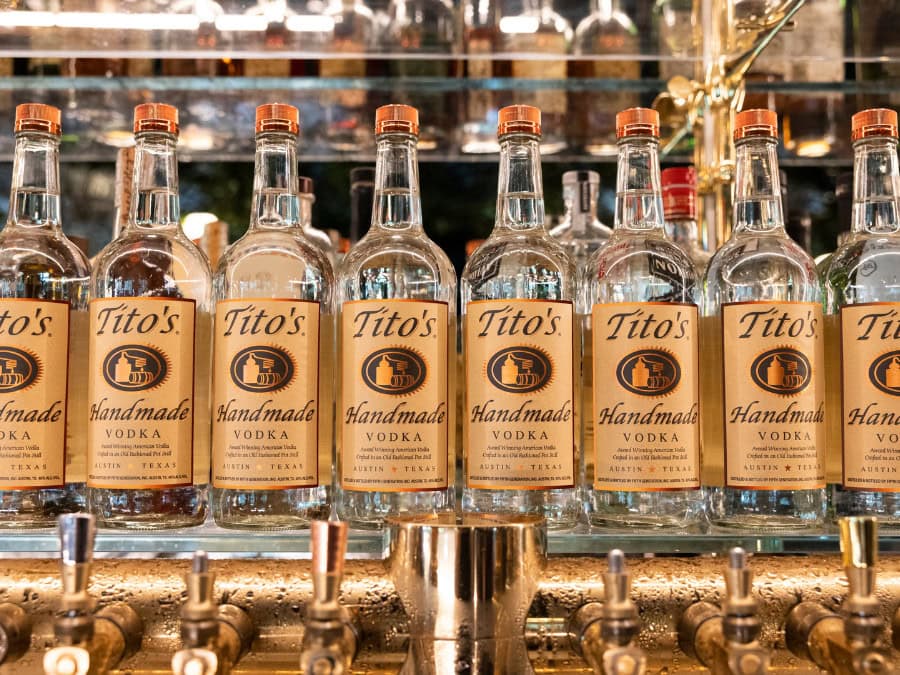
Versatility is the key to this enduring popularity, according to Tito’s Handmade Vodka MD international John McDonnell. “Vodka is a highly versatile spirit, which works in any number of cocktails,” says McDonnell. “For that reason, it continues to remain very popular in the US and around the world.”
Although the volume of vodka sold in the US has dipped slightly over the past three years, according to data supplied by Discus, sales by value have remained more or less consistent thanks to the strength of the high-end premium and super-premium segments, dropping less than 0.5% between 2021 and 2023. Such has been the growth of these price brackets over the two-decade period from 2003 to 2023 that, while volumes of vodka sold have increased 79%, the value of that volume has grown 143.7%.
“There’s a prevailing trend where consumers prioritise quality over quantity, and vodka is no exception to this shift,” notes Sergey Kucher, US CEO of Noblewood, which owns Beluga Vodka. “Consumers are increasingly seeking exceptional value and distinctive offerings, [which is why] Beluga Vodka has experienced notable growth of 31% over the past 26 weeks, attributed to its expanded distribution network and unique positioning as a luxury product.”
‘New luxury’ in vodka has artisanal credentials
This sentiment is echoed by Virtuous Spirits CEO Thomas Rejmell, albeit through a slightly different lens. “Consumers are looking for a new kind of luxury, where it’s less about being shiny and more about being real,” he says. “The new luxury in vodka is an artisan approach and quality. With the cocktail market booming, and as consumers continue to be knowledgeable about – and promiscuous in – the array of authentic spirits they are trying, I don’t think there has ever been a better time for an artisan vodka brand like Virtuous.”
Within this premiumisation trend, which IWSR Drinks Market Analysis predicts will deliver a global CAGR of 3% in volume between 2022 and 2027, there is a mini-trend towards the opening of discussions about the raw ingredients used in the production of vodka, as evidenced by Virtuous Vodka Rye and single harvest rye-based Belvedere 10.
It’s an area that vodka has traditionally been somewhat shy to promote, despite the fact that, as mixologist & author Tony Abou-Ganim notes in his landmark opus, Vodka Distilled, different ingredients can, and most often do, have an impact on flavour and aroma, although admittedly such differences can be understated.
“Think about tasting and comparing one vodka to another, not as comparing apples to oranges but comparing apples to apples – apples of the same variety grown in different orchards with differing geography and under various climate and nutrient conditions,” Abou-Ganim writes. “So it is with vodka – subtle variations, but there nonetheless.”
Virtuous Spirits’ Rejmell concurs. “In a category that historically has tried to get rid of as much taste as possible, [we] take a different approach,” he says. “Our Vodka Rye is distilled for taste, harnessing the qualities of the rye to deliver a vodka bursting with character and remarkably smooth. Needless to say, the raw ingredients mean everything to us.”
Focus on distilled botanicals
Also undergoing a shift is the industry’s approach to flavour extensions, which first experienced a period of massive growth beginning in the 1990s and reached their apex – and the end of its first boom period – with the rise of confectionary vodkas in the 2010s. The most recent generation of flavoured vodkas, notes IWSR, are inclined to be more reserved in character.
“New expressions have tended towards the more considered, with producers not only highlighting the flavours present in the raw materials used, but using additional ingredients in a measured way,” suggests IWSR in its ‘Vodka Innovation Trends’ analysis. “In some cases, these take a leaf from gin’s book, distilling botanicals to extract flavours rather than macerating or adding flavourings.”
Noblewood’s Kucher points to consumer preference as the instigator of this approach change. “The traditional perception of flavoured vodka has undergone a significant shift in recent years,” he says. “Consumers are no longer gravitating towards the conventional fruit- or berry-based flavours, which have declined 6% over the last 52 weeks, but are instead demonstrating a preference for unique, unconventional combinations [with] a growing interest in floral aromas, spices and other non-traditional ingredients.”
This transformation of the flavoured vodka landscape, Kucher continues, “underscores the importance of staying tuned to shifting consumer trends and adapting product portfolios accordingly”.
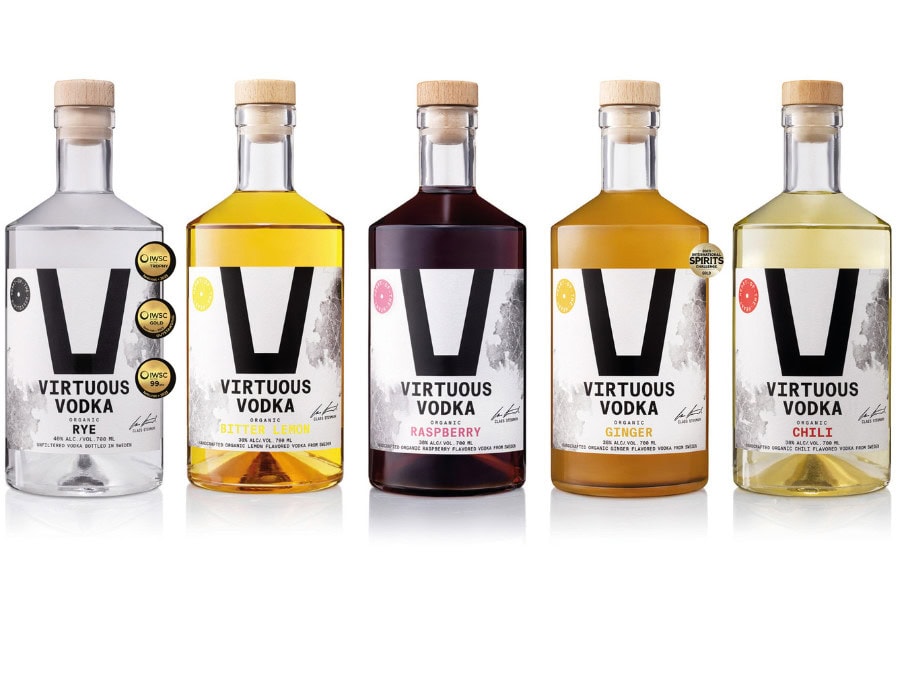
Many of this new breed of flavoured extensions highlight their natural and health & wellness cues by presenting a clear liquid. But Virtuous is bucking this industry trend – its range of flavoured organic vodkas (above) retain the natural colours of the raw ingredients used to produce them, such as lemon peel and raspberry.
Zeroing in on Latin America
With Canada emulating the behaviour of the US fairly closely, the remainder of the Americas market principally comprises Mexico and South America, with the majority of the latter coming from Brazil, which accounts for nearly 45% of all vodka sales in Latin America.
While most sources are optimistic that there is strong potential for vodka in Latin America, the actual size of the present marketplace is quite small. In Brazil, for example, vodka is expected to account for only US$1bn of the $42.2bn total beverage alcohol industry this year, according to Statista. Other Latin American markets are several times smaller, with Statista forecasting that Chile will account for $400m in sales in 2024, Colombia $300m, Mexico $46.1m and Argentina $21.5m.
Still, the modest size of the Latin American marketplace is offset somewhat by predictions of significant growth from 2024 to 2028 – Statista predicts a CAGR of 6.4% in Brazil, 3.9% in Chile, 4.8% in Colombia, 2.3% in Mexico and 14.1% in Argentina over the same period. It’s enough to have Tito’s McDonnell speak optimistically about the region.
“We’re in talks to enter Argentina and the Chilean domestic market, but other than those two countries, we’re pretty much in every market in the Americas,” he says. “Those two countries have great growth potential, especially down at the Southern Cone where cruise business is increasing.”
While the fragile economies of Latin American nations always add a degree of uncertainty to any predictions of growth, particularly in Argentina, which has cycled in and out of economic crises for decades, the overall picture for vodka in Mexico and South America does present reason for hope.
As for the rest of the Americas, as long as the category’s premium segments hold on to their growth, which seems likely, it’s a fairly certain bet that the spirits workhorse that is vodka will keep on working for a long time to come.