

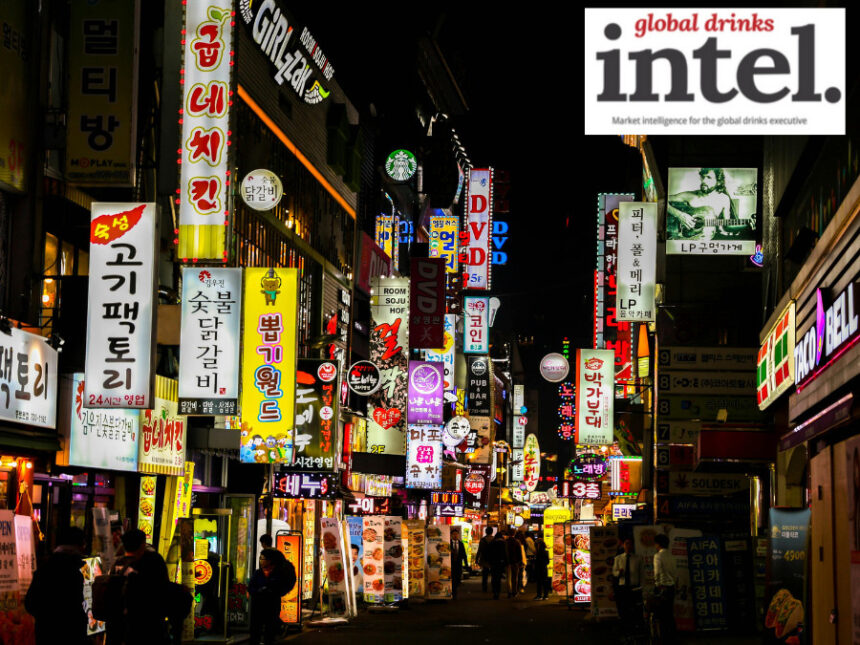
South Korea faces demographic headwinds with a contracting domestic market and ageing population. Yet the rebounding economy and changing lifestyles are creating optimism among beverage alcohol brands as tastes reshape the spirits landscape.
Post-pandemic, the food and beverage industry saw a strong rebound with substantially rising restaurant and bar employment. Eating out remains popular, with 65.9% of adults dining out weekly in 2023, according to the Korea Rural Economic Institute. Notably, 46.8% of households report no change in food purchases despite inflation, indicating the country’s continued economic resilience.
Following record household alcohol and tobacco spending in 2022 — KRW16.98tn (US$12.89bn) — and rises in inflation-adjusted incomes, it is predicted that the F&B industry will continue to recover in 2024.

The era of the highball
The highball serve, especially with a whiskey/whisky base, continues to rise in popularity in South Korea. Commentators attribute the serve’s success to Millennial and Gen Z consumers shifting toward moderate drinking experiences and seeking affordable luxuries post-Covid-19.
The country’s spirits market has seen a “surge in whiskey/whisky demand, firmly establishing the highball trend”, a Diageo spokesperson confirms. “Different venues cater to distinct segments, with standard whiskies dominating highballs in areas like universities, while malt bars are experimenting with cocktails and highballs featuring premium whisky.”
Since 2019, Diageo’s Korea division has actively promoted the group’s Johnnie Walker and Bell’s brands in highball serves, targeting large pubs and franchise bars with pop-ups and promotions. Ad campaigns with ‘local changemakers’, such as K-pop star CL, and the global roll-out of Johnnie Walker Blonde, a sweeter whisky made for mixing, have helped to broaden the serve’s popularity.
Suntory Global Spirits has also leveraged the highball trend, offering its Jim Beam bourbon and Kakubin Japanese whisky blend at accessible price points. Late last year, Suntory Holdings CEO Takeshi Niinami told Nikkei Asia that the highball craze had created such strong demand for SGS’s brands in Korea, that it could not be fully met. Niinami added that this year alone, he expected highball consumption in the country to expand “more than twofold”.
Pricepoint is not the only factor boosting highball consumption of SGS’s whiskey/whisky brands. Korea MD Young-ho Lee tells Global Drinks Intel: “We adapted the Japanese version [of the serve] for Korean palates, like using tonic and ginger ale instead of soda for a sweeter taste.”
Also driving the popularity of the easy-to-make serve is rising at-home demand, a trend that took hold during pandemic lockdowns. Capitalising on this, SGS launched Jim Beam Grapefruit and Lemon Highball RTDs in cans in the country last year.
Lee says the campaign, spearheaded by commercials with singers Uhm Jung Hwa and Kim Chaewon (above), was the brand’s most successful in South Korea to date. “The RTD space is much more innovation-driven than regular spirits,” he adds. “Consumers love to explore, and expect new things.”
Shifting tastes
On the back of the highball’s rise, South Korea has become one of whiskey/whisky’s fastest-growing markets. Korea Customs Service data shows the category’s imports hit new highs in 2022 – US$266.8m in value and 27,038 tonnes in volume (a huge increase from the previous year’s 15,622 tonnes), before declining slightly last year (-2.6% in value to $259.7m, with volume moderating to 30,586 tonnes). But it’s not all down to one serve.
“The whiskey/whisky market has grown rapidly since the pandemic,” explains Suntory Global Spirits’ Lee. “We continue to see growth and a trend toward premiumisation, as consumers, particularly younger LDA adults, move from soju to premium spirits.”
There is increasing interest in non-scotch whiskies, with Northern Ireland’s Belfast Distillery Co recently securing a deal to export nearly 10,000 bottles of McConnell’s and Pernod Ricard Korea launching Redbreast 15-year-old into the market late last year.
The category’s momentum has also buoyed importers, including GoldenBlue (Kavalan and the domestically bottled Golden Blue blended scotch), William Grant & Sons Korea (Glenfiddich, The Balvenie), Pernod Ricard Korea (Royal Salute, Chivas Regal, Ballantine’s) and FJ Korea (Dewar’s, Bushmills, Aberfeldy, Aultmore) – some reporting 60%–70% sales jumps in 2022 alongside doubled profitability helped by price hikes. Increased demand saw some whiskies, such as Royal Salute and Glenfiddich, rise in price by about 20% in less than two years.
The higher prices, however, are putting authentic whiskey/whisky highballs beyond the reach of many consumers. On top of the price rises, imports are saddled with hefty taxes — a 72% liquor tax and 20% customs tax — pushing retail prices even higher. This has driven some consumers to opt for cheaper, oak-flavoured highball RTD alternatives to mimic the taste of whiskey/whisky, while others are opting for value deals from rising imports of affordable whiskey/whisky from non-traditional countries, such as Australia, India and Taiwan.
Enjoying better, not more
The growth in whiskey/whisky has sparked interest in mixology as consumers increasingly focus on quality, taste and discovery over quantity. This is fuelling demand for creative cocktails. While most spirits are imported, nascent local companies, including Buja Gin Distillery (Buja Gin series) and Three Societies Distillery (Ki One and Jung One whiskies) signal that domestic alternatives are emerging.
Beyond whiskey/whisky, other imported spirits are finding niche appeal in South Korea. Gin imports, for example, nearly doubled in value to $5.5m from 2019-23, according to the customs service, the biggest brand being Bombay Sapphire. Rum imports, meanwhile, rose moderately to $3.2m over the same period, but volumes remained relatively flat (from 748 tonnes to 968 tonnes).
Diageo sought to “turbocharge” tequila in the market last year by introducing Don Julio 1942. “This strategic shift allows us to stay relevant and meet evolving consumer preferences amid changing market dynamics,” the company said.
While tequila imports in value terms were up between 2019 and 2023, volumes did not show a sustained upward trend, with 2023 tonnage at 755.2 tonnes — lower than 2019.
Although the current consumer base is limited, industry analysis suggests the potential for the category — including mixed tequila RTDs — in South Korea may be akin to that in the US and Japan.
Looking ahead
Early 2024 import data shows signs that the South Korean whiskey/whisky market may have peaked. In January and February, the country imported 4,229 tonnes, down 20.5% on the same two-month period in 2023.
Despite this, many believe that ample space remains in South Korea’s trendsetting, innovation-keen market. “South Korea is an increasingly premium market and we will continue to look for premiumisation opportunities,” says Suntory Global Spirits’ Lee, noting the country’s savviness for new formats such as RTDs.
Diageo is bullish about the market’s potential. “In anticipation of the growth of premium spirits across various categories,” a spokesperson says, “we plan to extend our offerings beyond scotch whisky to grow new categories of spirits that will interest consumers – such as tequila.”