

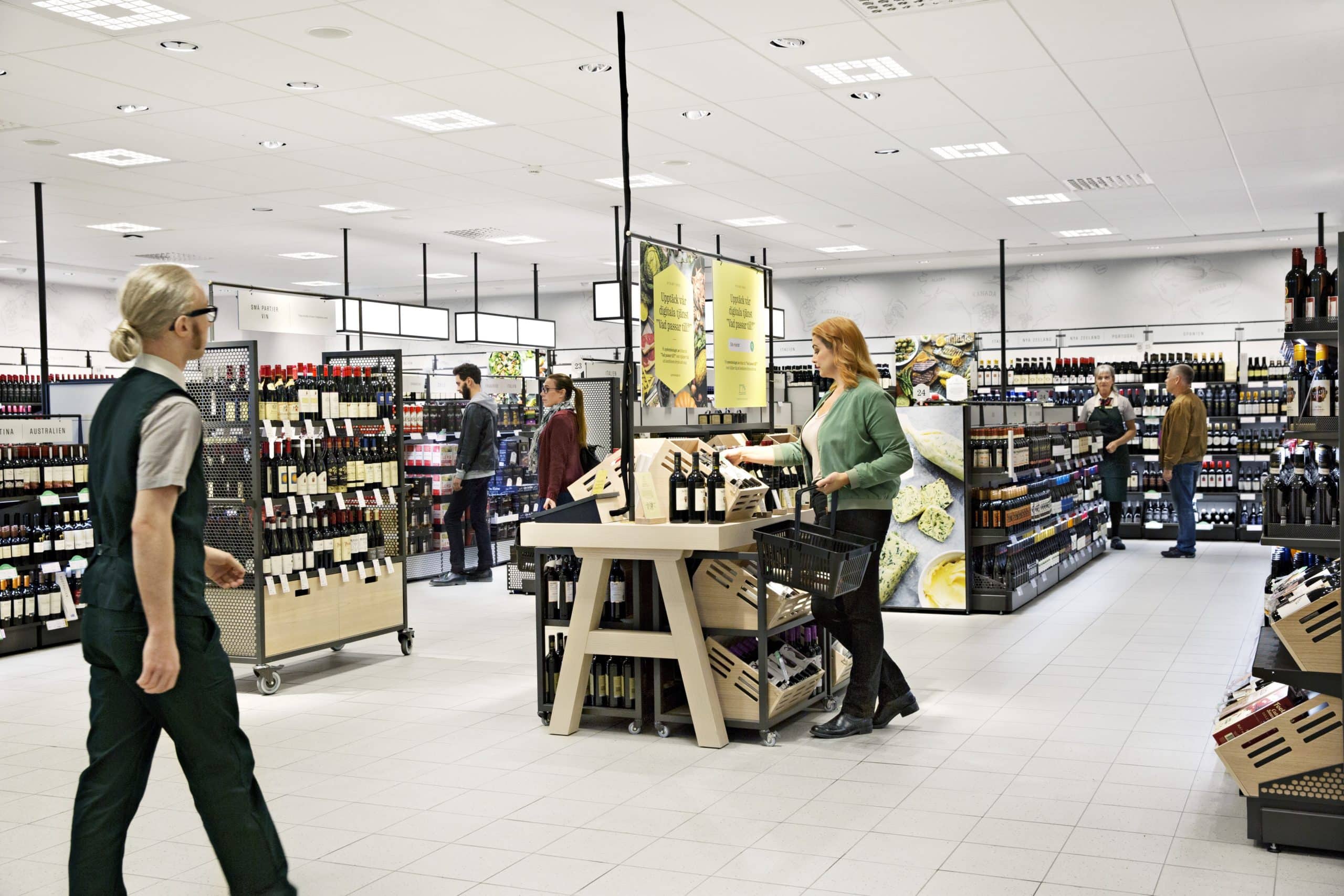
Stockholm. Buying alcohol for home consumption in Sweden is not as simple as in most other countries. Systembolaget (colloquially known as Systemet) is the only retail chain in Sweden that can legally sell alcohol above 3.5% ABV for takeaway consumption through its 448 shops and website.
Systembolaget is fully owned by the Swedish government, which strictly regulates the sale of alcoholic beverages. Sales of alcohol in Sweden’s on-premise are allowed to anyone aged over 18, but the legal minimum age for buying alcohol at Systembolaget is 20 and is enforced with ID checks. All promotions such as ‘buy one, get one free’ and money-off deals are prohibited, while individual products cannot be ‘favoured’. For example, beer cannot be refrigerated as Systembolaget argues that if some beers were chilled, the brewery that produced them would have an ‘unfair advantage’ over others.

There are other restrictions too, including limits on opening hours and the number of stores per capita. Larger cities, such as Stockholm, Malmö or Gothenburg, have many shops, whereas smaller cities have fewer. Systembolaget does not have a logistics centre — in most cases, it places its orders through local importers.
Alcohol marketing is heavily regulated, with in-store activities restricted to the promotion of brand owners, not individual products or importers.
After a five-year trial, Systembolaget began the national roll-out of a home delivery service in 2019. Systembolaget is the only Swedish-based retailer permitted to sell alcohol over 3.5% ABV via e-commerce for delivery or store pickup, although vendors based in other countries can sell wine and spirits directly to Swedish consumers.
In terms of volume, the most popular alcoholic drink in Sweden is beer, followed by wine, spirits and cider. Nevertheless, wine generates significantly more revenue than other categories. The total revenue for wine in 2019 was €5,220m ($6,295m), while beer generated €2,654m ($3,200m) and spirits €1,358m ($1,637m), according to Statista’s Alcoholic Drinks Sweden 2020 report. Seventy-six percent of all alcohol consumed in Sweden in 2019 was at home, accounting for 39% of total revenue, compared with 24% out of home (61% of total revenue).
Product listing
As in other government-owned alcohol retail monopolies, such as Vinmonopolet in Norway or Alko in Finland, all products chosen to be sold in Systembolaget stores are subject to a strict selection process.
Apart from the standard range offered year-round from fixed suppliers, a launch strategy is announced twice a year to source a seasonal range. All decisions are made at Systembolaget’s Stockholm headquarters — individual store managers do not take part. The strategy gives importers and producers an idea about the price, taste profile and quantity type of products Systembolaget is interested in for a specific season.
Systembolaget’s purchasing department sends this information to importers, specifying in more detail what they are looking for in particular products, in the form of tenders. All products submitted are blind tasted and scored before selections are made. Selected products are published biannually in a catalogue from which customers make selections. Currently, more than 700 companies from over 100 countries supply Systembolaget with 3,000 products for its standard range (available to buy immediately) and approximately 12,200 items for its available-to- order range, making it one of the world’s biggest single buyers of wine and spirits. The strict listing process combined with Systembolaget’s buying power means that prices in the stores are reasonable and affordable for all income groups. Products are taxed on alcohol content not on purchasing price, and are sold with the same profit margin. Systembolaget offers an incredibly wide selection and is rated by many industry commentators as one of the world’s most efficient retailers. Staff are well trained and knowledgeable about the products on sale, providing in-store, online and over-the-phone advice. The monopoly’s revenue for 2020 was SEK36.7bn ($4.4bn).
Unofficial trade
Outside Systembolaget, travel-retail shops are the only place Swedes can legally buy alcohol over 3.5% ABV for at-home consumption (low-strength folköl or people’s beer — up to 3.5% ABV — can be purchased in supermarkets). There is some unofficial trade, however, with Swedes travelling to neighbouring countries to purchase alcohol. Quotas on alcohol for personal use when traveling into Sweden from another EU country were abolished in 2003. This prompted alcohol-buying trips to Denmark and Germany where prices were much lower and had a negative effect on Systembolaget sales. Another unofficial source, impossible to measure, is home distilling and brewing.
Business as usual for Systembolaget
Systembolaget head of category management Ulf Sjödin MW talks consumption trends with Intel’s Agata Andrzejczak
Intel: The on-premise in Sweden remained opened during the pandemic, but surely there were fewer people visiting. How did Systembolaget perform? Was there an impact on the wine and spirits business overall?

Ulf Sjödin: In 2020, the off-trade in Sweden increased by 11% in volume and 14% in value. We have tried to go on with business as usual as much as possible, so our store formats or purchasing policies have not changed during the pandemic. The on-trade decreased substantially, although the exact figures are unclear. The parts of the business with a strong on-trade focus have probably struggled. E-commerce has developed beyond expectations and we see this accelerating after the pandemic. The number of independent companies selling wine directly to the consumer is constantly increasing.
Intel: What were the key consumer trends in the past year? Which categories performed well?
Sjödin: Spirits performed better than beer and wine at Systembolaget since a large portion of spirits consumed in Sweden is usually bought in travel retail. It is hard to identify any real consumer trends in spirits since the knowledge on what is normally bought in travel retail or in neighbouring countries and carried back is poor. Another important trend we see is that young people drink less or not at all. There are some positive developments in wine — organic and premium brands are enjoying growth.
Intel: What are you seeing on the spirits side specifically?
Sjödin: All categories except aquavit are increasing substantially. Gin and dark rum showed growth before the pandemic, so the increase for these categories is probably more or less not relevant to the pandemic. American and Irish whiskey and tequila have increased, but will probably return to previous trends once the pandemic is over. This is because those categories were historically large in travel retail and the on-trade before the pandemic.
Intel: What are you seeing in wine?
Sjödin: The total wine market increased by 9% in 2020, after years of stagnant sales. In our stores, there is an increased interest in organic wines and wines above €30 ($36). Premium segments are less dependent on the interruptions in normal purchase patterns, and this trend is likely to continue after the pandemic. Overall, organic wine increased by 18%, with the premium wine segment up by 27% as people treat themselves at home. Italy is the most popular country of origin, closely followed by France, then the US and Spain. Although the vast majority of rosé wine sales are during summer, sales in winter have been increasing slowly. We see more shopping baskets containing fine wines that now have some craft beers as well, indicating that many consumers with knowledge of fine wine also find craft beer interesting. This is a trend we have seen for many years and the pandemic hasn’t changed this. Sparkling wine is dominated by cava, prosecco and Champagne, and the development during Covid-19 has been similar for many years for all styles — steady growth. The sweet styles have lost market share.
Intel: What is happening in terms of innovation and new formats?
Sjödin: This is unlikely to happen. According to the latest numbers, 78% of the population supports the monopoly.

Sjödin: We see an increased interest in more climate friendly packaging and will be launching more wines in Tetra Pak in the coming year. In the addition to this, the number of small bottle format launches grew exceptionally.
Intel: What is the likelihood of Systembolaget being privatised?
Intel: How do Systembolaget prices develop and compare with Sweden’s neighbours?
Sjödin: The development of prices has historically followed the general price index, which means very moderate increases between 1% to 2% per year. Differences in prices between Sweden and its neighbours are mostly due to taxation differences.