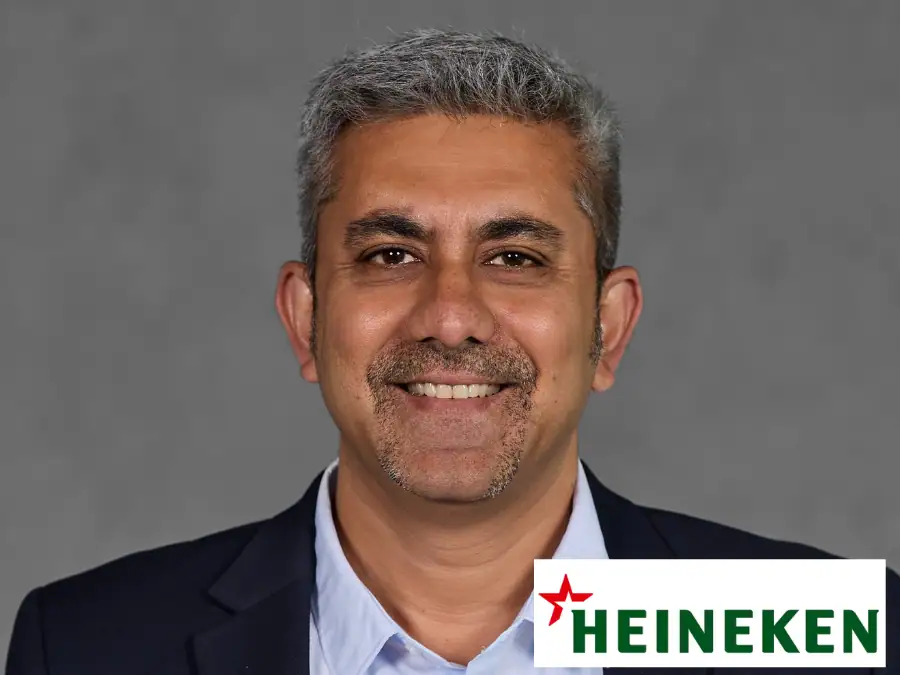
As the race to embed AI into companies’ business practices continues to resemble a 21st-Century equivalent of a gold rush, Global Drinks Intel editor Olly Wehring, secured time with Heineken’s chief AI officer, Surajeet Ghosh, to learn more about his priorities in the area for the group and what the tech veteran thought of the alcohol industry when he joined from Amazon almost six years ago.
What’s your background prior to your current role?
My AI journey started in 2003, when I started taking university classes on the subject in the US. Back then, AI was described more as machine learning and data science. My background was in engineering, but I did a lot of work in statistics, which back then was the launch pad for machine learning and data science.
Then, I joined a consulting company in US working with analytics and creating hands-on risk models for mortgage banking. After 16 years in the US, I moved to Europe to join Amazon in Luxembourg, leading the global data science team in e-books and the kindle. Then, I became the global data science head on the commerce side for Prime Video. I was about to move back to the US when the Heineken offer came through in 2020.
At the time, Heineken set as its ambition to digitally transform the company. It was starting from scratch in establishing its AI capabilities. This was quite new back then. Today, we have multiple products across multiple operating companies. AI is now embedded, so we have a lot of pull for AI within the business.
But, there’s always a lot to learn – the pace that the technology is evolving at is just crazy.
Where did you feel our industry’s relationship with AI was when you joined Heineken from Amazon?
There was definitely a lot of ambition back in 2020. When it comes to AI capability, Heineken has always benchmarked itself against other FMCG/CPG companies. We do this every couple of years. To be very honest, most of the CPG industries were just scratching the surface back then. The best thing about that starting point, though, is the opportunity you have – it was like a green field!
There was a lot of appetite in the company, and I got a lot of support from the company’s senior leaders to really sell the story and to do the change management. We keep doing our benchmarking with external industries to see where we are leading or lagging. Today. I think we’re quite mature.
How does something as 21st-Century as AI sit within an industry as traditional as beverage alcohol?
In the tech companies, the culture is different; their decision-making is very quick and there’s limited alignment – they just go with an experiment and get it done. But there are also positives to a company like Heineken, which has heritage and a legacy. This is a company that’s based on relationships and that’s a huge opportunity for AI. Once we’ve built those relationships with our internal stakeholders and external customers, there’ll be no stopping us.
It’s just a matter of time. The speed will pick up when we standardise some of our foundations. We aren’t slow because the company doesn’t want AI; we want to go at high-speed. We need to make sure the foundation is standardised, then we can deploy one model in multiple operating companies at one click of a button.
It’s about the foundation, not the culture. I was so positively surprised when I joined Heineken at the appetite for new ideas and innovation.
What do you actually do?
My main job is to make sure we don’t just do AI for AI and we don’t do tech for tech. The ambition is to do AI in such a way that can help Heineken grow its top line and make our employees more efficient. If any product or initiative doesn’t match that ambition, then it isn’t top of my priority list.
I work backwards from the business. I liaise to identify opportunities where we can apply something. I’m the first point of contact for a brainstorming. I have a team of data scientists, machine learning engineers, AI engineers, data engineers, product managers, decision intelligence – I could go on.
Along with the business, we structure squads with different profiles, to solve that specific business problem.
Could you share a recent example?
Let’s say we’ve been given a marketing budget to apply to two brands – say, Heineken and Birra Moretti – across three touch points – say, YouTube, TV and Instagram. We want to run our advertising in the most optimal way, based on the consumer preference across those platforms. That means, we need to optimise that fixed budget and allocate it efficiently across different brand and touchpoint combinations.
When you’re able to do that, two things happen; you can either get more ROI from the same budget, or you can reduce the budget and get the same ROI as you were getting before.
Of course, we measure that impact to ensure we can attribute it to the allocation strategy itself and not to things like the weather, macroeconomics or other initiatives going on in the company. But, this model has actually shown quite a bit of incremental impact. Today, there’s so much demand from the business to really scale this approach, because of its proven value.
Where’s the competitive advantage in using AI when everybody else is using it too?
In CPG companies, you can see how pervasive AI has become. At an aggregate level, perhaps everyone may be in the same boat, but then you have outliers, both in leading and in lagging. A lot of companies are still experimenting and dealing with proof of concept. We’ve been able to shift from that point to implementing large-scale AI products that our employees are using on their handheld devices.
The technology is available to everyone – Everything is now open-source. What gives you the edge is choosing the right use-cases and the right business problems to solve. The burning topic currently is whether to focus on what’s more feasible to solve or what has the maximum potential value but is enormously complex to solve.
When we compare ourselves to our FMCG competitors, we are leading in some cases and could do better in others.
How do you prioritise where to direct your resources?
There are some constraints here. We’re a global team, so for us, all of Heineken is important. Looking through the value chain, however, there are some pockets where you can achieve high value and quick value. We utilise a RICE mechanism – reach, impact, confidence and effort. That’s the formulation by which we rank the projects we should go after. It’s all mathematical.
To build the product, we create squads of multiple players that always include the business – we never want to build something in isolation.
Which business departments are you seeing the most success from for your squads?
In terms of ROI, it’s definitely commerce. But, we see success across the value chain, be it procurement, finance, supply chain, even legal & corporate affairs. Every time we launch a model, there’s a major change in ways of working. It changes the way we look at things.
We also do things that are the right things to do. For example, we may need to create better documentation for legal & corporate affairs to make sure we have proper guardrails. That might not create incremental value, but it does prevent reputational damage.
In terms of impact, generally, it’s a variety of products in a variety of ways.
This article is available to Global Drinks Intel members only.
Click below for details on how to join the Global Drinks Intel community.
Already a member?
Log in here to read the article in full.
If you work for any of the following corporate subscribers to Global Drinks Intel, head here to activate your access.
- AB InBev
- Bacardi
- Campari Group
- Diageo
- Moët Hennessy
- Pernod Ricard
- Proximo Spirits
- Suntory Global Spirits
- William Grant & Sons