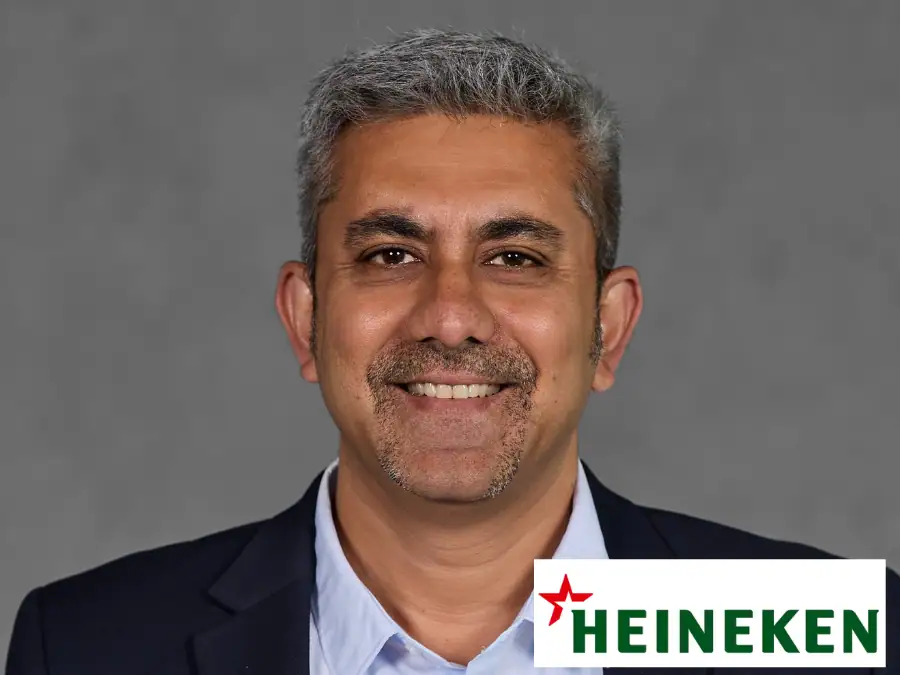
In the second part of our exclusive interview with Heineken’s chief AI officer, Surajeet Ghosh (below) shares his thoughts on the company’s employees’ view of AI, the costs involved and whether new tech is immune from cost-saving reviews.
Is your approach to implementing AI into Heineken’s business practices resource-intensive?
Initially, when we’re setting up, yes. As we get towards the models being built, we need people to monitor those models and update them. We’re not building a new model every time.
Broadly speaking, the ROI on the AI team itself is ten times more. If Heineken spends ‘one’ on my team, the benefit Heineken gets is ‘ten’. That’s not an exact number, but it gives you an order of magnitude higher. The more we get into things like new cloud workflow models, the cheaper it will become to build the models in the first place.
Do you prefer to have the expertise in-house or do you buy it?
It’s a bit of both. My ambition when I joined Heineken was to set up AI as a capability within the organisation. We need Heineken employees to be capable of solving complex problems as they occur now and in the future. If I don’t build that core capability of science, engineering and the tech, then we’ll never be able to get there.
At the same time, pragmatism sometimes takes over. With image recognition, for example, to build and train it with millions of images would take millions of Euros – it isn’t worth it, if I can buy a bespoke third-party product that we don’t have to train.
In that case, we’d look to buy third-party software and embed it within our bigger product suit. But, the underlying engine, the framework, the governance, the platform, the data foundation, everything is internal.
In every big project that we start, we engage external partners to give us that outside-in view. We don’t know everything, right? We’re a team inside a company. They bring an external perspective that helps us see the gaps that we’re missing.
We’re seeing many companies undertake headcount and investment reviews. Given the buzz around AI, is your department immune to such reviews?
That depends on what the company is targeting. As technology matures, certain roles can become more prominent compared to those that were there 20 years ago. That’s just the nature of how industries shift over time.
Alcohol as a category is on a declining trend, and long-term forecasts say there could be further declines going forward. The question, then, is, what are the areas that we should staff more compared to others? That’s where optimisation within the company comes in.
When it comes to my department, there’s an enormous push and appetite from our business partners to really embed AI at high-speed. We’re having short-term difficulty in keeping up with the demand of our internal stakeholders. And, that’s a very good place to be.
I wouldn’t call it immune as such, but definitely given the times we’re in, it’s very important to land AI even more, within the company.
Is AI being welcomed internally or viewed with suspicion and discomfort?
It’s about being transparent, showing what the AI team is doing, how it’s helping and how it impacts top-line growth. As long as we’re able to make that super-clear, then there shouldn’t be much scepticism. The company sees this as a necessity in the current world and I can guarantee that if we don’t do it, then somebody else will.
So long as we’re relevant and are creating incremental value that ties to Heineken’s ‘Evergreen’ strategy, then this is where we should bet. There’s also plenty of recognition of that within the company.
What project are you working on at the moment?
We’re looking into our flagship new product, Freddy AI, which is our overarching umbrella of doing commerce completely differently. It comes from marketing, brand-building, advertising, sales and revenue margin growth.
Our top line is volume or market share. We want to track and detect early on whether we’re winning or losing. To be able to do that, we need multiple parameters, such as weather, seasonal impact, along with macroeconomic parameters, such as GDP, inflation, consumer purchasing power, and internal parameters, such as pricing promotion, advertising budget and distribution network. This is like the model of all models, which basically explains how the business is trending, at your fingertips.
What we’re trying to get to is to be able to predict what might go wrong in the future. If we can tweak those parameters that are controllable, then we can change the outcome if it’s trending negative.
That’s our large-scale, next-level vision. This is our next big project. Progress will be step by step, but we want to make sure we’re tracking it, instead of waiting for one fine day.