

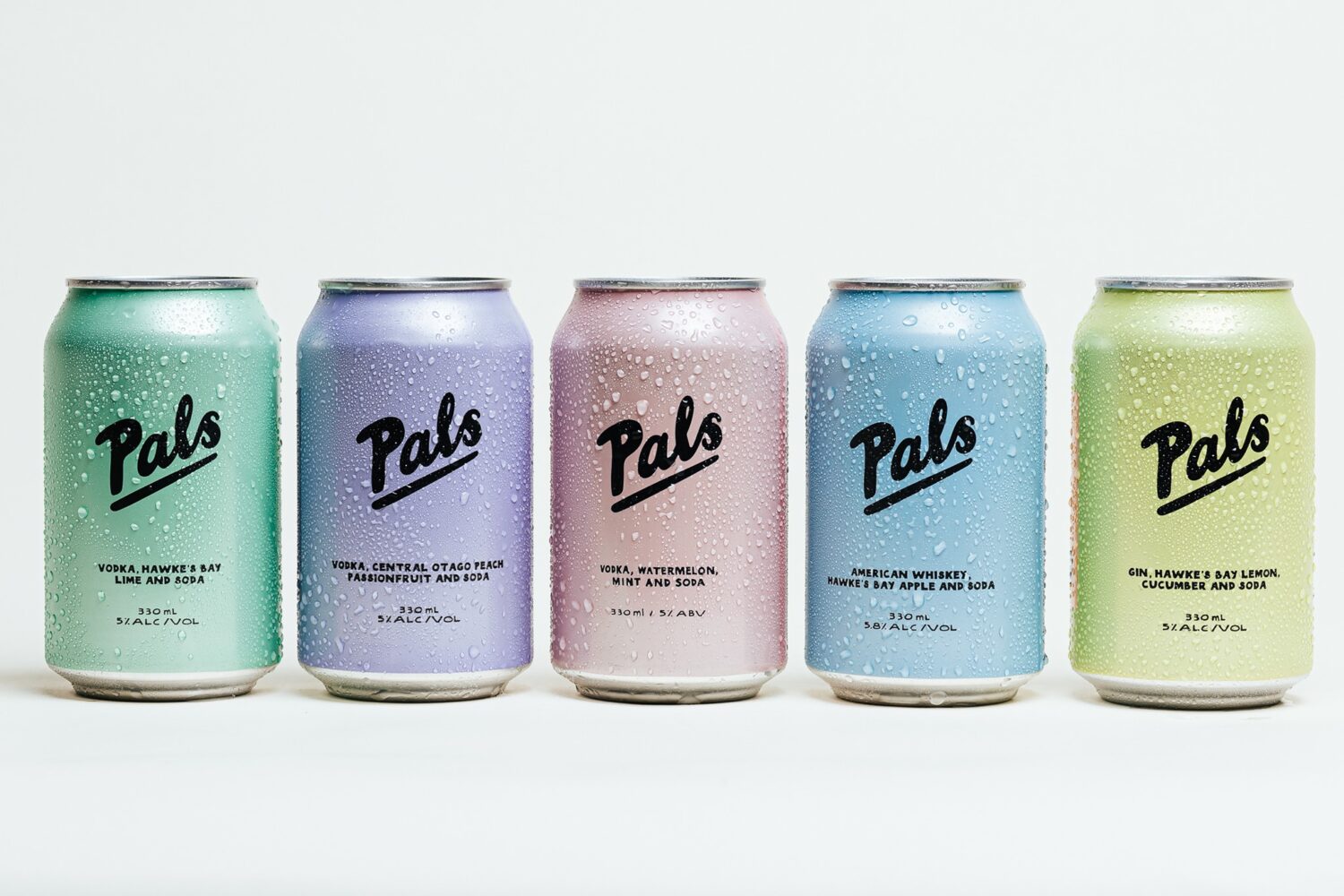
This is Pals. It’s an RTD from New Zealand. It’s been around a few years. It’s done extremely well. It’s now in Australia and doing the same. And will, no doubt, be taking over the rest of the world very soon.
It caught my eye about three years ago, when I was back in New Zealand for a summer holiday and noticed how many people in Auckland, Wellington and other cities were drinking, photographing and partying with these remarkably simple pastel cans. It caught my eye more recently because of how much it has grown from a small startup to a big player in both New Zealand and Australia.
I tasted a few and they’re quite nice. Light, refreshing, easy to drink. I personally prefer my booze with less stuff that isn’t booze in it, so I won’t lie and say I am their biggest customer, but I reckon I may be one of their biggest fans.
That’s not because the design of their cans successfully breaks all conventions of can design.
And it’s not because ‘Pals’ is a fantastic example of what all great names should be: memorable.
I am Pals’ biggest fan because of a very small detail on their can that smashes one of the oldest rules in booze marketing.
If you’ve read this column before, you’ll know that I love booze marketing. And I also do a fair amount of it at my agency, Impero. But you’ll also know that I think it is unfortunately laboured down by perceived rules and traditions which make it often unimaginative and less effective than it could be.
I say ‘perceived’ rules because they only exist in the minds of booze marketers. Here’s a couple of examples if you’re not sure what I am talking about. It was once perceived wisdom that clear spirits must come in a clear bottle, until Hendrick’s put their gin in a black one and consumers flocked to it.
Just like many marketers said craft spirits won’t challenge traditional ones because ‘craft must mean small’. And then Tito’s became the most-sold vodka in the US.
I love Pals because they have smashed possibly one of the oldest perceived rules of all. Look closely at those Pals cans and you’ll notice this: Pals drinks aren’t made with the same alcoholic base. Sure, there are a couple of vodka ones — with watermelon, peach or lime. But there’s a gin and cucumber one. And there’s a whisky and apple one. Pals have smashed the last taboo.
Pals have built a booze brand that’s not tied to a specific category.
Pals have ignored all category norms and have acted 100% consumer-centric.
For as long as booze has been marketed, it has been assumed knowledge that brands can only exist inside one category. It has been assumed that Chivas can only make a blended Scotch, that Moët can only make Champagne. Pals has shown us that isn’t true.
Pals has shown us that Johnnie Walker could launch a rum, and Jameson should start making beer.
Pals is living proof that if you build a consumer-centric brand your opportunity for growth is endless because your target market is not just the amount of people who like whisky or vodka. It’s the number of people with a mouth, who love the brand.
Michael Scantlebury is the owner and executive creative director of independent creative agency Impero — the creative agency for impatient brands. www.weareimpero.com