

This article was initially published in the November issue of Global Drinks Intel magazine. For details on how to subscribe, click here.
Global Drinks Intel has quizzed leading drinks brands, design agencies and sector experts to unearth the top trends that will affect alcohol packaging this year. Unsurprisingly, sustainability ranked highly among their responses, but QR codes, alternative formats and the supply chain crisis also feature.
A revolution is underway in drinks packaging. In a few short years, sustainability has gone from being a nice-to-have element in any packaging design brief to the first consideration before any other decisions are made. Awareness from consumers, industry competition and the need to meet legal targets are increasing the pressure on beverage brands to raise their game. But, while progress has been made, there remains work to be done.
One damaging aspect of drinks packaging that’s rarely discussed, for example, is the continuing use of chemicals. Mariella Menato, strategy director & sustainability lead at international drinks design agency Denomination, whose clients include Penfolds, Dow’s and Hardy’s, explains: “If you walk down the drinks aisle of your nearest shop, every single label you see has a varnish applied to seal the inks and an adhesive to glue down the paper. Every carton, can and label is printed with carbon-based inks.
“Recycled PET plastic, which is used for water and soft drinks bottles around the world, has also been shown to carry dangerous levels of antimony which causes major health problems,” she adds. “This is an area where we need more focus and oversight. Innovation in bio-plastics and bio-chemicals is moving at pace. However, we as an industry need to work collectively to ensure we’re not only reducing carbon but reducing toxicity.”
Beverage brands turn to nature
While the harmful aspects of single-use plastic are well known, alternative natural packaging materials from a variety of different sources are making their way into the mainstream. Jennifer Clements, project & marketing manager at Pentawards, one of the world’s biggest annual packaging awards competitions, is well-placed to comment on this emerging trend. “Drinks brands have been paying more attention to the materials used across the packaging, from what the labels, bottles, corks and stoppers are made of, as well as the shipping and transport processes.
Re:incarnated Spirits by Ruska Martin Associates was this year’s ‘Sustainable Design – Beverages Platinum’ winner at Pentawards. Some of the brand’s packaging features include a glass bottle made completely of recycled post-consumer glass, a cork made from recycled sparkling wine corks and a label that is printed on uncoated paper made from grape-waste, post-consumer recycled fibres.
“Another example is last year’s Diamond winner [Eminente Rum] by Moët Hennessy and Stranger & Stranger,” she adds. “It has labels made from cotton by-products, a sustainable cork and FSC wood stopper. Thanks to its design, one of its key appeals is its reuse ambition.”
Similarly, Savannah Scott, senior foresight analyst at London-based agency The Future Laboratory, highlights the recent example of non-alcoholic spirits brand Seedlip, which created compostable packaging for its Spice 94 giftsets, using biomass and mycelium, the root structure of mushrooms.
“Alongside a highball glass made from 100% recyclable glass, the gift set also included tags that are infused with thyme seeds,” she notes.
Circular distribution schemes gain ground
The most effective way to reduce beverage packaging’s effect on the environment is to implement circularity, where bottles can be reused and refilled, or, in the case of closed-loop distribution system ecoSPIRITS, eliminate the bottle altogether. In the UK, for instance, Black Cow vodka is partnering with the company to avoid the use of single-use glass bottles in on-premise venues around the country.
Instead of bottles, Black Cow will be using ecoTOTEs – fully-reusable, refillable, tamper-proof and shock-proof 4.5-litre glass vessels – to distribute to the channel. Through the partnership with ecoSPIRITS, Black Cow believes it can reduce its carbon output by 85.4% versus glass bottles.
In a similar vein, craft distiller East London Liquor Co unveiled a new refill programme last year that allows consumers at its two off-premise shops in London to use any empty 70cl bottle to refill with one of three of its portfolio’s expressions. Bottles are filled from 20-litre containers and marked with a paper label to indicate both their content and that the duty on the spirit has been paid.
Supply chain woes affect design process
The packaging industry has not escaped the global supply chain crisis. The price of shipping containers has rocketed, as has the cost of cardboard, plastics, energy and labour. This rampant inflation has forced both beverage brands and packaging firms to be more cautious about the design process and less concerned about the choice of colours, fonts and shapes.
“Changing something as small as a label means the whole chain stops and needs to start again, which of course costs a lot of money,” says Carsten Glock, founder & creative director of London-based design agency GLOCK. “So, it’s more about doing everything else around the brand, whether that’s Social Media, on a billboard, or on TV, to make sure people notice the bottle when they see it on shelves.
“We are also seeing fewer brands ship their bottles,” he adds. “All of the glass they use now comes from the same country as the drink itself. Not only does this save the business a ton of money on shipping costs and logistics, but it’s good for the environment too because it reduces the need for bottles to be flown halfway around the world, just to then be shipped back out to retailers when filled.”
QR Codes and Augmented Reality prove their mettle
The ubiquitous QR Code, those instantly-recognisable patterns of black & white squares that encode data, has been around since the mid-1990s. The pandemic turbocharged their use, however, with the electronic scanning technology replacing many paper items, such as menus, flyers, forms and, notably, vaccine passports. Their use in beverage packaging has also grown significantly.
“Amongst the hugely exciting smart packaging innovations emerging in the drinks category, it’s worth giving a special mention to the humble QR code, which, as we all know, had a great pandemic,” says Mary Lewis, founder & creative director of international design agency Lewis Moberly. “Its built-in call-to-action is not to be sniffed at, when the measure of smart packaging’s success begins and ends with whether the consumer actually understands and actions it.
“Our current digital-first campaign for Lambay Whiskey Prestige Edition – ‘Unlock the Untold’ – drives exclusivity with immersive content accessible only via a QR code and password placed on the label.”
Carsten Glock agrees that QR codes have never been more popular. “What’s great with QR codes is that brands can link them to pretty much anything. We recently worked with [Scotch brand] William Lawson’s and put a QR code on the bottle; when you hold a phone up to it, the character on the label shows up to tell the story of the brand and the product. It means that designers and agencies can include everything they need in the packaging.
“We’re seeing a similar thing at the moment in Global Travel Retail, where we have drinks brands relying heavily on AR [augmented reality],” he adds. “It gives a richer experience with no footprint, and this is a common thread we’re seeing in briefs from alcohol brands – how can we tell richer stories, without the need to create more physical stuff?”
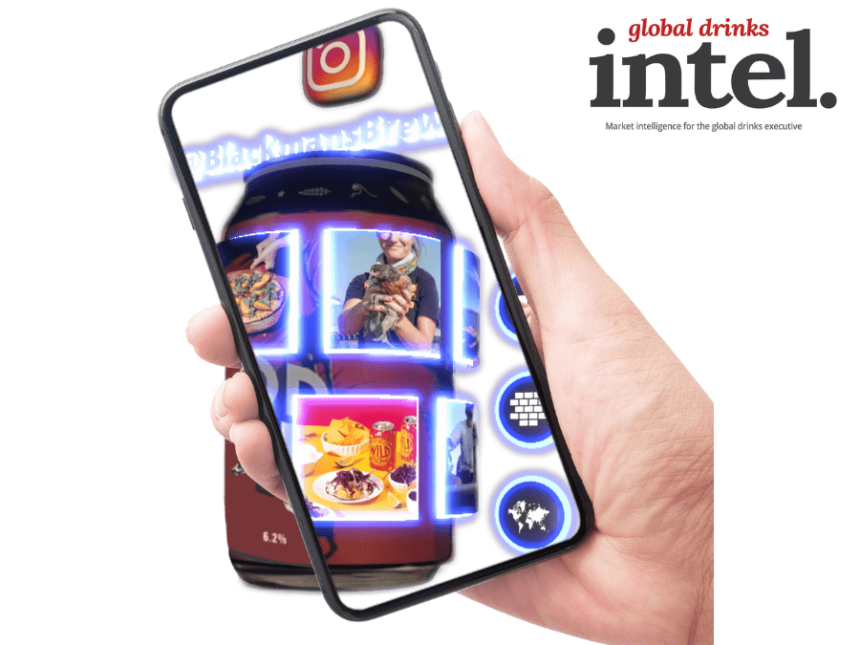
Australian tech start-up Swigr has created an AR platform for the drinks industry, which allows beer, wine and, most recently, spirit producers, to link content virtually to their products. Smartphone users scan products to activate the content, which is brought to life with augmented reality, virtually animating via the product label.
“Consumers love the experience – it’s a new form of storytelling that’s authentic and engaging,” says Swigr co-founder Dave Chaffey. “It offers brands a great opportunity to connect with today’s digital-savvy consumers.”
Canned wine targets younger demographic
COVID-19 helped canned wine lose some of its historical stigma. While traditionally-negative perceptions of the format remain in some more traditional wine countries, younger LDA drinkers in markets such as the UK and Australia have embraced its convenience, portability and environmental credentials. Between 2021 and 2028, according to a report by Grand View Research, the global canned wine market is set to expand at a CAGR of 13.2%.
Canned wine’s alternative status has allowed brands and designers to target younger LDA drinkers with less conservative, more individual designs. “Cans provide superior shelf standout to help brands differentiate,” says Simon Gresty, chairman of industry body Can Makers. “With a 360-degree printable surface, wine producers can showcase bold designs on their packaging that’s label-free, quick to produce and easily tailored to the producer’s requirements.
“Many higher-quality wine brands, such as Underwood, Nice Wine, and Frico, have adopted or launched exclusively in cans, making full use of the format’s design benefits, ” he adds. “The can allows brands to create consistency across their products with subtle colour keys used to distinguish between white, red or rose.
“Wine in a can has also proved to be more accessible to younger consumers, breaking the trend of wine traditionally being associated with a more mature palate. In the last six months of 2021, more than one in ten consumers aged 18-to-34 purchased wine in a can, which is three times more than for those aged over 55. Producers of wine seltzers or spritzers like Barefoot tend to take the design possibilities of the can even further by including illustrations of the beverage flavour, which increases the ease with which consumers can choose products.”
Drinks brands support craftspeople and artists
Beverage brands are increasingly using packaging to try to tell their stories, tying their product to a specific location, its culture, history and community. Last year, Whyte & Mackay unveiled the Global Travel Retail-exclusive Jura Islanders’ Expressions Limited Edition Collection No.1 iteration last year. The single malt aims to support the artistic community of the small Scottish island where the distillery is based, partnering with jeweller and Jura native Amy Dunnachie for the first installation in the three-part series. As part of the project, Dunnachie contributed a handmade pin to accompany the bottle made of copper and rope that had been washed up on the shores of Jura.
Meanwhile, Pernod Ricard-owned Royal Salute teamed up with British sculptor Kate MccGwire to create a bespoke art piece to accompany the first expression in the blended whisky’s ‘Art of Wonder’ line. Each of the 21 decanters is engraved with intricate feathers and gilded in 24-carat gold leaf, with curves inspired by MccGwire’s sculptures. Furthermore, each decanter is accompanied by one of 21 pieces of art, called Paragon, created by MccGwire using sustainably sourced pheasant feathers.
“Cross-dressing” with other categories
Luxury drinks brands are increasingly borrowing codes from other product categories in their packaging. Speaking to Global Drinks Intel, one designer likened the trend to “cross-dressing”, as brands become more experimental and try to reach out to new consumers.
Recently, Hennessy Cognac collaborated with men’s fashion house Berluti to create a hand-crafted attaché case containing a decanter of Richard Hennessy Cognac. Designed by renowned architect Daniel Libeskind, The Baccarat carafe is limited to 150 units and has an SRP of EUR40,000 [US$43,600].
Another recent example from Beam Suntory is Bowmore’s collaboration with Aston Martin to create a series of single malts inspired by some of the British carmaker’s most famous vehicles. The pinnacle product of the collaboration was unveiled last year: Bowmore ARC-52, a rare 52-year-old malt housed in a futuristic-looking whisky decanter which balances on just two points, making it appear weightless. It also features a bespoke magnetic key which releases the aluminium top.
This article was initially published in the November issue of Global Drinks Intel magazine. For details on how to subscribe, click here.