

This article has been available to Global Drinks Intel subscribers since May. For details on how to join them, please click here.
With seven ‘millionaire’ brands in its portfolio, MD Abhishek Khaitan believes Radico Khaitan – India’s fourth largest liquor company – is treading its own path to success.
Most companies expand by a variety of means: not only through organic growth of their own brands, but also through M&A activity, via a combination of acquisitions – some of them large and transformative, others smaller, tactical, bolt-on purchases.
Not so Radico Khaitan. A powerhouse of the vast Indian market, the company has risen to its current status by creating and building its own brands, from whisky to vodka, rum, brandy and gin. At the time of writing, Radico Khaitan has seven ‘millionaire’ brands – products that sell in excess of 1m nine-litre cases a year – 8PM and 8PM Premium whiskies, Magic Moments Vodka, Contessa Rum, Old Admiral and Morpheus brandies and 1965 Spirit of Victory Rum. The last two have joined the ‘club’ since the turn of the year.
“We have learned the art of creating our own brands, so definitely we will continue to pursue that strategy,” says company MD Abhishek Khaitan. “It takes two or three years to prepare the product, then the product goes to the market. We never do an ‘all-out’ launch – we do it very gently.”
The trajectory and focus of those launches has shifted in Khaitan’s time with the company. Early innovations, such as 8PM and Old Admiral, were positioned in the high-volume ‘regular’ pricing segment but, since Magic Moments Vodka was first released in 2006, the emphasis has been clearly on premium-and-above.
This became more pronounced with the launch of Rampur Indian Single Malt Whisky in 2016, and then Jaisalmer, a high-end Indian craft gin, two years later – two bona fide luxury products with more of an eye on export destinations than on the domestic marketplace.
More high-end whiskies followed – Royal Ranthambore, a blend of malt and grain Scotch with Indian grain whisky, in 2021, and ‘world malt whisky’ Sangam in March this year. Magic Moments has ascended the pricing ladder through Verve [2012] and then Dazzle [2021].
“[With these products], we are catering to the younger generation, starting from the packaging and price positioning,” explains Khaitan. “We always price our products higher than the competition, because this is a luxury segment – if you price it higher, the perception of the brand is automatically higher. But, the heart of any brand is the liquid. That’s what will attract the consumer again and again.”
This evolution is tracking – even anticipating – the development of the Indian market. “We know exactly what the consumer is aspiring to,” Khaitan says. “Before Magic Moments, there was no vodka at that price; before Morpheus, there was no brandy.”
Moving early enables the business to capture market share, leaving rivals playing catch-up.
Rise of middle class drives luxury boom
Khaitan believes this is only the beginning for India. “Income levels are rising very fast,” he says. “The middle class has emerged, and the luxury segment is booming.” Perhaps counter-intuitively, he believes the Covid-19 pandemic has only accelerated this process.
“People started drinking in their own homes and they got used to drinking a superior product. That’s become a habit. Also during Covid, people got this idea of living in the moment, because you never know what will happen the next day.”
Air passenger numbers have now exceeded pre-Covid levels and India’s increasingly impressive hotels are often full. This rapid development owes much, Khaitan believes, to Prime Minister Narendra Modi’s prioritisation of infrastructure, building world-class airports and opening up travel corridors such as that between Delhi and Mumbai. “Earlier, everyone was saying ‘China, China, China’, but now ‘India’ has become a substitute,” Khaitan says. “It’s a continuous progression. In the next ten years, the premium alcohol market will be tremendous.”
White spirits, especially vodka, offers ‘vast’ growth opportunities
India is also increasingly open to the world, both through travel and the digital sphere of smartphones and social media {data in India is very cheap]. Not only is this forcing companies to focus on digital marketing – Khaitan simply says it is “the name of the game” – but it is also driving trends at increasing speed.
“India will always be a large whisky market, but I personally believe in white spirits,” he says. Here, the room for growth is vast, with white spirits currently commanding only about 4% of the total spirits market. “Even if it [only] goes from 5% to 10% in the next years, being the category leader, we will really benefit,” Khaitan says.
Vodka has drawn in younger and, increasingly, female consumers – which in the long term could transform the demographic of beverage alcohol in India. “Earlier, the female consumer was not drinking alcohol in India, but gradually everyone has started,” says Khaitan. “Society has opened up.”
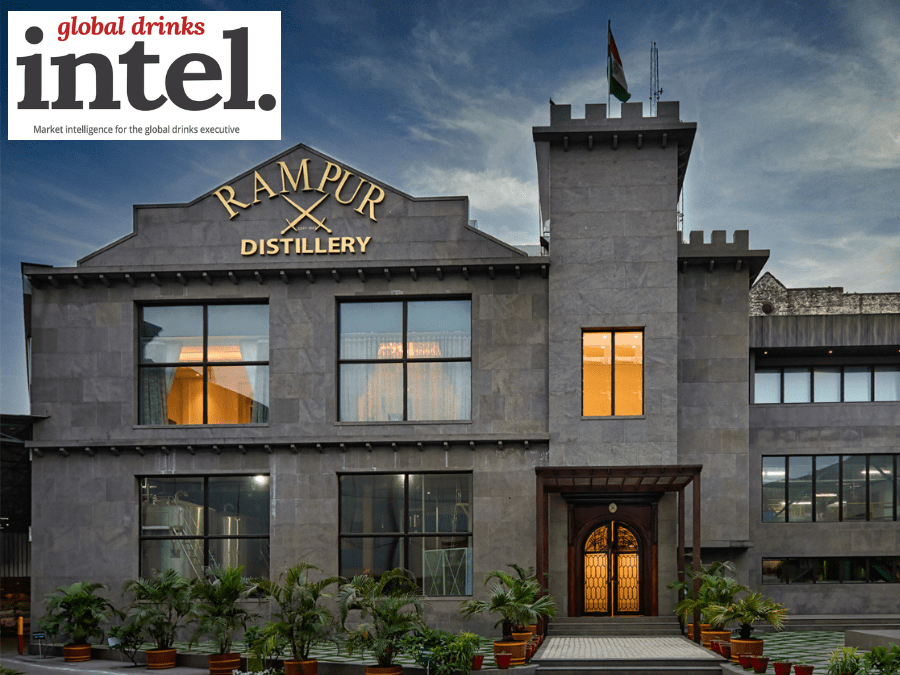
As the speed of change increases, companies like Radico Khaitan must evolve in line with it. The business is in the process of doubling its production capacity to some 320m litres of alcohol, via a new INR55bn [US$67.7m] plant at Sitapur in Uttar Pradesh, and new facilities at the core distillery complex Rampur [also in Uttar Pradesh] and at Aurangabad [in Maharashtra]. Not only will this free up capacity for further launches – Radico’s NPD pipeline is a busy one – it will also enable the company to meet unrequited demand for Rampur Single Malt, currently on strict allocation worldwide and not even launched domestically yet.
For all these developments, Radico Khaitan remains hugely focused on its home market, with only 6% of sales coming from overseas. That’s not a number that hugely concerns Khaitan. “Where we see exports is the luxury side, so it’s not so much about that 6%,” he says. “Our quality of exports is increasing day by day, and we’re more concerned with that.”
However, the company’s spread of price points enables it to target long-term growth prospects, such as in Africa, with high-volume products at ‘regular’ pricing levels today building a presence for future expansion at premium-and-above.
Doing business in India is complex, but offers huge rewards
Challenges remain. The long-awaited free trade agreement between India and the UK offers as much of an opportunity as a threat to Radico Khaitan – it imports a lot of bulk Scotch for its IMFL [Indian Made Foreign Liquor] portfolio, but would like to see non-tariff barriers on IMFL lowered. The group remains hopeful a deal can be struck this year.
And then, there’s the challenging regulatory landscape in India itself, with each state imposing its own rules. Here, Khaitan is less optimistic: “We would love to get it simplified, but from a political aspect, it’s next to impossible,” he admits. “After GST [Goods & Service Tax], alcohol is the largest revenue provider to the state. Each state is run by a different political party, and it’s hard to get them to give up that revenue. Operating in India is like operating in 28 different countries.”
Complex it may be, but the prize could be the largest in today’s global beverage alcohol industry. Uttar Pradesh alone, with a population of about 250m people, is about the same size as Western Europe. That explains Khaitan’s sanguine stance on the increasingly fierce competition for the Indian consumer’s attention. “When we started, our market cap was US$750,000,” he says. “Now, it’s US$2bn. More and more companies have come in, so I think we already have the largest players here.
“Any other company that comes in, they’re welcome. The pie is so big.”
This article has been available to Global Drinks Intel subscribers since May. For details on how to join them, please click here.