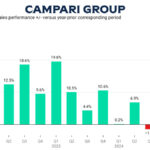

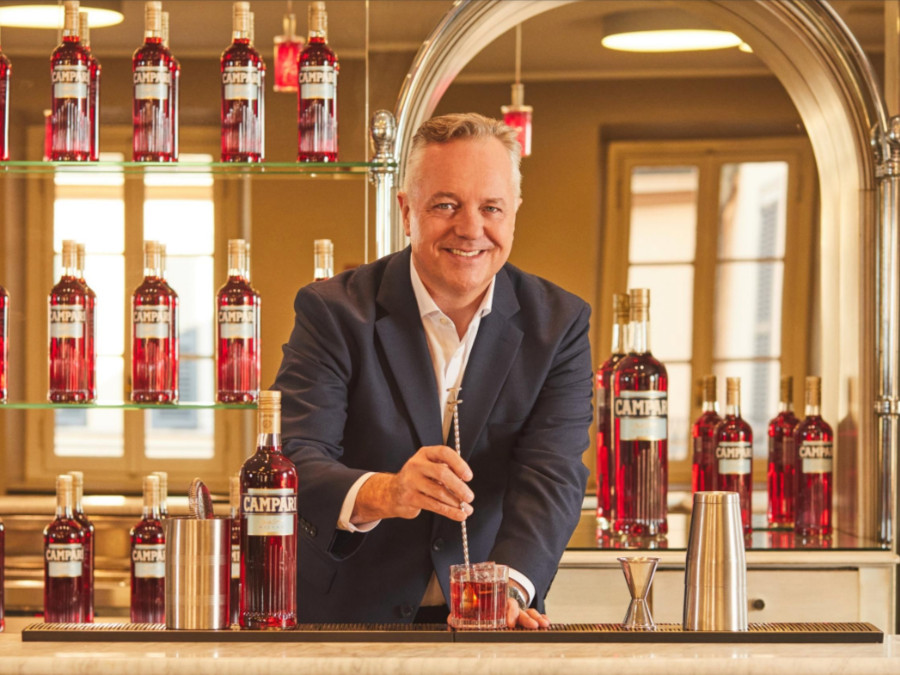
On the same day as announcing a 2.4% rise in sales for 2024, Campari Group CEO Simon Hunt (who has been in the hot seat for only a couple of months) sat down with Global Drinks Intel senior reporter Henry Mathieu to break down the key talking points of the company’s performance.
You must feel pretty happy with last year’s results, given the current trading environment?
Absolutely. I can’t take credit for any of it because I got here in January, but what I would say is, in the current environment and covering the industry, there’s a lot of negativity. There’s a lot of tough stories out there. I think it really shows the resilience of the Campari portfolio. It shows the capabilities of the team to execute really successfully in a tough market and finally, just the experience of the team. It’s a great team that knows what they’re doing. In a tougher market, I think that’s what you’re seeing coming through.
I’ve been doing this for 30 years and it’s probably the toughest market I’ve seen. Wholesalers and retailers are saying it’s the worst they’ve seen in 30 years, as well, so for us to deliver the growth that we did at a total group level – but then also the successful growth we have through Aperol, Campari, Espolòn and also through Grand Marnier in that environment – I think is a real testament to the strength of the company.
What caused you the biggest headache in 2024?
I would probably split the headache in half. On one side, it was volatility, macroeconomic pressures, destocking and consumer patterns changing a little bit.
Then, on the other side, were some internal things, like the change of leadership was quite disruptive. We had the Courvoisier integration coming through. We had the largest capex investment programme the company has ever seen.
When you think about the headache, I like to split it into what’s outside of us and what’s inside. When you put all those things together, actually, it further reinforces my point that, with all that going on and still achieving +2.4%, it was a great performance.
Is organic growth your priority in the coming months for the group, following the Courvoisier acquisition in late 2023?
What we have is a fantastic portfolio of brands. We just need to pause our M&A. We need to digest some of the brands we’ve brought in, because we have this amazing collection that have a lot more potential of being leveraged around our retail market, around the world. We have 27 in-market companies, and at the moment, some of the brands we bought are only working in two or three of those. So there’s an opportunity to leverage our geographic footprint more successfully than we have.
Secondly, from a debt point of view, in September we were at 3.5x and we’re down to 3.2x at the end of year. It’s a great achievement by the team and took some really hard work getting there. We’ve got to continue to deleverage. Once we’re in a position and we go through that, we then look at our portfolio strategy, which is being done now. Then, we review what opportunities we see going forward.
I would say, generally, I’m leaning more towards disposing of brands than acquiring at this stage, because we have so much potential with the portfolio we already have. You’re normally acquiring things when you haven’t got some of those opportunities, and we’ve got a lot of opportunities to already go after.
How have you looked to settle the turbulence following Matteo’s Fantacchiotti’s departure last year?
One of the benefits of having been in this industry for as long as I have is that I’ve worked at five companies with different cultures and chairmen. I have a natural bias towards family-controlled businesses. I’ve spent half of my career in listed businesses and half in private. One of the things for me that’s really coming through here is the culture, and the strength of the culture, the passion of the ‘Camparista’ community and the capability.
When you start seeing that side come through, that’s the more interesting opportunity from a leadership basis – How do we start defining where we’re going, which is the process we’re working through now, and then engage the team in taking us on that journey?
It’s difficult because we recognise the team had a tough year last year. They all worked incredibly hard and should be very proud of what they’ve achieved. But also, at the moment, I haven’t said this is where we’re going, and that’s the process we’re working through. We’re in that middle phase, but I’m confident that once we get there, I’m absolutely determined to make sure that all the ‘Camparistas’ are engaged and know exactly where we’re going, and we’re excited about that vision.
Looking forward, you used the term “transition year” for 2025.
I’ve come in and I’m going through every part of the organisation, trying to get my arms around and understand it. The benefit of being in the industry is I know it well but I’m learning and really investing time in learning the brands, the way of working and the team. That takes a bit of time.
So we talk about transition: there’s me getting up to speed, which is what we’re working through. The second part is that the board has brought me in to lay out a new strategy for the business in terms of where we need to go. We need to recognise that the business has been incredibly successful over many years, but the world has also changed in the last 18 months. As a result, we now need to evolve, not massively, but we need to evolve our thinking and redefine a new strategy that the whole team can get behind.
It’s about what we can control with also what we can’t. Tariffs suddenly appearing 24 hours ago; Will they go up? Will they go down? Will it be more or will it be less? What’s going to happen to the macroeconomic environment? What’s happening with inflation rates? It’s still quite a volatile market. As a result, we’d rather be more cautious in terms of our outlook, recognising what we can control and what we can’t.
The company recently announced an “organisational restructuring” process and has introduced ‘Houses of Brands’ to break up divisions. Can you explain that move in more detail?
You either have a global marketing team that has brand teams, or you have a ‘House of Brands’ model. To be honest, it’s either one or the other, or a variation of those things. For Campari in particular, the ‘House of Brands’ model absolutely fits. It fits the culture and the entrepreneurial ‘Camparista’ mentality. It means you’ve got people that openly think about those brands and they’re not worrying about anything else, and that makes them really focused about the geographic opportunities, but also making sure that the markets have the tools that they need.
It’s very early days. It’s a new way of working within Campari. I think the teams have been fully resourced for about five weeks. Our new CMO and head of strategy is doing a great job in defining how to work with the markets and then laying out a plan to make sure that those two conversations of markets and brands are happening the right way to design a winning strategy for the brands. On that side, that’s shaping the organisational design in a way that’s different from the past, and that’s allowed us to then look at being different and organising ourselves differently.
The second part of that is from an SG&A (selling, general & administrative expenses) point of view, the business was continuing to deliver at this top end of expectations. As a result, there was more and more infrastructure being built to meet that future growth. But we’re seeing a change in the marketplace. We then had to adjust our expectations on some of those plans. Now, we want to make sure we’re absolutely fit for the future. We’re recognising the future is probably going to be a bit bumpy this year.
The only ‘House of Brands’ to post a decline in sales for the year was ‘Whiskeys & Rum’, falling 6%.
One of the biggest things in that was on the rums. It was the fact that we couldn’t get supply because post-hurricane, two things happened: one is consumption in Jamaica was significantly impacted in Q2 and Q3, while the second part is we couldn’t produce the rum, so we had a significant destock in the big markets for Wray & Nephew. As a result, that impacted the sales.
If you look at the UK performance in Q4, without the lack of supply we would have been flat. Given what’s happening in the UK, that would have been a pretty good performance as well. So, the biggest driver of that negative performance on the house of brands was based on supply, not on demand.
On the whiskey side, certainly within bourbon, we saw some negative trends impacting the category in Australia on Wild Turkey, but then conversely, some really good trends on Russell Reserve the US. So, it’s more of a mixed bag in terms of the whiskeys.
This article is available to Global Drinks Intel members only.
Click below for details on how to join the Global Drinks Intel community.
Already a member?
Log in here to read the article in full.
If you work for any of the following corporate subscribers to Global Drinks Intel, head here to activate your access.
- AB InBev
- Bacardi
- Campari Group
- Diageo
- Moët Hennessy
- Pernod Ricard
- Proximo Spirits
- Suntory Global Spirits
- William Grant & Sons