


This article appears in the November issue of Global Drinks Intel magazine. For details on how to subscribe, click here.
Celebrity-favourite Tequila leads the charge, while flavour innovation keeps gin in the running and vodka plugs into the sustainability trend to progress its position. Jaq Bayles reports.
Despite — or just as likely because of — economic uncertainty around the world, premium white spirits are forecast to continue growing globally, with the three main sectors of gin, vodka and Tequila all benefiting from a slew of complementary consumer trends.
Hopes are particularly high for Tequila, with IWSR Drinks Market Analysis predicting the most rapid growth will be focused on 'super-premium-and-above' price points and 'higher-value' product segments such as 100% agave Tequilas and cristalinos — aged Tequilas that use charcoal filtration to remove their colour.
“As recently as 2016," IWSR says, "standard Tequila products accounted for more than half of global Tequila volumes, and almost half of global value — compared to super-premium-and-above’s 13% volume and 33% value shares. By 2026, however, super-premium-plus products are forecast to take a 55% slice of Tequila’s global value, and to account for almost 40% of category volumes.”
Between 2021 and 2026, gin's volumes are expected to grow at a compound annual growth rate (CAGR) of 8%, with the US, Canada, Australia, Italy and Brazil listed as the top five markets set for the largest volume growth of premium-and-above over the five-year period.
The global premium-and-above vodka segment, meanwhile, is expected to grow at a volume CAGR of 5% over the same five years, following volume growth of approaching 30% in 2021.
Cult of celebrity propels Tequila’s remarkable rise
The phenomenal growth of Tequila from a small base can be attributed in part to the cult of celebrity, started by George Clooney and his Casamigos brand — launched in 2013 and sold to Diageo for US$1bn in June 2017 — and built on since by a raft of big names, from Dwayne ‘The Rock’ Johnson (Teremana) to Eva Longoria (Casa Del Sol), Rita Ora (Próspero), and Bryan Cranston and Aaron Paul (Dos Hombres).
At the same time, consumers across the globe have also picked up on Tequila’s versatility. High-quality brands have convinced consumers of the segment's chameleon tendencies — it’s a good sipper and a lauded cocktail ingredient, as well as being, according to CGA in its 'September 2022 Tequila Report', a “focus category” for suppliers and operators.
“A measure of Tequila sales volume [in the 12 months to the end of May] shows the average of its price tier per cent growth at 116% compared with the same period a year before," says CGA. "All price tiers are adding to that volume growth, but remarkably, it’s the ultra-premium (+171%) and premium (+133%) tiers that lead the way for Tequila’s share grab. To compare, vodka’s average per cent growth across all price tiers was 89%, led primarily by its mid-priced tier, and whisky’s tiers averaged 97%, led by the ultra-premium tier across the ... 52 weeks.
"Premiumisation, a wider trend to watch, continues to be a factor in disrupting share in the spirits category.”
Pushing boundaries with innovative NPD
Brand owners are cashing in on Tequila’s cachet, with new releases abounding and innovation and marketing pushing new boundaries.
“Despite the challenging market environment, the Tequila category has been thriving in Germany, with 28.2% growth in sales volume [versus the previous financial year, AC Nielsen data 2022]," says Sierra Tequila owner Borco’s communication manager, Nikolas Odinius. "Also, we see exceptional growth in our international markets, where Sierra Tequila is distributed. With consumers’ growing interest in artisanal spirits and the category gaining popularity due to celebrities’ acquisitions of Tequila brands, the category’s development will continue.
“Last year, we launched a new brand design and campaign with the motto ‘Lead the Party’, which is designed to unravel the inner party leader of Tequila fans. [Sierra] is constantly being developed, which has a positive impact on our sales.”
Back in Germany, Odinius adds that Sierra’s sales volumes have grown 18.9% “due to our strong investment in the brand, including a state-of-the-art Social Media communication campaign as well as limited editions and on-packs in retail that are paying off and driving the success of the brand”.
He continues: “Sierra Tequila [has] a remarkably high off-trade market share in other markets, including Sweden (52%), Denmark (62%) and Hungary (62%) [Swedish Monopoly, year to end September 2021, IWSR 2022]. In Australia, Sierra Tequila is the No.1 in the off-trade [IRI MAT data, 13 February 2022].”
Odinius adds that the growing interest in 100% agave Tequila is coming to Europe - and other international markets - from the US. “Consumers are increasingly intrigued by handcrafted spirits that are made with passion and show a clear origin,” he says. “Additionally, consumers appreciate variety, which can be found with Tequila as it is a perfect ingredient for a wide range of drinks.”
Cuervo — whose ultra-premium and prestige ranges include Maestro Dobel, 1800 Cristalino, 1800 Añejo, 1800 Milenio, Gran Centenario and Jose Cuervo Reserva de la Familia — reports a similar growth trajectory. Between 2017 and 2021, the CAGR retail value across its ultra-premium Tequilas grew by 45%, and by 95.3% for its prestige portfolio across EMEA and Asia Pacific. A spokesperson for the company's Proximo business says: “This is compared to a value growth of 3.9% in Proximo’s standard category from 2017 to 2021 across EMEA/APAC. While this standard category growth is above the category average of 2.5% (in value terms 2017-21) across EMEA/APAC, this vast difference highlights the significant value of premium Tequilas.”
Tequila's "significant runway"
Over at Diageo, it’s a similar story: “Tequila now represents 10% of our total net sales volume across all categories," says a spokesperson. "Our Tequila net sales grew 55% in fiscal 2022. Growth reflects the strong performance of Casamigos and Don Julio, which continued to gain share of the fast-growing Tequila category within the US spirits market.
“Tequila cuts across demographics and gender, is consumed across drinking occasions and has strong versatility. We believe there remains significant runway for further sustained growth and expect this momentum to continue, led by the US and Mexico.
“There is also an exciting opportunity outside the US, and we expect growth in these markets to build steadily. We have seen Tequila start to gain traction in Europe — in high-end bars, for example — and there's a lot of interest among mixologists.”
Room for smaller players in the premium space
It’s not just the bigger names that are riding the wave of Tequila’s ongoing rise, with many smaller producers noting there is still plenty of room for the premium and super-premium levels to grow, especially as consumer understanding increases. And as this continues, brands are releasing iterations to further pique interest, as well as introducing new and innovative designs, flavours and options for consumers.
In October, Jose Cuervo revealed the third iteration of its limited-edition 'Day of the Dead' bottles, with Proximo saying: “The trend of creating limited-edition moments is continuously gaining momentum.”
In recent months, Amber Beverage Group (ABG) has responded to the popularity of the sector with the launch of two smoky expressions from its Rooster Rojo brand — Ahumado and Smoked Pineapple. “A little like the gin craze a decade or so ago, the proliferation of well-made agave spirits appeals to consumers looking for something new and to the on-trade looking to create new serves," says CMO Pepin Janssens. "There's still a big education job to be done in demonstrating that well-made Tequilas are created in Mexico using 100% Blue Weber agave, but people are beginning to understand — and taste — the difference between these premium spirits, such as Kah Tequila and Rooster Rojo Tequila, compared with the mixto-made Tequilas.”
It’s all a far cry from Tequila’s previous image as a slammer. “Sipping is definitely something we promote, especially for Tequila,” Janssens adds. “Umami taste notes are popular in food and are becoming more so in drinks, so we're seeing savoury as well as sweet cocktail serves. Our smoky Tequilas hit the trend for these types of unusual flavours.”
Flavour diversification and RTDs keep gin on track
In the UK, according to CGA, gin is “still losing out as drinkers flock to more on-trend categories — with non-flavoured gin, in particular, bearing the brunt as flavoured plays into wider macro trends in spirits”.
Meanwhile, in the US, gin performed better in the mid-priced tier during the 12 weeks to August (+16% versus the previous quarter) and is the only spirits category earning more from eating outlets compared to others performing better in drinks-led venues.
IWSR Drinks Market Analysis says flavour diversification is a major trend driving gin. “Distillers are blending flavour profiles to increase its appeal for consumers; gin distillers often use unique botanicals to help distinguish themselves in the market, with many distillers choosing locally-sourced botanicals,” says the analyst.
“In the US, gin has obtained additional awareness and familiarity due to its use as a base for many spirits-based RTDs. This has brought new consumers into the category.”
Diageo reports that gin grew 18% last year, primarily driven by strong double-digit growth in Europe, Africa, Latin America and the Caribbean. The group's Tanqueray and Gordon’s brands both grew by double digits - Gordon’s was up in all regions except North America - while growth in Africa was mainly driven by Gilbey’s and Gordon’s.
Flavour diversification has benefited Borco’s Finsbury Gin, particularly in Germany where, despite the category “slowing down due to less availability and the on-premise reopening”, it showed “a bigger growth than the overall category, with growth of 10.8%”.
According to Borco's Odinius: “The category is driven by product innovation exploring new flavours and tapping into the low-ABV trend. We are particularly delighted to see our line extensions Finsbury Wild Strawberry and Finsbury Blood Orange 20% flourishing in Germany, and see a positive development in our export markets as well.”
The savoury cocktail opportunity
Dunnet Bay Distillers’ co-founder & co-director, Claire Murray, says sweet flavours remain popular, but “we also see people enjoying more savoury and umami taste notes in cocktails”.
She adds: “Our recently launched cocktail recipes include a black truffle Negroni and a drink we called a 'McRed Snapper' — a riff on a Bloody Mary — garnished with mini hamburgers and pickles.”
RTDs play a strong role in gin, too, as does the sustainability movement. Murray says: “People are increasingly interested in the provenance of drinks and want better-quality spirits. This is where the classics come into their own: a Martini made with a smooth vodka or gin using balanced botanicals goes down well.
“We've introduced new expressions for our gin and vodka products and these have seen an enthusiastic take-up. We’re also seeing people react well to RTD cocktails like our all-Scottish G&T in a can made with Rock Rose Gin and Cushiedoos Scottish Tonic.”
Vodka brand owners plug into sustainability
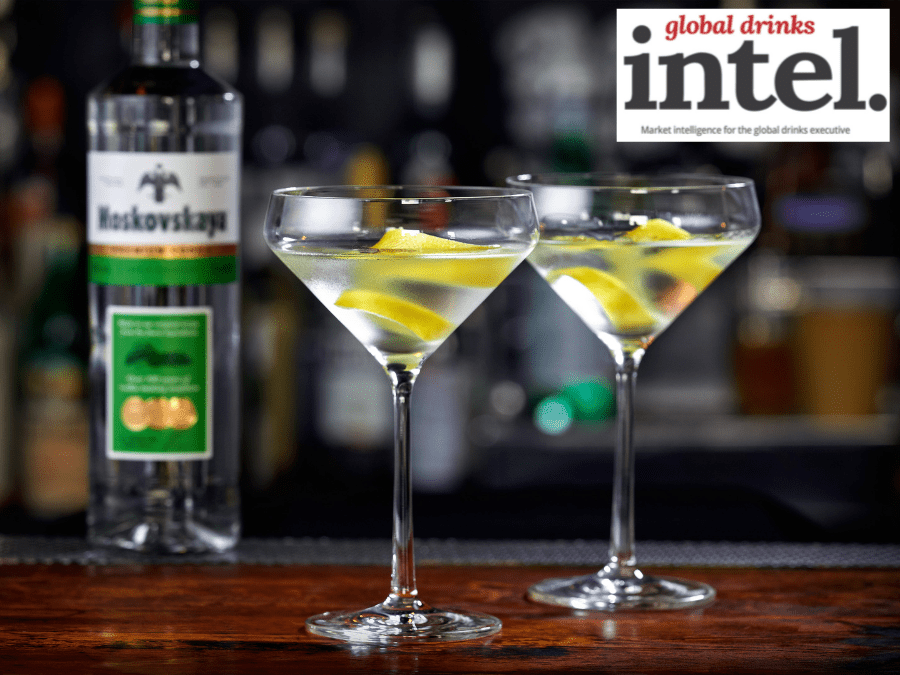
In premium vodka, sustainability is a key trend, where Amber Beverage Group will soon launch a global sustainability-oriented initiative for its Moskovskaya brand. “We'll be engaging with a global campaign about the important role trees play in biodiversity and offsetting our carbon footprint,” explains Janssens. “We're proud to be taking positive action to improve the environment.”
Russia’s invasion of Ukraine has undoubtedly impacted the category. “Like every business, we're conscious of the impact of the economic challenges facing key markets," Janssens admits. "There is no doubt that brands such as Moskovskaya have benefited from the downturn in Russian vodka sales. We feared a backlash due to the name, but we worked hard to quickly and effectively point out that our vodka is made in Latvia, part of the European Union, using 100% EU-sourced materials.
“We have also supported our neighbour, Ukraine, with several donations and a special edition of our vodka to raise further financial support for the people of Ukraine. ABG was one of the first global companies to state that we were standing shoulder to shoulder with that country in its fight for independence.”
The appeal of philanthropy among consumers
One of the biggest names in the category in recent years has been Tito’s Handmade Vodka, which according to MD for international John McDonnell has “a loyal consumer base in markets across the globe, especially in the US, the Caribbean, Australia and throughout most of Europe”.
“Clearly, consumers are drinking better," he says. "People are also increasingly seeking brands that are produced with sustainability in mind, and companies that are good corporate citizens. I’m very proud that at Tito’s Handmade Vodka ... we’re heavily involved in philanthropic efforts and support causes that are important to our consumers.
“Sustainability is very important, and consumers recognise and appreciate brands that are committed to sustainable efforts. Our efforts include a solar farm — one of the largest privately-owned solar farms in Texas — that helps cover a substantial portion of our energy needs. We’re even able to put renewable energy back onto the local utility grid.
“We also collect rainwater at our distillery to support our water usage for landscaping and for organic farm irrigation. And in terms of waste recycling, approximately 99% of our production packaging waste stream is captured and recycled in our facility.”
This article appears in the November issue of Global Drinks Intel magazine. For details on how to subscribe, click here.