


The search for comfort in uncertain times has seen sales climb, but it is innovation that will keep the category moving. Richard Woodard reports
The growth areas for beverage alcohol that emerged during the Covid-19 pandemic are well-known now: RTDs, agave spirits, retail, e-commerce and — counter-intuitively, perhaps — Port.
According to Rob Symington, director at Graham’s, Dow’s, Warre’s and Cockburn’s owner Symington Family Estates (SFE), Port sales volumes dipped by -6.7% in 2020 — but only because the Portuguese market plunged by -31% thanks to the severe impact of the pandemic on tourism.
“Of the other big six Port markets,” Symington says, “the UK saw an increase of 10% volume, the US and Belgium were both up 2%, and France and the Netherlands saw modest declines of -7% and -4%, respectively.”
Meanwhile, SFE’s own sales volumes rose 4%, “thanks to the strong performance of our brands globally and our strength in the UK”, says Symington. “This was broken down by 3% volume growth in the standard categories and 7% volume growth in the premium categories.” Variations largely depended on Port’s main channels of distribution in individual markets, says Churchill’s director of sales and marketing Zoe Graham. “In markets where Port consumption generally skews towards at-home occasions and therefore the off-trade, such as the UK and Scandinavian markets, the negative impacts on on-trade and travel channel sales were largely offset,” she adds.
Relevance through innovation
Pinning down the reasons behind Port’s success proves more elusive. Adrian Bridge, CEO of Taylor’s, Fonseca and Croft owner The Fladgate Partnership, offers a number of possible explanations — including a sense of reassurance.
“Port is delicious and comforting at a time of uncertainty — there’s a feel-good factor,” he says. “The phenomenon that we’ve previously seen in recessions is that Port tends to sell very well, partly for at-home consumption, but partly for just making people feel good.”
Another key to the continued popularity of Port — with its long heritage and ‘traditional’ reputation — is to maintain relevance through innovation while not sacrificing its quality credentials.
Vintage Port continues to be the category standard bearer — both ‘classic’ vintage years, when the great houses such as Taylor’s and Graham’s declare, and years like 2019, when single quinta vintages such as Vargellas (Taylor’s) and Malvedos (Graham’s) are the norm. One exception to this rule is Quinta do Noval, the property owned by AXA Millésimes which is technically a single quinta, but has long been regarded as one of the great classic vintage houses (along with its even more sought-after Nacional, from a tiny parcel of vines on the estate).
Noval has declared every vintage between 2001 and 2019, but with a close eye on the quantities released, says AXA Millésimes MD Christian Seely. “During the period 2011 to 2019, our declarations have ranged from under 1,000 cases in some years to higher levels ranging from 3,000 to 5,000 in others,” he explains. “The market response to this series of Quinta do Noval vintage Ports has been excellent, with each declaration since 2011 selling out rapidly, without exception.”
Another strength of Noval since Seely’s arrival at the property 28 years ago is Colheitas — single-harvest tawny Ports — of which there have been six releases. “I believe high-quality Colheitas are an important element in the future prosperity of the Douro Valley and of Port in general,” says Seely. “Apart from being wonderful wines, they have the huge advantage for urban consumers that we age them here for you, and release them when they are ready to drink.”
Portonic a gateway to category
Colheitas are part of the general surge in popularity for tawny Ports over the past decade and more. Symington points out that volumes of aged tawnies grew by an average of 4% annually over the 2009-19 period — that’s also music to the ears of a tawny focused business like Sogevinus, owner of Cálem, Burmester, Barros and Kopke.
“Portugal, the Netherlands, Denmark and the UK, to mention only four, have all shown incredible interest in this, until recently, very Portuguese style of barrel- matured Ports,” says Sogevinus CEO Sergio Marly Caminal. “Our Port wine houses have always focused on aged tawny and Colheita Ports, so we are lucky to have a vast library of aged tawny Ports to pick from.”
As Seely says, these Ports benefit from being ‘ready to drink’, but they are far from being the only RTD products on the Port shelves now. Step forward white Port and tonic in a can — both from SFE’s Cockburn’s house, and from Fladgate with Taylor’s Chip Dry & Tonic and Croft Pink & Tonic — all branded commercially as Portonic.

These products aim to exploit multiple consumer trends, including the ongoing G&T boom and the thirst for convenient, ‘chill and pour’ RTD drinks. “We think it’s a fantastic way to introduce new consumers to the category and to tap into new consumption moments,” says Bridge — words echoed by Symington, who describes RTDs as a potential gateway to the category.
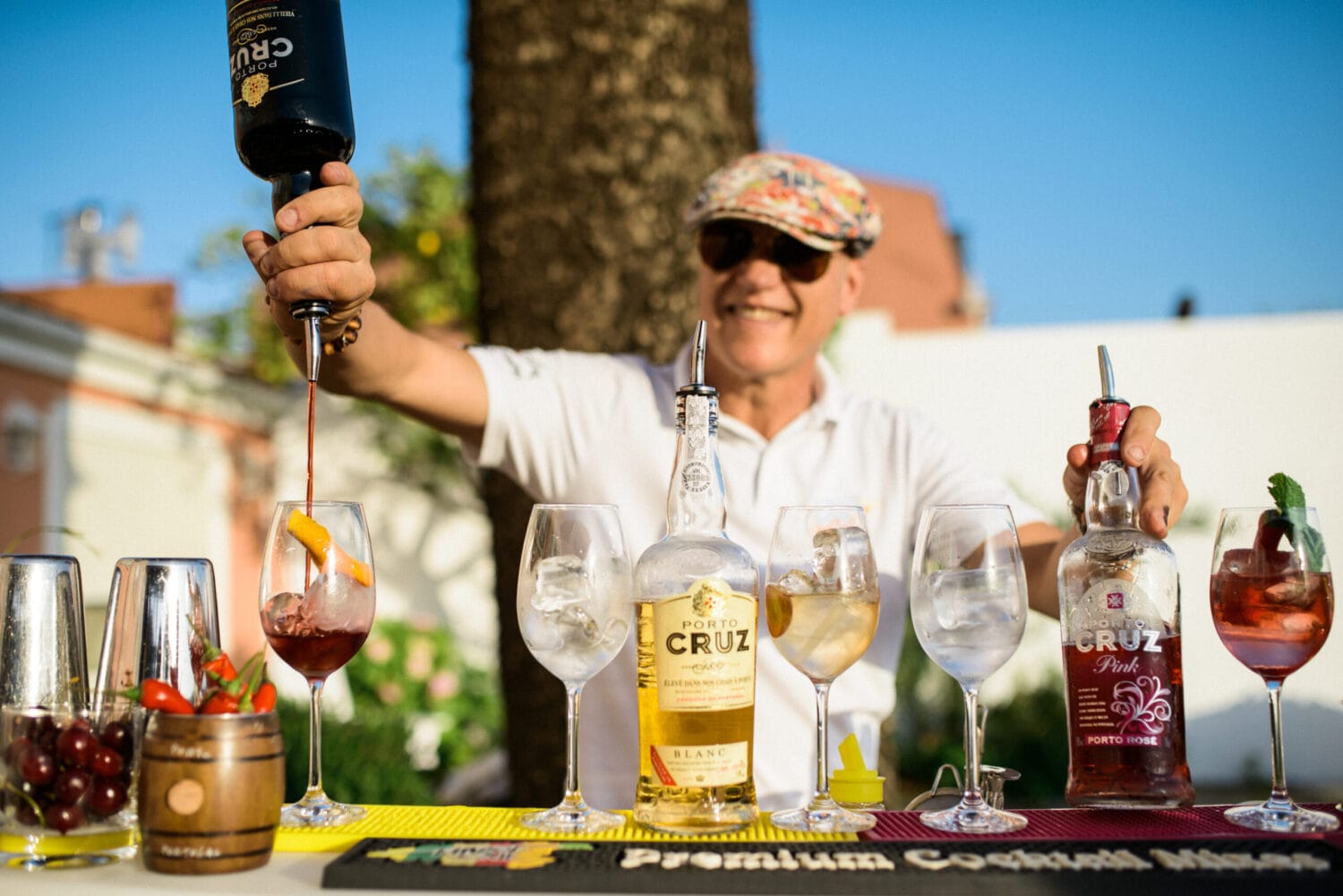
The idea of using Port in a refreshing serve is not new to anyone who’s visited Portugal in recent years — it’s a trend that has been successfully explored in particular by La Martiniquaise-Bardinetowned Porto Cruz.
“As one of Portugal’s largest Port producers, we pay a lot of attention to the growth potential of the ready-to-drink subcategory of Port,” says Constance Descamps, international marketing manager. “Portonic represents a real diversification challenge for the Port wine category by being a more refreshing and trendier [means of] drinks consumption.” The company has worked for some time on diversifying occasions for Port consumption through its Cruz Fresco! summer cocktails programme: tawny or ruby Port on ice with a slice of citrus; Cruz White or Pink with ice and tonic; flavour combinations like ginger and rosemary with white Port, or red chilli with pink Port. “We continue to support this way of consumption in our key countries: France, Portugal and Belgium,” says Descamps. “The message is clear: Port can also be consumed fresh, mixed and with low alcohol.”
Moving with the times, focusing on innovation, while maintaining its centuries old quality credentials and heritage — these are the key strategic priorities for a relatively buoyant Port category in 2021. ●
Fearing to tread
The foot treading of grapes in the large granite troughs called lagares is one of the quintessential sights of harvest time in the Douro Valley — but the spectre of the Covid-19 pandemic has made it an increasingly rare one.
Most Ports are produced mechanically, but a number of companies maintain foot treading for some of their top Ports, such as Symington Family Estates’ (SFE) Quinta do Vesúvio — or they did until the arrival of Covid-19.

At Vesúvio, 2020 was the first harvest not to feature foot treading since the winery was built in 1827, but it will be at least 2022 before people return to the property’s famously huge lagares. “Although Portugal is making good progress with its vaccine programme, for the 2021 harvest we have decided that the safety of our teams is paramount, and therefore we have reluctantly decided that we will miss another year of foot treading,” says SFE director Rob Symington.
It’s a similar story at Taylor’s owner The Fladgate Partnership, according to CEO Adrian Bridge. “At this stage, I think it would be irresponsible,” he says. “By not foot treading we can have a smaller workforce, which means wider spacing in the dormitories. That seems sensible to me.”
One place where foot treading did take place in 2020 — and will again in 2021 — was Churchill’s, as Zoe Graham, director of sales and marketing, explains. “All of our Ports, from entry to vintage, are and always have been foot-trodden, and so we decided it was worth investing in, rather than compromising.
“We have put in place strict social distancing restrictions, separating our teams into smaller groups from the same communities, and established effective protocols to keep everyone in the lagares safe.”