Harnessing the power of storytelling
Much of the consumer appeal of beverage brands relies on the memorable stories that underpin them. Where would Pernod Ricard’s Beefeater be, for example, without the Tower of London-guarding Yeoman Warder who appears on its label? Similarly, would Dom Pérignon have quite such a revered status were it not for the myth of its namesake Benedictine monk’s sparkling winemaking experiments?
Packaging can be a crucial means of communicating these compelling stories. Moreover, in an age where provenance, craft values and heritage have such currency among Millennial and Gen Z consumers, storytelling is becoming an increasingly integral part of so many design briefs, according to industry experts.
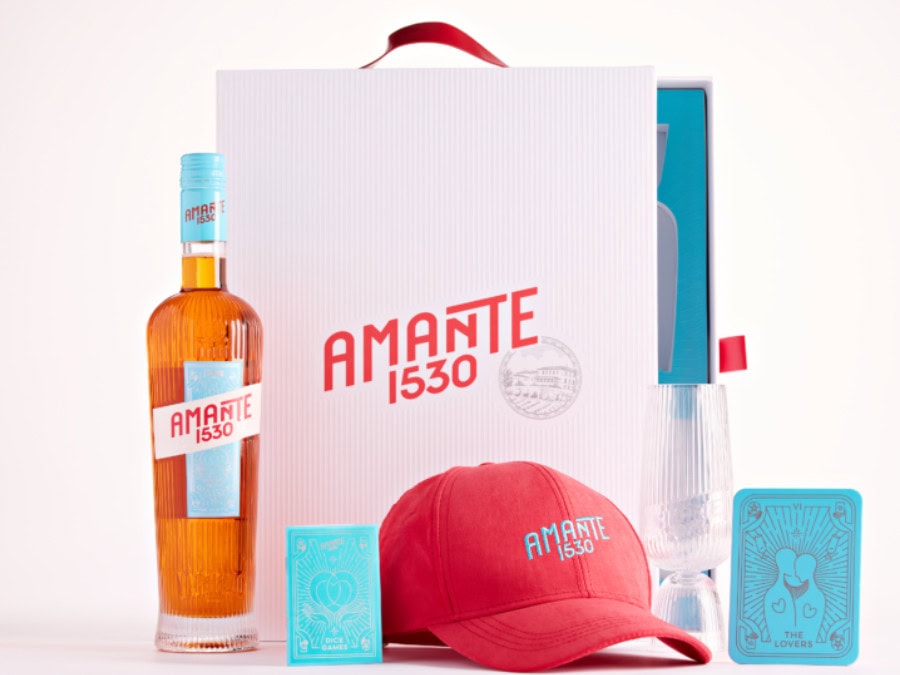
“I worked with brand Amante 1530 (below) and [they] wanted to get a story of their brand across that they’re an Italian brand,” says Alison Gildersleeve, account director at Stephen Gould Corp, one of the biggest packaging manufacturers in the US, referring to the new low-alcohol Italian amaro founded by musician Sting that launched last year.
“We created a launch kit box for them with a red leather handle to match their logo, [and] other swag items in the box such as elegant high-end glassware, a deck of cards, a hat and the bottle,” she adds. “They wanted to showcase their brand as a high-end Italian beverage that can be enjoyed on a hot summer day wearing their hat, in their fancy glasses and having fun playing cards with friends.”
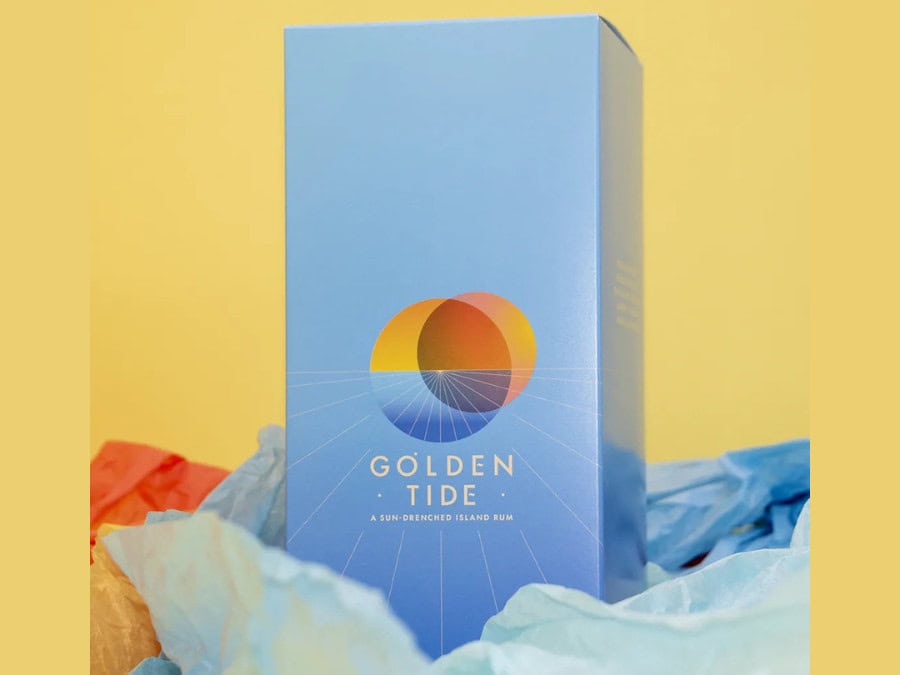
Storytelling was also an important part of the design of Golden Tide (below), English craft distiller The Tidal Rum’s ‘distilled-at-sea’ aged and spiced expression produced in partnership with P&O Cruises. UK firm Packaging Supplies, one of the country’s leading carbon-free packaging providers, worked on the brief. “We incorporated their logo and design into folding box board packaging with high-micron printing resolution,” recalls marketing manager Adam Middleton.
“To capture the brand’s story, we used a shade reminiscent of the purest Caribbean waters, featuring delicate lines that represented the sun’s setting rays dancing upon the water,” he adds. “This visual storytelling element captured the essence of Golden Tide, providing a narrative that speaks to the brand’s origins and quality.”
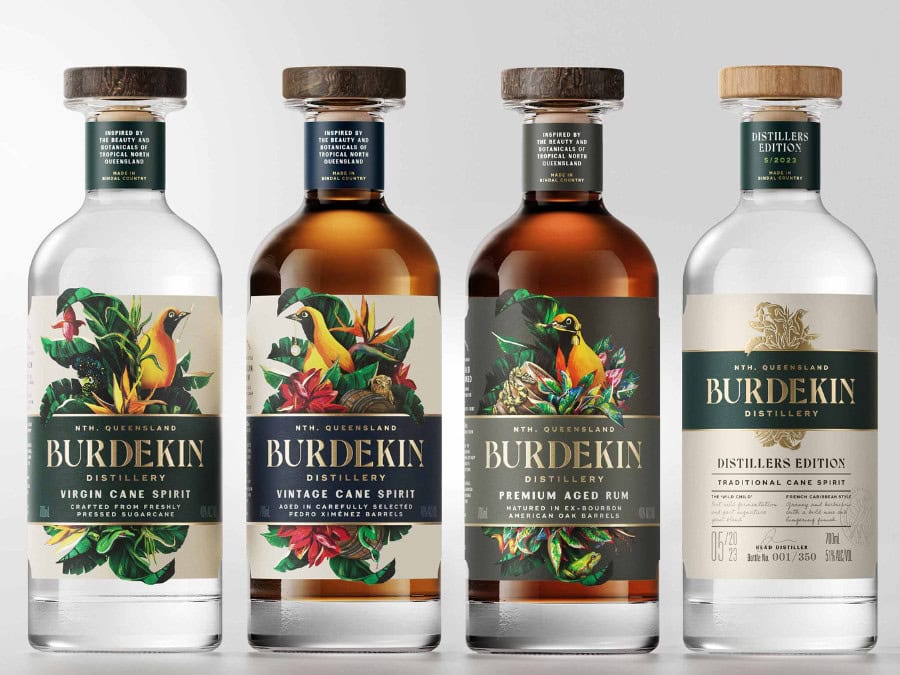
Similarly, Rowena Curlewis, of Australia-based international drinks design agency Denomination, says the firm’s recent work with Australian rum Burdekin’s packaging (below) strived to evoke the brand’s Queensland provenance. “We captured the natural beauty of the distillery’s unusual home in tropical North Queensland by creating a lush, dense illustration of flora and fauna of the region.
“In each variant, the bower bird holds an item related to the style of the rum – a swizzle stick for the Virgin Cane Spirit is perfect for cocktails and mixers, and a watch to indicate that the Vintage Cane Spirit has been aged for longer, developing colour and depth of flavour.”
Drawing in Gen Z and Millennials with colour and humour
The wine industry is battling with a recruitment challenge. Two main issues are to blame: ageing populations in key wine-drinking markets such as Europe and the US, and the fact that more diverse Millennial and LDA Gen Z consumers are yet to be turned on to the category’s charms. In the US, for instance, 28% of wine drinkers in 2010 were aged between 21 and 34; by 2020, that percentage had fallen to 18%, according to data from Wine Intelligence.
Denomination’s Curlewis believes that packaging can play an important role in making wine attractive to younger LDA consumer groups. The use of a simple colour palette, for instance, can help guide consumers to their ideal wine and demystify the decision-making process.
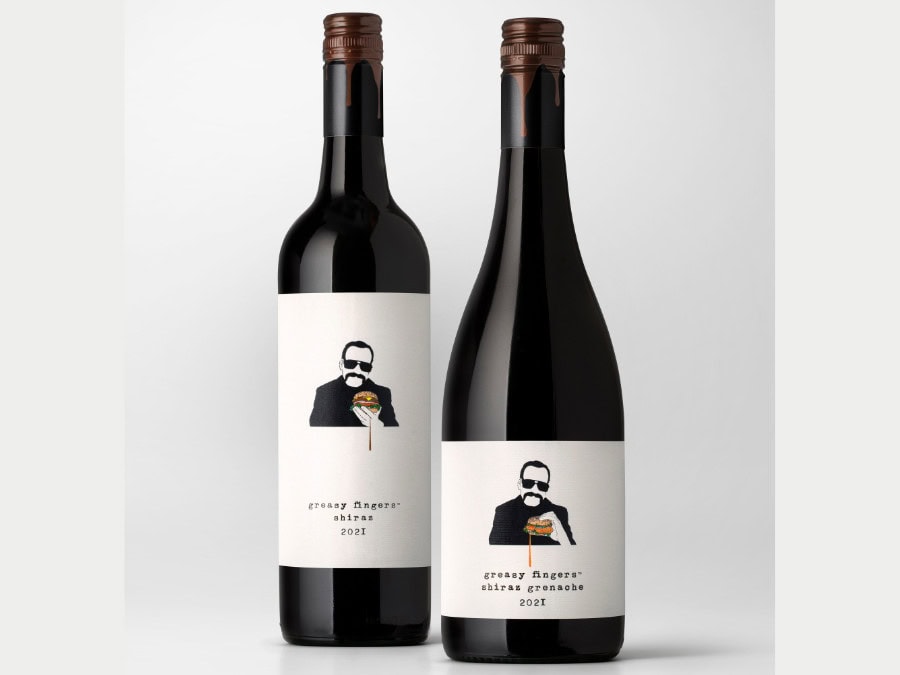
Humour can also play an important role, she maintains, pointing to Denomination’s recent work with Greasy Fingers (below), a Pernod Ricard-owned wine brand launched in the UK last year and designed to pair with fast food. “Greasy Fingers challenges traditional boundaries of wine and food pairings by … delivering two bold wines … crafted to cut through greasy food and provide the perfect match for gourmet fast food,” she says.
“The ‘greasy’ Pablo Escobar-esque personality on the front of pack, mouth drooling over his fast food of choice, pokes fun at the traditional wine category and encourages consumers to choose wine to match a new occasion,” she adds.
Green targets shaping innovation in luxury
Regulatory pressure to improve the sustainability of drinks packaging is intensifying. In March, the EU reached a political agreement on its Packaging & Packaging Waste Regulation directive, a potentially seismic set of proposals for alcohol brand owners operating in the EU market. If formally adopted, the new regulations will introduce ambitious targets at the EU level for waste prevention and reuse, as well as for product recyclability.
The clock, then, is ticking for both beverage alcohol producers and their packaging suppliers. Jennifer Clements, senior project manager at Pentawards, one of the leading international design competitions, which most recently attracted more than 32,000 entries from almost 100 countries, believes many brands are already making substantial progress in this vital area.
“We’re seeing a continued emphasis on creative and innovative designs that prioritise sustainability,” she says. “This focus on green practices is driving the industry to new heights of inspiration and invention. In the beverage category, we’ve noticed some remarkable examples of sustainable luxury: Air Vodka, the world’s first carbon-negative spirit; circular brand Re:Incarnated Spirits and Lagg Single Malt Scotch Whisky’s eco-conscious packaging, to name just a few. Each of these brands has successfully integrated sustainable practices without compromising on the sophistication and appeal of their packaging,” she adds.
The co-founder & executive creative director of UK-based design agency Thirst, Matt Burns, argues that brand owners no longer need to face the dilemma of choosing aesthetically-pleasing packaging that’s bad for the planet or dull, eco-conscious designs. “So many of the new sustainable materials we’re discovering are both beautiful and luxurious,” he says. “It’s no longer a question of either/or with sustainability and aesthetics.
“For example, we partnered with James Cropper to create a bespoke outer wrap for Bruichladdich’s age statement, high-provenance Luxury Redefined range — the first-ever colourform secondary pack seen in the spirits category. Produced using 100% green energy and entirely free of plastic and glue, this lightweight material speaks to the modern language of luxury. It’s high-end and beautiful to touch, creating an elevated experience in the hands of consumers, reducing Bruichladdich’s CO2 impact while never compromising on elegance and quality.”
Especially in these inflationary times, however, sustainable design does not come cheap. “We urge our customers to first tell us their budget before we start designing and recommending materials,” says Stephen Gould’s Gildersleeve. “Sustainability comes with a cost. If it didn’t, then it would be easy for all brands to make the changes.
“We work a lot with brands incorporating recycled materials, soy-based inks, wood grains and try to avoid plastics and metals,” she adds. “We can use sustainable materials and still make a gorgeous package that’s aesthetically pleasing. Paper tubes are an example of high-end brands with luxury prices, but they’re very sustainable and affordable.”
Using smart closures to tackle counterfeiting
The problem of counterfeit alcohol continues to grow, impacting business on both a local and global scale, and, of course, eroding consumers’ faith in otherwise strong brands.
A full suite of measures is needed to tackle an issue that affects 26% of global alcohol consumption, according to the World Spirits Alliance, and the role of packaging, and closures in particular, shouldn’t be overlooked.
Closure specialist Tapì is developing iTap, which embeds an NFC (Near Field Communications) chip in the closure of the bottle. “The iTap technology serves multiple functions,” explains marketing manager Paolo Boratto. “First, it helps in verifying the authenticity of the product by allowing the brand and consumers to check the opening of the bottle. This ensures that the product has not been tampered with and maintains its integrity from production to consumption.
“Additionally, the NFC chip enables the end customer to access more content related to the product they are consuming,” he adds. “By tapping their smartphone on the closure, consumers can discover a wealth of information about the product, including its origins, production process, tasting notes and more. This not only enhances the consumer experience, but also reinforces the brand’s authenticity and transparency.”
Unleashing the power of custom digital printing
The arrival of digital printing has revolutionised the drinks packaging industry. Unlike traditional methods, it offers more flexibility, allowing for smaller print runs, perfect for craft brewers and distillers, as well as seasonal flavours and limited editions. Additionally, digital printing has ushered in an age of personalised packaging, empowering brands to tell their story on every can or bottle.
According to the marketing manager at Tetra Pak US & Canada, Yasmin Segura, the revolution is still ongoing. “In 2023, Tetra Pak launched Tetra Pak Custom Printing, a unique, premium inkjet-based printing method that enables greater design variability,” she explains. “By allowing multiple different designs to be printed on a single packaging material reel, Tetra Pak Custom Printing offers more creative freedom in both design and business.
“This innovation allows for greater design agility across orders, meaning brands can try out new ideas in a cost-effective way,” she adds. “It’s never been easier to leverage opportunities to collaborate on cross-promotions, create collectables or produce limited-edition package series.”
This article is available to Global Drinks Intel members only.
Click below for details on how to join the Global Drinks Intel community.
Already a member?
Log in here to read the article in full.
If you work for any of the following corporate subscribers to Global Drinks Intel, head here to activate your access.
- AB InBev
- Bacardi
- Campari Group
- Diageo
- Moët Hennessy
- Pernod Ricard
- Proximo Spirits
- Suntory Global Spirits
- William Grant & Sons