
Sign In
Global Drinks Intel Logo - Home
  • News
    • Beer
    • Spirits
    • Wine
    • Environmental, Social & Governance
    • Financial Results
    • Marketing
    • Mergers & Acquisitions
    • New Product Development
    • From the Industry
  • Intel
    • Comment
    • Interview
    • Category Intel
    • Consumer Intel
    • Market Intel
  • Awards
    • Global Drinks Awards
    • New Product Awards
    • ESG Awards
  • Magazine
  • Newsletter
  • Subscribe
  • Contact
Search
OKI Banner - https://www.oki.com/uk/printing/label-printer/?utm_source=OKI+Web+Chat&utm_medium=Bing&utm_campaign=Global+Drinks+Awards&utm_content=ACTFUND-1070&activity_code=ACTFUND-1070


The nuances missing from ‘Gen Z consumption crisis’ narrative – Consumer Intel

Olly Wehring
Last updated: 24/04/2025 at 9:15 AM
By Olly Wehring
23 April 2025
5 Min Read

‘We find these narratives are greatly overblown.’


Gen Z consumers posing for a photo
Credit: iStock

Among the many rocks being slung at the beverage alcohol industry, one of the biggest is the claim that younger LDA consumers are considerably less interested in its wares than older generations are/were. A research note from Rabobank this month, however, has dug deeper into the claim and found that the argument is at best, flawed, and at worst, downright lazy.

SHARE

Among the many rocks being slung at the beverage alcohol industry, one of the biggest is the claim that younger LDA consumers are considerably less interested in its wares than older generations are/were. A research note from Rabobank this month, however, has dug deeper into the claim and found that the argument is at best, flawed, and at worst, downright lazy.

The report, ‘The Real Reasons Generation Z is Drinking Less Alcohol’, starts by referencing an Instagram post from an account called ‘insidehistory’ (which has 5.5m followers) last month.

View this post on Instagram

A post shared by Inside History (@insidehistory)

Citing figures from the Bureau of Labor Statistics in the US, the post claims that “Gen Z drinks 87% less alcohol than previous generations”.

“Though the post is, surprisingly, even more incorrect than most commentary on the subject,” counters Rabobank’s senior beverage analyst – and report author – Bourcard Nesin, “the data cited in this Instagram post is emblematic of a broader failure among journalists and industry analysts to distinguish between shifts in behaviour driven by life stage and shifts in behaviour driven by generation.”

Indeed, Nesin qualifies the source data by flagging that the widely-agreed age range for Gen Z consumers – those born between 1995 and 2012 – contains a sizable cohort that isn’t of legal drinking age or above. “Furthermore,” he adds, “the members of Gen Z that are over 21 years old have yet to get a college degree, are working an entry-level job or not working at all, and therefore don’t have any money to spend on alcohol.”

What is of critical relevance here is that the same circumstances applied to the previous generations of Millennials, Generation X and Baby Boomers.

The report goes on to admit that Gen Z consumers are drinking less alcohol than their predecessors, but then poses the crucial question: Will they eventually start drinking more?

“Understanding why Gen Z drinks less than previous generations did at the same age is very important for answering this question,” says Nesin, before offering up as two explanations the ubiquity of mobile devices as part of teenage life, and the associated rise in the likelihood of ‘getting caught’ from these devices.

Put simply, parents and “school administrators” today know not only where the kids are but also what they’re doing.

“On one hand,” Nesin expands, “the move away from in-person socialisation toward social media seems like a permanent shift, with consequences for young people’s wellbeing that go far beyond alcohol consumption. However, if the main driver is universal parental surveillance and a loss of privacy making underage drinking a far riskier activity than it was in the past, then that is a condition or restriction that will disappear as Gen Z becomes more independent during later years of adulthood.”
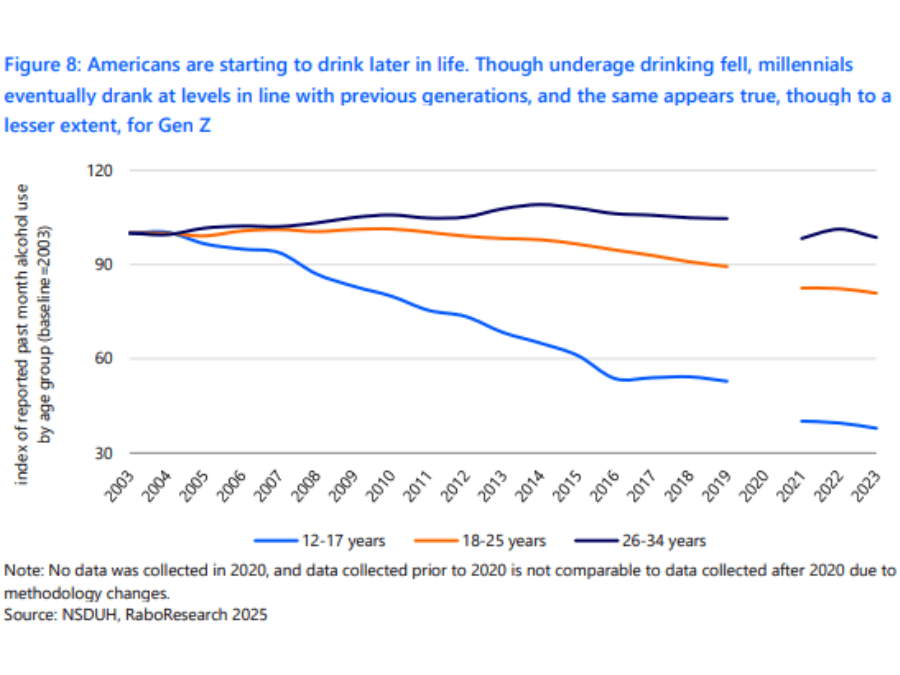
Chart of reported past month alcohol use by age group in the US

The report also breaks down the demographics within Gen Z, citing figures from the National Survey of Drug Use & Health in the US that show that “women now represent the majority of adult alcohol consumers aged 25 and under”.

Another noticeable change is also ethnic/racial lines: “Black, Asian and Latino consumers historically drink less alcohol than white consumers,” the report states. “Those groups represent 50% of Gen Z, yet were only 29% of the Baby Boomer generation.”

The takeaways from Rabobank’s research provide succour to brand owners bruised by the dominant narrative. “Companies need to realise that knowing that Gen Z is drinking less is far less important than knowing why Gen Z is drinking less and, ultimately, which members of Gen Z are drinking less.”

The first recommendation, then, is to reposition brand marketing efforts to appeal to women – “women with college degrees, to be precise” – and to people of colour. Secondly, brand owners would do well to target their employee recruitment appropriately to the demographics they need to focus on.

One final suggestion – and this one comes from me – is to be wary of attention-grabbing headlines warning that the end of the world is near. Because, it’s not.
What will the world – and the consumer – look like in 2050? – Consumer Intel

Olly Wehring
ByOlly Wehring
Olly has been reporting on the beverage industry as a B2B journalist since 2003. He spent 18 years at Just Drinks, 16 of which as managing editor. Since joining Global Drinks Intel in 2022, he's interviewed the CEOs for brand owners including AB InBev, Campari Group, Carlsberg, Heineken and Suntory Global Spirits and has a bulging contacts book from across beverage alcohol worldwide.
Previous Article Johnson Brothers and Maverick Beverage Co logos Johnson Brothers acquires part of US peer Maverick Beverage Co
Next Article Tequila El Mexicano portfolio El Mexicano tequila releases updated packaging
MPU for Global Drinks Intel ESG Awards 2027

The Newsletter

Sign up to receive our newsletter email

  • The very latest news from across the world's beverage alcohol industry
  • Cutting-edge intel from our in-depth category & market analyses, backed by benchmark industry data
  • The best insight on your competitors from our interviews with the industry’s leaders

This field is for validation purposes and should be left unchanged.

Follow on Social

Linkedin Twitter
Short Tower for Global Drinks Awards
Banner for Mont Blanc Vodka - https://www.montblanc-vodka.com/intro/

You Might Also Like

Four varietals of Casillero del DIablo

Viña Concha y Toro ‘open’ to ‘near-term’ wine M&A opportunities

21 October 2026
Pollen Projects Sylva

Pollen Projects adds ex-Diageo North America head to board

21 October 2026
Bottles of Heineken on a production line

Heineken to appeal US$125m fine as Greece row approaches endgame

21 October 2026
Baileys marketing winter

Diageo kicks off global push for Baileys – video

21 October 2026
Linkedin Instagram

What next?

  • Sign up to our FREE newsletter
  • Subscribe
  • My Account
  • Sign up to our FREE newsletter
  • Subscribe
  • My Account

About

  • Contact
  • Privacy Policy
  • Cookie Policy
  • Terms & Conditions
  • Contact
  • Privacy Policy
  • Cookie Policy
  • Terms & Conditions

Copyright © 2026 Global Drinks Intelligence Limited. All Rights Reserved

Built and Managed by Kukoo Creative