
- Planogram compliance under 60% is widespread and damaging to both sales and brand trust
- AI-powered compliance tools enable real-time, image-based tracking that improves speed and precision
- Rapid insight leads to faster corrective action, driving sales upwards
- Compliance data supports strategic planning, in-field efficiency and retailer collaboration
- Predictive analytics is the next evolution, offering proactive management of execution risk
In the dynamic world of retail, the increased prevalence of technology has shifted the battleground. It’s no longer just about product, price or promotion – it’s about precision. Specifically, precision in execution. The ability to consistently deliver the right product, in the right place, with the right visibility, is what separates high-performing off-premise operators from the rest.
At the heart of this shift is artificial intelligence.
Inconsistent off-premise execution
Most retailers and brand owners know they’re leaking value in-store, but often struggle to pinpoint where, why and by how much. The traditional approach to store audits and field visits is expensive, slow and subjective. Worse still, outdated systems and input-bias can mask the true extent of the problem.
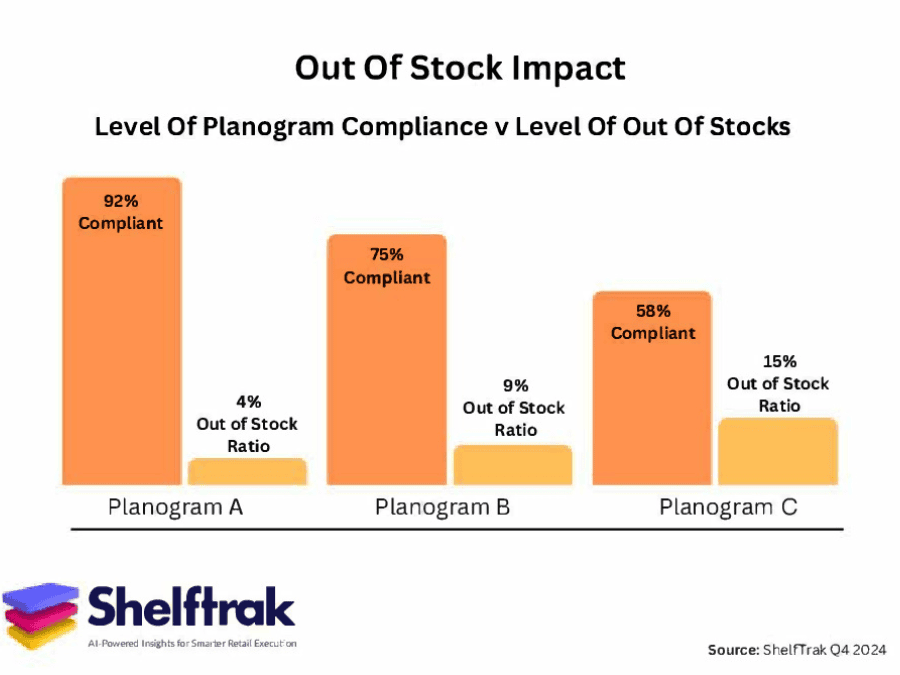
Planogram compliance – one of the most fundamental metrics in off-premise execution – is often below 60%. This means that in nearly half of all stores, the layout agreed between brand and operator is not being followed. Products can be in the wrong place, promotions not activated correctly and pricing inconsistent.
The implications of this are profound. Poor execution can lead directly to:
- Out-of-stocks, even when inventory exists in the backroom
- Missed sales, particularly during critical promotional windows
- Damaged brand equity, as shoppers experience frustration and disappointment, and
- Reduced return on marketing investment, as campaign support falls flat on the shelf.
This issue isn’t new, but the tools to solve it are. That’s where AI comes in.
The AI revolution in compliance
AI is ushering in a new era of execution excellence. At the core of this transformation is image recognition – software that can analyse photos of shelves and determine compliance against planograms, promotional guidelines and pricing expectations.
AI-powered solutions, such as those offered by execution tracking specialists, are changing how both brands and retailers operate. These platforms are engineered specifically to support precision compliance at scale. They capture, process and analyse thousands of shelf images with rapid-insight turnaround. What previously took a field team days to audit and measure can now be completed in a matter of hours with greater consistency and objectivity.
This represents a fundamental shift: from retrospective reporting to real-time analysis and fast insight – and that speed matters.
Why timing is everything
The off-premise is a channel built around velocity. The ability to identify and correct execution issues at a rapid pace creates a flywheel of performance improvement. When insight is immediate, action can be taken while it still matters.
Consider this: a major brand launches a global airport promotion to coincide with a new product release. Within 24 hours of launch, AI tools scanning store images flag that 40% of the promotional units are either incorrectly merchandised or not set up at all.
Without this visibility, weeks might pass before the issue is uncovered – by which point the campaign has ended and the opportunity is lost. With AI, however, in-store or in-field brand teams can be mobilised the same day to correct the issue.
The result: visibility is restored, revenue is protected and the ROI on campaign spend is improved.
Rapid GTR display correction
One Shelftrak client – a premium drinks company operating across global travel retail – leveraged real-time analysis with rapid compliance tracking and reporting via AI tools in over 70 international locations.
During this specific campaign, their brand ambassador teams discovered that promotional displays in 19 of the top 45 stores were not properly activated by day two. Using rapid data from fixture image scans, corrective actions were implemented by day three.
The impact? An immediate lift in compliance (58% to 93%), which led to an improvement in sales across affected stores.
Category leadership through data
Beyond compliance, AI enables brands to better understand their position within the category. Advanced systems now track category share by SKU, monitor competitor activity and identify trends in assortment, pricing and promotional execution.
This ‘total category view’ is vital, allowing brand owners to:
- Identify competitor encroachment on key shelves
- Monitor shifts in pricing and promotional strategies
- Detect distribution gaps before they impact sales, and
- Benchmark execution consistency across geographies
From policing to partnership
Retailers are not the enemy in the execution equation. In fact, AI-driven compliance tools are becoming a bridge for more productive brand-retailer collaboration.
By sharing objective data – supported by time-stamped images and reporting – brands can engage in constructive conversations around in-store standards. Retailers, in turn, gain clearer visibility over execution performance at store level and can manage their internal teams more effectively.
Many off-premise operators now see value in empowering their own store teams with execution tracking tools. Mobile applications allow ‘click-and-go’ capture of shelf images, which are then automatically analysed by AI to provide fast, accurate feedback loops. This empowers frontline teams to self-correct, reducing the need for reactive intervention.
This kind of bottom-up visibility builds trust, drives consistency and turns compliance into a shared goal rather than a top-down enforcement mechanism.
The commercial link
The link between execution and sales is clear. Numerous studies show that when products are merchandised correctly, positioned prominently and priced consistently, conversion rates rise.
Compliance is not just an operational KPI – it’s a leading indicator of sales performance. Here’s how:
- Better visibility = higher likelihood of purchase
- Correct pricing = trust and value perception
- On-shelf availability = captured demand
- Proper promotion = increased basket size
Improvements in compliance have been shown to yield double-digit lifts in revenue in high-traffic locations. Even a 10% increase in compliance can result in meaningful ROI for brand owners.
Predictive compliance
As AI systems learn over time, their predictive power grows. Rather than simply reporting what has happened, next-gen compliance tools will forecast where and when issues are likely to arise.
Imagine receiving an alert that a store is likely to go off-planogram within the next 48 hours, because shelf scans show declining compliance trends and staff turnover is high. Or being told that a top-selling SKU is at risk of going out-of-stock within the next two hours based on fixture image data and sales velocity history.
These advances will shift brand teams from reactive firefighting to proactive retail execution management.
Efficiency meets strategic value
While the obvious benefits of AI in retail are around speed and accuracy, the less obvious – yet equally important – gains lie in operational efficiency and strategic agility. By automating data collection and analysis, brands can redeploy field teams toward higher-value tasks such as relationship building, training and performance coaching.
At the same time, strategic planning becomes more data-driven. Instead of relying on anecdotal feedback or quarterly recaps, category teams can build plans based on granular, live execution data.
The shelf as a strategic asset
Retail excellence used to be aspirational. Today, it’s operational – and increasingly, it’s measurable. AI is making that possible. It’s not just raising standards, it’s redefining what ‘standard’ even means.
As adoption of execution intelligence tools spreads, those who don’t adapt risk being left behind. Execution blindness is no longer an acceptable excuse. Every missed opportunity, every compliance slip, every shelf gap is now visible – and solvable.
The retail shelf is no longer just a point of sale. It’s a source of data, a driver of brand equity and a battlefield for consumer attention. Treating it with the seriousness it deserves is no longer optional.
Artificial intelligence isn’t just making retail more efficient – it’s making it more accountable, more transparent and, ultimately, more profitable.
About Shelftrak
Shelftrak is a high-performance commercial technology business transforming how brands and retailers monitor and optimise in-store execution across travel retail, global domestic markets and hospitality environments.
At the heart of its offer is the Shelftrak Retail App — a powerful, AI-driven mobile solution designed to enable in-store teams and field staff to capture real-time retail execution data with instant accuracy. Leveraging proprietary image recognition technology, the app allows for fast, seamless tracking and reporting of product placement, compliance, pricing and promotional activity across multiple locations.
In addition, Shelftrak provides a Global Tracking Service for travel retail, providing SKU-level category execution insights from 50 airports and 75 stores worldwide.
Backed by AI, Shelftrak identifies execution gaps, competitor activity and retail-optimisation opportunities, helping brands reset, reposition and grow across multiple categories and channels. Its clients include leading FMCG, beauty, drinks and confectionery brands, along with duty-free operators, high-street retailers and hospitality chains.
Shelftrak delivers the insight businesses need to drive performance, enhance shopper experience and stay competitive in today’s fast-moving retail world.
For more details, click here.
This article is available to Global Drinks Intel members only.
Click below for details on how to join the Global Drinks Intel community.
Already a member?
Log in here to read the article in full.
If you work for any of the following corporate subscribers to Global Drinks Intel, head here to activate your access.
- AB InBev
- Bacardi
- Campari Group
- Diageo
- Moët Hennessy
- Pernod Ricard
- Proximo Spirits
- Suntory Global Spirits
- William Grant & Sons