

This article was initially published in the November issue of Global Drinks Intel magazine. For details on how to subscribe, click here.
Back in the day – whenever that was – it was the promise of alcohol that brought people together in social groups, to share ideas, to connect and, let’s be frank, to help reduce the anxiety of meeting new people. Today, however, things have changed — consumers are simply not connecting with each other like they once were.
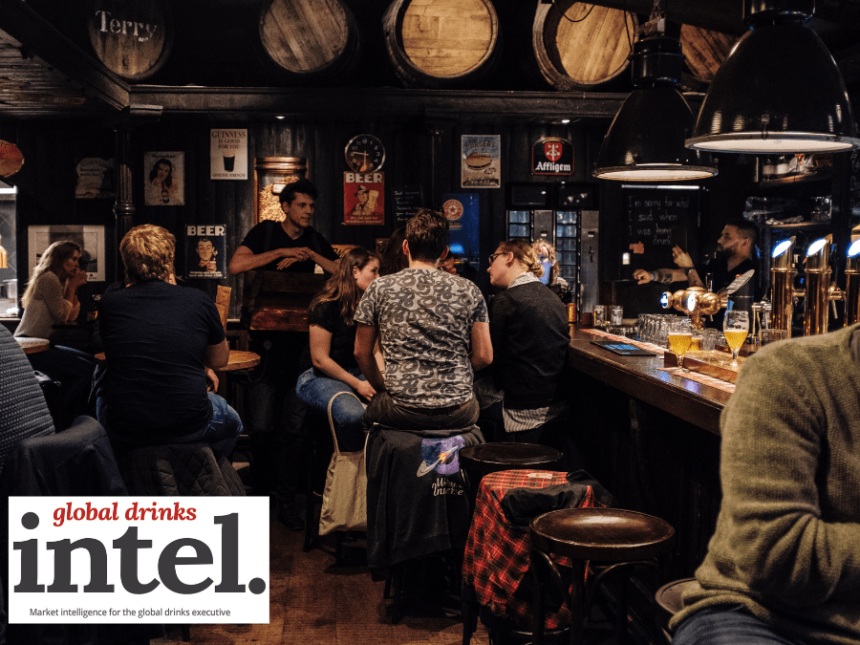
In the 1980s and ’90s, a UK pub, for example, was almost a retreat from the responsibility of family life; a place where predominantly men would socialise without needing to make too many social plans. Life was less transient and we lived in smaller social neighbourhoods, making it easy to build relationships. The upshot was the pub was a social space to meet strangers and mingle with other like-minded people. One could argue it created a safe space to let off steam after the day’s activities and share the burden of everyday life. Yes, some of the relationships were somewhat fickle, but it provided some of the social glue that bonds society together.
Fast forward 40 years to a post-COVID world and on-premise venues have changed a lot. There’s been the rise in mobile ordering and the fall in vertical drinking, while at the same time, people are generally staying in their direct friendship groups as though they’re still in their COVID bubbles. This has resulted in many mid-tempo drinking venues becoming less social. Consumers are stuck in dicotomía — their need to meet new like-minded people conflicting with the less-social atmosphere of many on-premise establishments. Add to that the increased cost of going out and the net result is a footfall issue, with UK retail footfall down 14.2% in July, compared to the same month in 2019.
What we’re seeing play out is the slow and steady death of the habitual pubgoer. While in the short term, this can be offset with consumers trading up, longer term we’re facing a declining market if we can’t recruit new people and grow volume.
Let me take you back to the coffeehouses of London in the 1700s to see what we can learn. Inside these venues, poets, playwrights, journalists and members of the public gathered around long wooden tables sipping, thinking, writing and discussing the news of the day and literature, late into the night. Conversation was the lifeblood of coffeehouses. Patrons were often strangers to each other, so having conversations with other strangers was a founding principle of the venues.
Different districts of London housed different styles of coffeehouses, focused on different patrons. Those close to the Royal Exchange in the City provided for businessmen and Westminster coffeehouses were for politicians, while those in the vicinity of St Paul’s Cathedral were patronised by clergymen and theologians. From these humble beginnings, successful companies were born, like Sotheby’s, Lloyd’s of London and the London Stock Exchange.
In essence, coffeehouses were social hubs where like-minded people could mingle with strangers through shared passions. And it’s in this concept where I feel our industry can take some serious learnings if we want to make the on-premise the social hub it once was.
Look to the current day and we can see examples of this. Take the rise of UK dating app Thursday, which takes over bars — you guessed it — each Thursday; Strangers getting together with a shared passion, packing out bars.
Or the 2019 campaign to bring back slow dancing in Argentina launched by US tortilla chip brand Doritos. More than 500,000 people signed a petition calling for the return of slow dancing, while 7,000 attended a connected event. Again, strangers getting together with a shared passion.
Sound familiar?
Alcohol brands have forgotten their purpose. If we’re not bringing people together, we’re forgetting why we exist. While in the short term, we can get consumers to trade up, the shared social occasion has been forgotten, especially at a time when loneliness and mental health issues continue to rise across the world. The need has never been greater.
Often, alcohol brands leave it to venues to build the demand. But, the power to create mass social occasions lies in the power of brand-building.
Only last month Diageo-owned Johnnie Walker announced a partnership with UK nightlife discovery app Dusk to give away 270,000 ‘Johnnie & Lemonades’ at participating venues across the country. I think this is a clear sign of the role brands need to play to drive footfall and bring back the shared social occasion with strangers.
This article was initially published in the November issue of Global Drinks Intel magazine. For details on how to subscribe, click here.