Nearly 30 years ago, Microsoft’s Bill Gates wrote an essay about the future of the Internet as a place where “content is king”, predicting the World Wide Web as a profitable medium to deliver information or entertainment. While true, in today’s business environment, professor & author Dave Ulrich offers a profound twist: “Content (what we do) is king, but context (setting in which we operate) is the kingdom”.
This sentiment underscores the critical importance of understanding the market context in which brands and their owners operate, particularly in an industry as complex as beverage alcohol. Relying solely on sales numbers to anticipate future consumption can be misleading (just look at what happened to the hard seltzer category in the US).
The global alcohol industry is adjusting to an unprecedented period of disruption. Ulrich’s theory on market-oriented ecosystems argues that companies today need to adapt from old ways of thinking to penetrate market opportunities more effectively. The adage that all brands are built in the on-premise, for example, is less relevant than it was a decade ago. Consumers today are more influenced by what they see on social media, and they are buying their alcohol online.
To put Ulrich’s theory another way: if we understand the reasons why, we can better serve consumer needs and innovate quickly. To do this, we need to acknowledge contextual conditions that are often embedded within larger trend buckets: demographics, social, technological, environmental, political and economic.
While all these factors influence general consumer behaviours when it comes to their purchase considerations across the alcohol category, a few in particular are worth exploring, particularly in the US market.
Three key themes driving purchase decisions
When thinking about what consumers choose to drink and why, their motivations often intertwine with three key themes: economic considerations, health & wellness priorities and a sense of purpose. Even recent drinks company earnings reports have cited these factors – In January, for example, Diageo speculated that consumers’ “health consciousness” and “less discretionary spending” contributed to a 0.6% sales dip in the second half of 2023.
Consumer alcohol purchases are financially driven — can I afford it, or do I want to splurge for it?
From an economic perspective, the concept of the ‘lipstick index’ provides intriguing insights into consumer behaviour during downturns. Coined by cosmetics mogul Leonard Lauder in the early 2000s, this phenomenon suggests that sales of affordable luxuries, such as lipstick, tend to increase during times of financial uncertainty.
Similarly, premium alcohol sales experienced a surge during the pandemic, reflecting consumers’ willingness to indulge in aspirational purchases despite economic constraints. According to Deloitte’s 2024 Consumer Signals survey, 41% of US consumers said their last splurge purchase was on food & beverage (the most popular category), with an average spend of US$45. These are smaller relative items of affordability that make people feel better.
This segues into the larger social trend of health & wellness. The pursuit of well-being is shaping consumer beverage choices, which has given rise to low- & no-alcohol alternatives, as well as functional beverages. Recent NIQ data shows that in the 12 months to the end of April, US non-alcoholic beverage sales were up 34% to $620.4m, while alcoholic beverages posted a meagre 0.8% increase during the same time frame.
NIQ also reports that functional beverages account for about 10% of the total US non-alcoholic beverage market. This trend reflects a broader shift not only towards moderation but also to mindful drinking as consumers seek beverages that align with their health goals without sacrificing taste or enjoyment.
The inexorable rise of health & wellness
Where did this come from? There has been a movement – a combination of innovative better-for-you product availability, societal awareness and now, government regulation – to make the American diet healthier. Indeed, the US Food & Drug Administration (FDA) has new guidelines for usage of the term ‘healthy’ that are focused on limiting the amounts of unhealthy ingredients like sodium, saturated fat and sugar.
With more alternative options and a greater awareness of dietary elements, consumers are looking for healthier choices. A Wasserman Next Gen study showed that 45% of consumers look at nutritional labels on food and beverages before purchasing or consuming. The US alcohol industry is now facing future amendments to nutritional labelling that would affect product transparency.
The rise of the use of Ozempic – a drug designed to treat people with type 2 diabetes – for weight management and appetite control may be contributing to the heightened interest in blood sugar beyond the diabetic community, which comprises about 30m people and just over 8% of the US population.
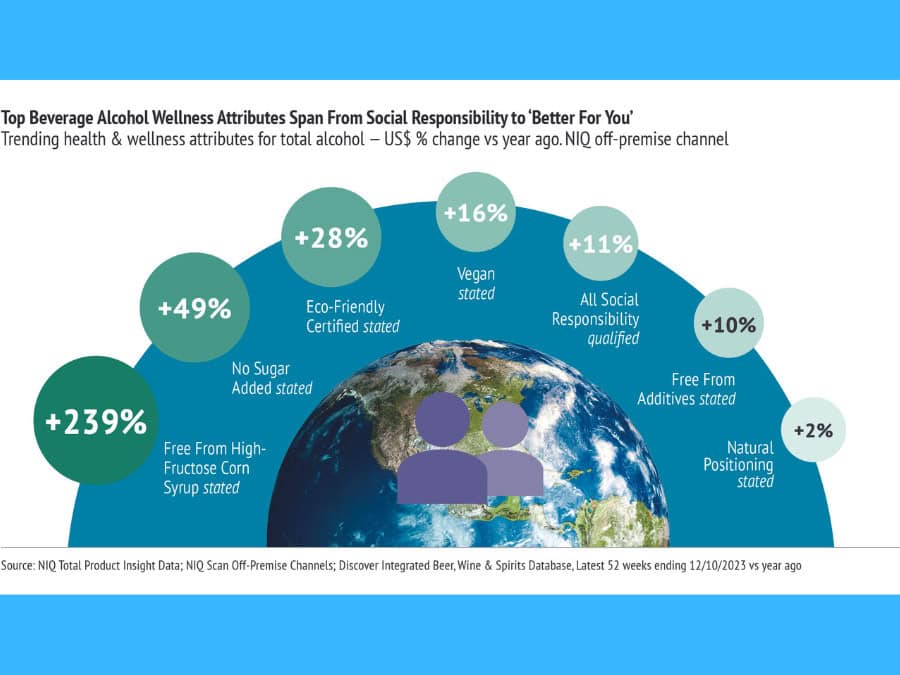
The latest trend of blood sugar-friendly diets has created a surge of food and beverage products designed to help people manage their glucose levels. NIQ looked at retail dollar sales by beverage alcohol attributes in 2023 and found that ‘free from high-fructose corn syrup’ and ‘no sugar added’ grew the most.
Brands must now also deliver on intrinsic and extrinsic values
The concept of health & wellness also encompasses purpose-driven consumer motivations. Brands that prioritise ethical sourcing and sustainability resonate deeply with consumers, offering not only quality products, but also a sense of alignment with their values and beliefs.
As consumer attitudes toward products and services shift from ‘What does it do?’ to ‘How does it make me feel/change my life/change the world?’, companies need to evolve by also delivering higher-purpose elements. In fact, IWSR Drinks Market Analysis reports that 48% of US beverage alcohol drinkers’ purchasing habits are positively influenced by a company’s sustainability or environmental initiatives.
Purpose-led and socially-conscious products are gaining momentum, particularly among younger generations. Deloitte’s Gen Z & Millennial Survey reports that 64% of Gen Z consumers would pay more to purchase an environmentally sustainable product versus 36% who would choose a cheaper product that is not as sustainable. Not only do these products have a perceived higher value, they also offer a connection between the brand and consumer that can result in greater loyalty.
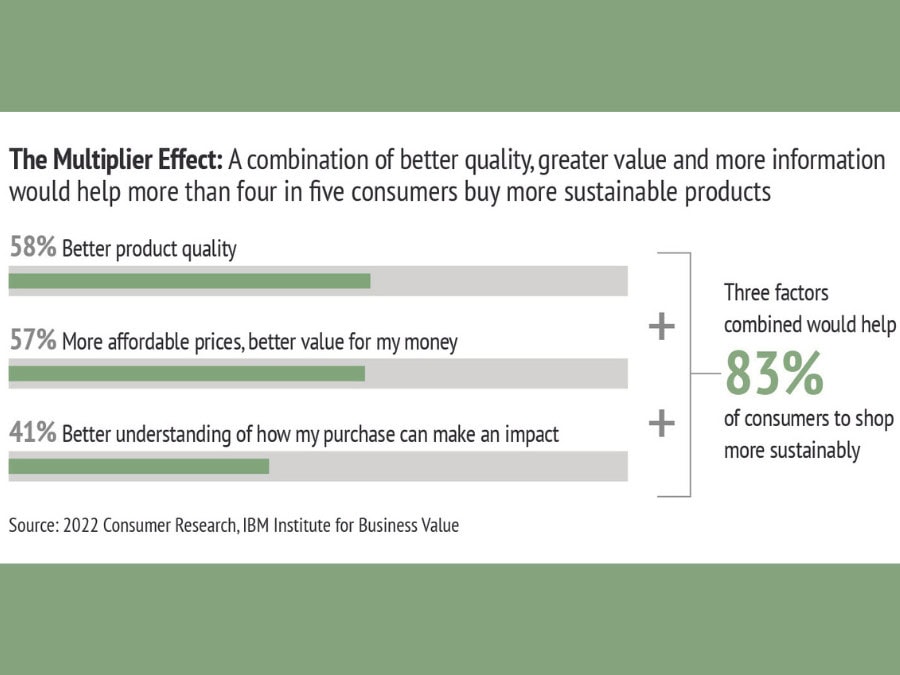
The IBM Institute for Business Value conducted a consumer research study on sustainability and concluded three factors would help consumers shop more sustainably: better product quality, better value for money and a better understanding of how the purchase will make an impact. When combined, 83% of consumers would shop more sustainably.
To put this in context for alcohol brands, providing clearer labels and more information about a product’s environmental impact can be effective in driving sustainable purchases.
The changing variety of food and beverage products is influencing what consumers will expect in the future. As the retail shelves become more crowded, brands that deliver not only on taste, but intrinsic and extrinsic values, will win.
As we navigate the complexities of beverage alcohol, one thing remains clear: by embracing the broader market context and understanding the intersecting forces of economics, health & wellness and purpose, brands and brand owners can better anticipate future trends and shape their innovations accordingly.
This article is available to Global Drinks Intel members only.
Click below for details on how to join the Global Drinks Intel community.
Already a member?
Log in here to read the article in full.
If you work for any of the following corporate subscribers to Global Drinks Intel, head here to activate your access.
- AB InBev
- Bacardi
- Campari Group
- Diageo
- Moët Hennessy
- Pernod Ricard
- Proximo Spirits
- Suntory Global Spirits
- William Grant & Sons