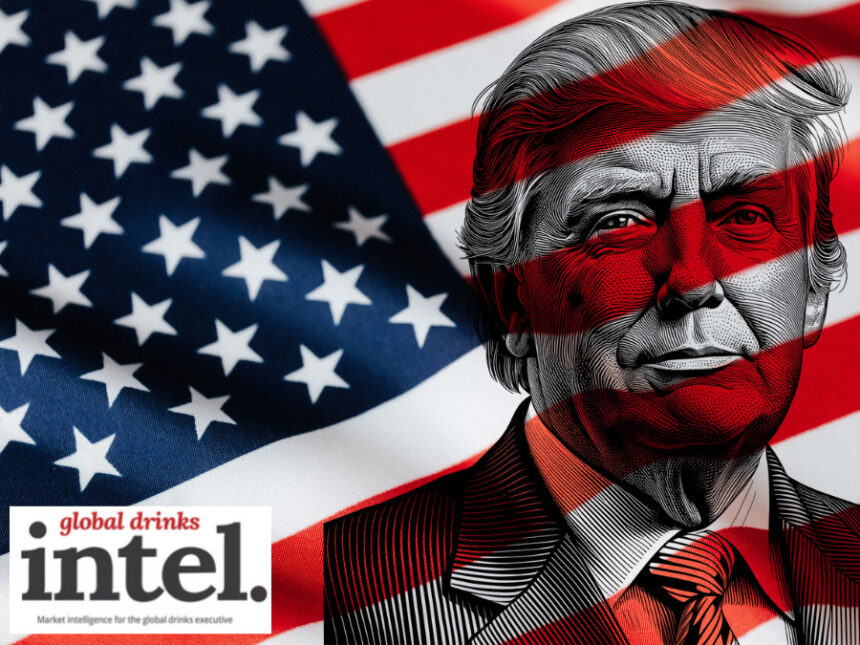
For many in the beverage alcohol industry, the new year won’t start properly until Monday (20 January), when the US Republican Party takes office. Only then will they see if the president-elect and his team make good on their much-publicised pre-election promises to slap tariffs on Mexico, Canada and China, with taxes on the EU and the UK pledged to follow in short order.
Having suffered the damage inflicted by tariffs during Donald Trump’s first term in office, industry executives have, unsurprisingly, reacted with dismay at the prospect of Trump 2.0, despite political commentators advising the business community to judge the outspoken president-elect by his actions, not his words.
The CEO of trade association the Distilled Spirits Council of the US, Chris Swonger, has warned that the last thing the already ailing US hospitality sector needs is a retaliatory trade war. “Tariffs on spirits products from our neighbours to the north and south are going to hurt US consumers and lead to job losses across the US hospitality industry just as these businesses continue their long recovery from the pandemic,” he said.
The Trump presidency could also have a profound – yet underexplored – impact on corporate ESG initiatives both in the US and further afield. The president-elect has always been unashamedly pro-business, pro-fossil fuel and anti-regulation; more liberal causes, such as concern for the environment and promoting diversity, equity & inclusion (DEI) programmes, rather less so.
In truth, the ESG movement has been an increasingly polarising issue in the US for some time – 2023’s backlash against Anheuser-Busch InBev’s partnership with transgender influencer Dylan Mulvaney for Bud Light being a prime example.
Sensing the rightward drift of public opinion and the likelihood of another term for Trump, a slew of blue-chip US corporate names such as Harley-Davidson and Ford scaled back their DEI initiatives last year. Their number included Jack Daniel’s owner Brown-Forman, where executive pay is reportedly no longer linked to DEI targets.
Other companies have been embracing so-called ‘greenhushing’, effectively adopting radio silence on ESG issues to avoid arousing the wrath of either the pro- or anti-ESG lobbies. A report published by data insights companies Connected Impact and Ringer Sciences last year discovered that 58% of US firms were underpromoting their legitimate sustainability credentials.
The fear is that this new anti-ESG sentiment could quickly spread beyond the US – the influence of the world’s biggest economy should never be underestimated, especially as right-wing populist governments are now in power in many countries worldwide, from Argentina, Italy and Hungary to India and the Netherlands.
At Global Drinks Intel, we remain convinced, as many studies have shown, that those drinks companies committed to reducing their environmental impact, improving the diversity of their workforce and supporting social causes are following a path that chimes with the mindsets of Gen Z and Millennial consumers, the two consumer demographics that everyone agrees are vital to the future of the alcohol industry.
As the world nervously watches how Trump’s policies unfold, our industry faces a critical choice: either double down on ESG and thrive in the long run, or retreat in the face of political headwinds and risk alienating the next generation of consumers.
The stakes are high, but so is the potential payoff for brands that align with the consumer values of tomorrow.
This article is available to Global Drinks Intel members only.
Click below for details on how to join the Global Drinks Intel community.
Already a member?
Log in here to read the article in full.
If you work for any of the following corporate subscribers to Global Drinks Intel, head here to activate your access.
- AB InBev
- Bacardi
- Campari Group
- Diageo
- Moët Hennessy
- Pernod Ricard
- Proximo Spirits
- Suntory Global Spirits
- William Grant & Sons