

To mark Earth Day at the end of last month, Anheuser-Busch InBev’s OB Beer unit in South Korea launched a social media-based campaign that rewards participants for sharing the “small habits” they adopt on a daily basis to benefit the environment, such as using sustainable beverage holders, plus tips to avoid wasting electricity. OB is running similar campaigns internally for its staff, which will extend to the company’s beer production processes and operations.
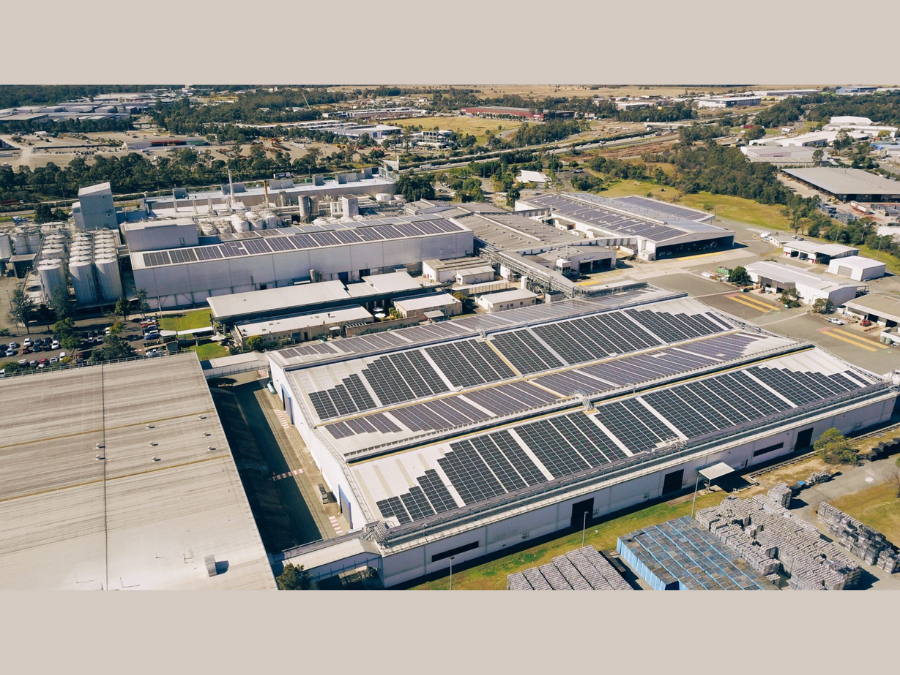
Asahi has installed the largest solar panel project of all Australia’s breweries (below). With 7,000 PV panels over 15,000 square metres, the facility, in Yatala, can generate enough energy to power more than 800 homes and nearly 9,000 beer fridges annually.
National broadcaster ABC also featured Asahi’s 2021 direct purchasing arrangement with barley farmers in Victoria, which gives the brewer clear oversight of the barley growing process and supports the region’s farmers by investing in sustainability and efficiency improvements.
In Asia, Carlsberg has partnered with the World Wide Fund for Nature (WWF) as part of the group’s ‘Together Towards ZERO and Beyond’ programme. The WWF initiative, which commenced last year, will restore wetland ecosystems and increase water availability in basins in four locations in China and Laos. The project, which follows Carlsberg’s year-long water risk assessment of its brewery sites around the world, will run until the end of 2025.
In Ireland, Diageo announced a EUR100m (US$109m) investment to decarbonise its 260-year-old St James’s Gate brewery in Dublin. This includes phasing out the use of fossil fuel in brewing operations and reducing the site’s Scope 1 and 2 greenhouse gas emissions by more than 90%, in line with the Science Based Target initiative’s (SBTi) definition of net zero. Diageo also intends to reduce the volume of water required to brew Guinness by 30%.
Over in the US, Diageo is replacing natural gas boilers with heat batteries at its Kentucky and Illinois production sites, with the aim of reducing carbon emissions by 15% over the next 15 years with a ‘brick toaster’ system installed by start-up Rondo, which is funded by Bill Gates.
Heineken launched a global circular brewing initiative in France as part of its ‘Brew a Better World’ sustainability commitments. ‘Project Circle’ is pioneering new methods to re-use spent grain to make the brewing process more sustainable. While the grain is traditionally disposed of as waste, the project uses new technology to separate it into fibres and proteins, which are then repurposed for applications including food-related uses and renewable energy production. The first phase of the project is being implemented at Heineken’s Mons-en-Barœul brewery, where it is expected to reduce CO2 emissions by 50%, with implementation at another six breweries planned for 2027.
Kirin announced the collaborative ‘Kirin Supply Chain Environmental Program’ in Japan to promote initiatives to reduce Scope 3 greenhouse gas emissions. The move will initially focus on 17 of the brewer’s suppliers, intending to reduce their high Scope 3 emissions levels to Science Based Targets 2 level. The project will contribute one-third of Kirin’s medium-term goal of reducing Scope 3 emissions for the entire group by 30% of 2019 levels by 2030.
In South Korea, Lotte Chilsung’s recently-unveiled transparent PET beer packaging was recognised with a Prime Minister’s Award at the Ministry of Trade, Industry & Energy’s annual national packaging competition. The bottles are the country’s first single-material PET beer packaging material that can be fully recycled, and will replace current composite-material, coloured PET bottles, which are more difficult to recycle.
Molson Coors Beverage Co held a series of company- wide initiatives and volunteer activities in its hometowns and brewery sites across the US to mark Earth Week. The company offered opportunities for all of its staff to participate in activities that underscored its recent sustainability initiatives, including renewable energy, water conservation, recycling and supplier engagement initiatives.
Pernod Ricard committed to new SBTi emission-reduction goals, announcing a series of near- and long-term climate-related targets. This includes a commitment to reduce Scope 1 and 2 emissions by 54% by 2030, and by 90% by 2050. Pernod Ricard will also reduce Scope 3 forest, land and agriculture-related (FLAG) emissions by 30.3% by 2030, and by 72% by 2050. Scope 3 emissions account for around 95% of the group’s total emissions, and the reductions will be achieved through actions to increase the use of renewable energy, circular packaging and electric- or biofuel-powered transportation.
In Japan, Suntory issued JPY42m (US$270m) in funding during its current fiscal year for bird conservation, to be allocated to 23 projects across three categories. The ‘Suntory Fund for Bird Conservation’ charitable trust continues long-standing activities that began in 1973, and saw the registration of the trust in 1990. The fund will have granted over JPY700m to a total of 517 organisations by the end of fiscal 2025.
Finally, in the UK, Suntory Global Spirits announced its second partnership with RSPB Scotland as it further expands its ‘Peatland Restoration Programme’. Suntory has invested GBP250,000 (US$320,000) to restore another 80 hectares of Islay peatland through the ‘Peatland Water Sanctuary’ project, which comprises a diverse reserve with freshwater lochs, peat bogs, sea cliffs and coastal grasslands.